


Search results
Search for "alkyl radical" in Full Text gives 84 result(s) in Beilstein Journal of Organic Chemistry.
Homolytic substitution at phosphorus for C–P bond formation in organic synthesis
Beilstein J. Org. Chem. 2013, 9, 1269–1277, doi:10.3762/bjoc.9.143

- phosphorylation of carboxylic thiohydroxamic mixed anhydrides (Scheme 13) [41]. Radical addition of a phenylsulfanyl radical to the thiocarbonyl generates the corresponding alkyl radical R•, which undergoes homolytic substitution at the phosphorus of P(SPh)3 to furnish (PhS)2P–R as the initial product (Scheme 14


Exploration of an epoxidation–ring-opening strategy for the synthesis of lyconadin A and discovery of an unexpected Payne rearrangement
Beilstein J. Org. Chem. 2013, 9, 1179–1184, doi:10.3762/bjoc.9.132
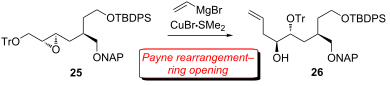
- efficiently furnish its bicyclo[5.4.0]undecane system, which is shown in bold in Figure 1. Subsequent to this observation, we performed model studies that demonstrated the viability of highly stereoselective 7-exo-trig acyl radical–6-exo-trig alkyl radical cyclizations as a means of preparing bicyclo[5.4.0


Electron and hydrogen self-exchange of free radicals of sterically hindered tertiary aliphatic amines investigated by photo-CIDNP
Beilstein J. Org. Chem. 2013, 9, 437–446, doi:10.3762/bjoc.9.46
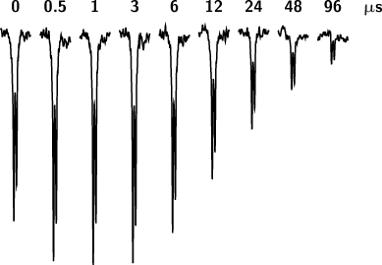
- • denote the sensitizer ketyl radical and the α-amino alkyl radical. The reason why some sensitizers yield polarizations that stem from the radical ion pair, even though the precursor to the products must be the neutral radical D•, is the existence of two deprotonation pathways of DH•+: The proton can be
- magnetic parameters of the α-amino alkyl radical of DABCO are not known precisely: A negative hyperfine coupling constant of about −14 G is to be expected for the single proton attached to its radical center, a noticeably larger positive one of about +19 G for the two protons at the adjacent carbon, and a
- account for the absorptive polarization, the g value of the α-amino alkyl radical must thus be larger than that of the sensitizer ketyl radical, which is corroborated by the polarizations of the regenerated sensitizer. Whereas these are undetectably small in the case of AQ and BP, XA exhibits weak


Radical zinc-atom-transfer-based carbozincation of haloalkynes with dialkylzincs
Beilstein J. Org. Chem. 2013, 9, 236–245, doi:10.3762/bjoc.9.28
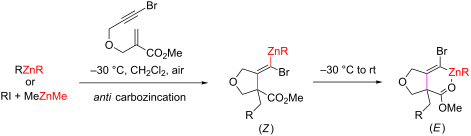
- in synthesis. Pivotal to the processes disclosed so far using alkylzinc derivatives is zinc atom radical transfer [4]. In general terms, the reaction involves a radical chain process initiated by the formation of an alkyl radical from the organozinc derivative in the presence of oxygen [5][6][7][8][9
- ][10][11][12][13][14]. The newly formed radical then undergoes one or more radical transformations before being reduced by the alkylzinc reagent through homolytic substitution at zinc, producing a new organozinc derivative along with an alkyl radical that sustains a radical chain. Overall, the in situ


Photoreactions of cyclic sulfite esters: Evidence for diradical intermediates
Beilstein J. Org. Chem. 2012, 8, 1208–1212, doi:10.3762/bjoc.8.134

- decarbonylation results in an alkyl radical. The latter reaction yields bibenzyl (4) and toluene (7) in the photoreaction of 8. It should be noted that the diradical BR2 may be formed also upon photoinduced ring-opening reaction of an intermediate oxirane 2a, which is not detectable in the reaction mixture


Convergent syntheses of LeX analogues
Beilstein J. Org. Chem. 2010, 6, No. 17, doi:10.3762/bjoc.6.17
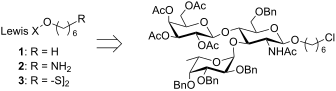
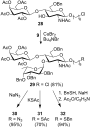
- the carbon sulfur bond giving a thioacetate salt and an alkyl radical. The alkyl radical is then converted to the corresponding anion by a second electron transfer and the resulting anion is protonated by ammonia giving trisaccharide 1. In contrast to the thioacetate 31, treatment of the 6



Reduction of arenediazonium salts by tetrakis(dimethylamino)ethylene (TDAE): Efficient formation of products derived from aryl radicals
Beilstein J. Org. Chem. 2009, 5, No. 1, doi:10.3762/bjoc.5.1
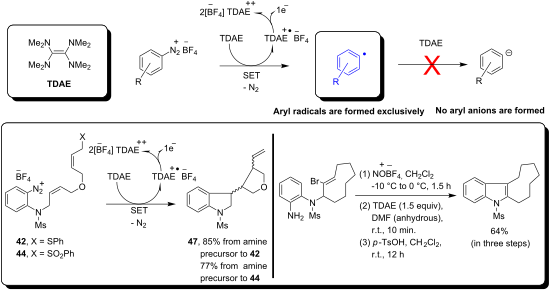
- studies on similar substrates by TTF [5][8][16][17] and TMTTF [16] had shown competitive trapping of the intermediate alkyl radical 46 by TTF+• or TMTTF+•. Preparation of indoles Following the successful implementation of the methodology on the synthesis of indolines, we next sought to harness the aryl
- )]. We expected that the aryl radical 53a generated by the reduction of arenediazonium salt 49a by TDAE would undergo 5-exo-trig radical cyclization onto the vinyl bromide to afford the alkyl radical intermediate 54a, from which Br• would be eliminated to afford the exocyclic alkene 50a (Scheme 6). Such


Part 2. Mechanistic aspects of the reduction of S-alkyl- thionocarbonates in the presence of triethylborane and air
Beilstein J. Org. Chem. 2007, 3, No. 46, doi:10.1186/1860-5397-3-46

- , Newcomb,[14] following Wood's and Renaud's reports, carried out kinetic estimations of the rate of hydrogen abstraction by an alkyl radical from the complex between Et3B and water using the routine radical clock method. This author also came to the conclusion that hydrogen abstraction from the α position


Do α-acyloxy and α-alkoxycarbonyloxy radicals fragment to form acyl and alkoxycarbonyl radicals?
Beilstein J. Org. Chem. 2006, 2, No. 10, doi:10.1186/1860-5397-2-10
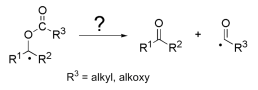
- setting is illustrated in Figure 4. Abstraction of iodine from 11 produces alkyl radical 12, which will rapidly cyclize to give key intermediate α-acyloxy radical 13a or α-alkoxycarbonyloxy radical 13b. Partitioning of 13a,b between bimolecular reduction to give 14a,b and unimolecular fragmentation to





Other Beilstein-Institut Open Science Activities



