


Search results
Search for "aromaticity" in Full Text gives 79 result(s) in Beilstein Journal of Organic Chemistry.
β-Hydroxy carbocation intermediates in solvolyses of di- and tetra-hydronaphthalene substrates
Beilstein J. Org. Chem. 2010, 6, 1035–1042, doi:10.3762/bjoc.6.118
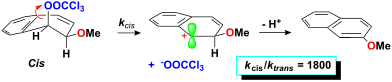
- –H hyperconjugation is particularly pronounced for a β-hydroxynaphthalenium ion intermediate because the stability of its no-bond resonance structure reflects the presence of an aromatic naphthol structure. Keywords: aromaticity; β-hydroxycarbocations; hyperconjugation; solvolysis; Introduction Cis
- intermediate (2) [3]. This contrasts with reactions of cis- and trans-dihydrodiols of non-aromatic double bonds for which only a small advantage for the cis-diol is observed. Indeed, the cis/trans rate ratio decreases regularly as the aromaticity of the double bond decreases, as shown for the dihydrodiols of
- solvolysis ot 4-trans. Measurements for benzene and phenanthrene dihydrodiols confirm that, whereas the ratio of cis-rate constants to those of the corresponding alcohols, which lack a β-hydroxy group, remains roughly constant, those for the trans-dihydrodiols increase sharply as the aromaticity of the


Structure and reactivity in neutral organic electron donors derived from 4-dimethylaminopyridine
Beilstein J. Org. Chem. 2010, 6, No. 73, doi:10.3762/bjoc.6.73
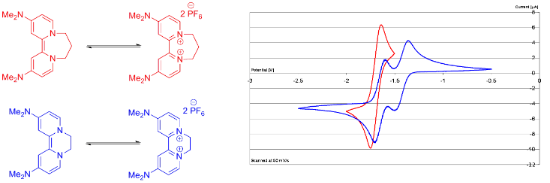
- ][7][8][9][10][11][12], but is not strong enough to react with alkyl and aryl halides. The driving force for its oxidation is the attainment of some degree of aromaticity in the formation of its radical cation salt 2 on the loss of one electron, and full aromaticity in its dication salt 3 on loss of


Ring-alkyl connecting group effect on mesogenic properties of p-carborane derivatives and their hydrocarbon analogues
Beilstein J. Org. Chem. 2009, 5, No. 83, doi:10.3762/bjoc.5.83
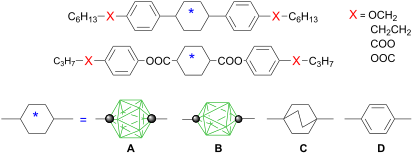
- and are characterized by 3-dimensional σ-aromaticity and high-order symmetry axis [23]. Therefore, it is of interest to understand how the electronic properties of the two clusters and their unusual molecular symmetry and size affect bulk properties of mesogens. Through extensive comparison of


Inversion symmetry and local vs. dispersive interactions in the nucleation of hydrogen bonded cyclic n-mer and tape of imidazolecarboxamidines
Beilstein J. Org. Chem. 2008, 4, No. 23, doi:10.3762/bjoc.4.23
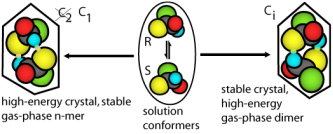
- denser than aliphatic organics [37]. This is likely due to the fact that bonds are shorter for sp2/sp2 atoms than for sp3/sp3 atoms. The effect of aromaticity on density is likely enhanced because these double aromatic substituents in these small structures accounted for much of the molecular mass. In


Other Beilstein-Institut Open Science Activities



