


Search results
Search for "grinding" in Full Text gives 84 result(s) in Beilstein Journal of Organic Chemistry.
Inclusion complexes of 2-methoxyestradiol with dimethylated and permethylated β-cyclodextrins: models for cyclodextrin–steroid interaction
Beilstein J. Org. Chem. 2015, 11, 2616–2630, doi:10.3762/bjoc.11.281
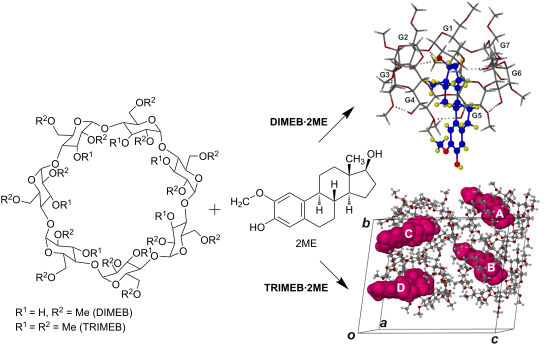
- further development of 2ME. Results and Discussion Interaction between 2ME and native CDs Initial studies focused on possible isolation of solid inclusion complexes of 2ME with the native cyclodextrins α-, β- and γ-CD. Following neat co-grinding of each CD and 2ME (1 h, 1:1 molar ratios) and kneading (1 h





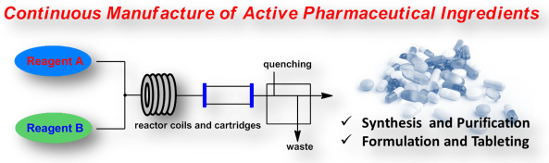
The synthesis of active pharmaceutical ingredients (APIs) using continuous flow chemistry
Beilstein J. Org. Chem. 2015, 11, 1194–1219, doi:10.3762/bjoc.11.134


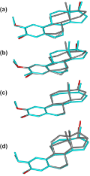
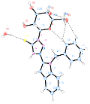
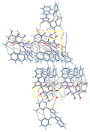
Inclusion of trans-resveratrol in methylated cyclodextrins: synthesis and solid-state structures
Beilstein J. Org. Chem. 2014, 10, 3136–3151, doi:10.3762/bjoc.10.331
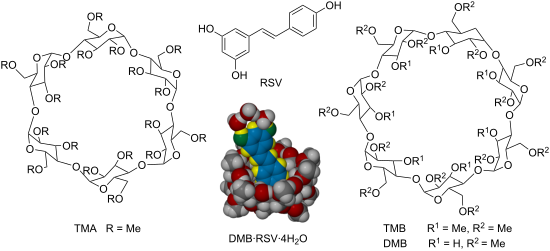
- materials and solvents used were of analytical reagent grade. Preparation of the binary systems Each physical mixture (PM) (1:1 mol/mol) was prepared by gentle co-grinding of the powder components in a mortar with a pestle and passing the resultant material through a 250 μm sieve. Kneaded products (KN) were
- prepared by wetting each PM in a mortar with ethanol/water 4:1 (v/v) and grinding thoroughly with a pestle, after which the product was dried to constant weight at 70 °C in an oven. The entire procedure was repeated in triplicate. The samples were then sieved through a 250 μm sieve. Co-evaporated products







Expeditious, mechanochemical synthesis of BODIPY dyes
Beilstein J. Org. Chem. 2013, 9, 786–790, doi:10.3762/bjoc.9.89

- reagents. The condensation of 2,4-dimethylpyrrole and 4-nitrobenzaldehyde was performed with grinding by using a simple mortar and pestle, followed by the addition of a few drops of TFA (complete consumption of the aldehyde was confirmed by TLC) and oxidation with p-chloranil. The reaction mixture was
- subsequently treated with Et3N and BF3·OEt2 to afford BODIPY dye 1 (Scheme 2). All reagents were added sequentially with grinding in ca. 5 minutes. Each step was accompanied by a color change. The desired product was isolated in 29% yield, which was comparable to those reported in literature protocols, 24–40
- grinding to take place. Next, we examined several different bases for the deprotonation of the dipyrrolium species. Organic bases such as Et3N and DBU (Table 1, entries 1 and 5), proved to be most effective. Although DBU gave comparable results to Et3N, variations in yields were observed, likely due to the


A new synthetic access to 2-N-(glycosyl)thiosemicarbazides from 3-N-(glycosyl)oxadiazolinethiones and the regioselectivity of the glycosylation of their oxadiazolinethione precursors
Beilstein J. Org. Chem. 2013, 9, 135–146, doi:10.3762/bjoc.9.16
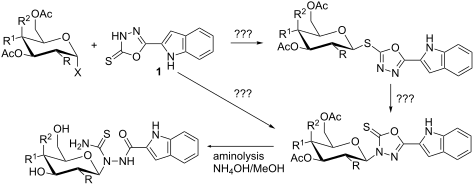
- , Germany 10.3762/bjoc.9.16 Abstract Glycosylations of 5-(1H-indol-2-yl)-1,3,4-oxadiazoline-2(3H)-thione delivered various degrees of S- and/or N-glycosides depending on the reaction conditions. S-Glycosides were obtained regiospecifically by grinding oxadiazolinethiones with acylated α-D-glycosyl halides
- the N-glycosyl analogues. Grinding the reactants with basic alumina afforded regiospecifically S-linked glycosides 5–7 in 52–63% yields. However, if glycosylations were carried out on the chloromercuric salt of 1 in toluene under reflux, 3-N-linked glycosides 8–10 were regiospecifically obtained in 48


Mechanochemistry assisted asymmetric organocatalysis: A sustainable approach
Beilstein J. Org. Chem. 2012, 8, 2132–2141, doi:10.3762/bjoc.8.240
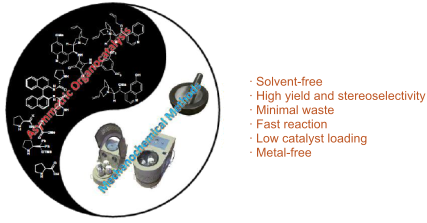
- Pankaj Chauhan Swapandeep Singh Chimni U.G.C. Sponsored Centre for Advance Studies in Chemistry, Department of Chemistry Guru Nanak Dev University, Amritsar, 143005, India, Fax: (+)91-183-2258820 10.3762/bjoc.8.240 Abstract Ball-milling and pestle and mortar grinding have emerged as powerful
- . To address many of these issues mechanochemical methods such as ball-milling and grinding with pestle and mortar have emerged as powerful techniques [5][6][7][8][9][10][11][12]. The mechanical energy generated by grinding two solids or one solid and one liquid substance results in the formation of
- new surfaces and cracks by breaking the order of the crystalline structure, and this results in the formation of products [8]. Grinding and ball-milling are widely applied to pulverize minerals into fine particles, in the preparation and modification of inorganic solids. Recently, their use in


Catalyst-free and solvent-free Michael addition of 1,3-dicarbonyl compounds to nitroalkenes by a grinding method
Beilstein J. Org. Chem. 2012, 8, 534–538, doi:10.3762/bjoc.8.61

- yields by a grinding method under catalyst- and solvent-free conditions. Keywords: catalyst-free; grinding; Michael addition; solvent-free; Introduction Nowadays, chemists are vigorously taking on the challenge of developing green synthetic methodologies to meet the criteria of sustainable
- absence of solvents and catalysts have been accomplished for greener and cleaner syntheses [1][2][3][4][5][6]. As the typical representative of solvent-free reactions, the grinding technique has been widely used in organic synthesis [7][8][9][10][11][12][13]. Compared to traditional methods, some organic
- reactions occur more efficiently in the solid state than in solution due to a more tight and regular arrangement of the substrate molecules [14]. Thus, the grinding mode for solid-state reactions had been applied in the Reformatsky reaction [15], Dieckmann condensation [16], Knoevenagel condensation [17


Conserved and species-specific oxylipin pathways in the wound-activated chemical defense of the noninvasive red alga Gracilaria chilensis and the invasive Gracilaria vermiculophylla
Beilstein J. Org. Chem. 2012, 8, 283–289, doi:10.3762/bjoc.8.30
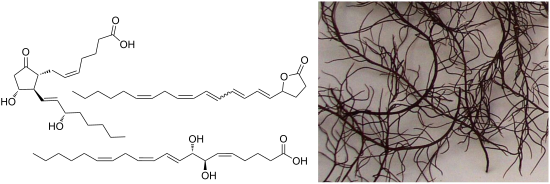
- -hydroxy-eicosatetraenoic acid (8-HETE (4)) [3]. This was verified by comparative LC–ESIMS and LC–ESIMS/MS analysis of algae that were wounded by grinding in a mortar, incubated at room temperature for five minutes, and extracted (wounded), versus algae that were boiled before grinding and extraction
- mechanically simulated by grinding of algae (10 g) in a mortar and subsequent incubation for 5 min at rt before extraction with MeOH (2 mL). After filtration through cellulose, the extracts were mixed in a glass Petri dish with hot (60 °C) seawater (10 mL) containing 1.5% agar (Sigma Aldrich, Deisenhofen
- grinding and incubation for 5 min at rt. In comparison, control runs with intact algal material that was boiled to prevent enzyme activity before extraction are given in (C) and (D). Total-ion-count (TIC) traces (ESI-negative mode) are shown; note: TIC normalized to 35000 counts in the wounded and to 500


Solvent-free and time-efficient Suzuki–Miyaura reaction in a ball mill: the solid reagent system KF–Al2O3 under inspection
Beilstein J. Org. Chem. 2010, 6, No. 7, doi:10.3762/bjoc.6.7
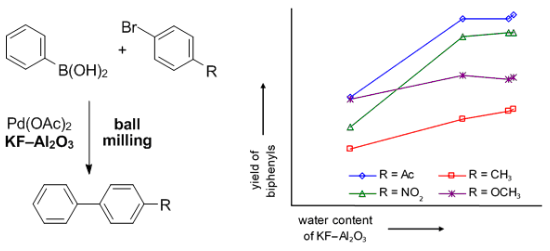
- mechanical manner by co-grinding the reactants with agate milling balls using a planetary ball mill as the source for alternative energy input [4][5][6][9][36][40][41][42][43][44][45][46][47][48][49][50][51][52][53][54][55][56]. It is worth mentioning that all results presented in this paper were achieved by
- acid and surface oxygen of alumina (ArB(OH)2–O–Al(O–)3). The reported results also confute the results from microwave-assisted cross-coupling with pure basic alumina, which was seen to be completely inert for this type of reaction [33]. Apparently co-grinding of all reactants in a ball mill leads to in
- -low amounts of Pd [64][65][66] required either longer reaction times or co-grinding with higher-weight milling balls (ZrO2, stainless steel, tungsten carbide) [40][67][68]. The application of the as-prepared KF-loaded SRS in the other Suzuki–Miyaura reactions led to interesting results summarized in


Other Beilstein-Institut Open Science Activities



