


Search results
Search for "indoline" in Full Text gives 83 result(s) in Beilstein Journal of Organic Chemistry.
Intramolecular carbonickelation of alkenes
Beilstein J. Org. Chem. 2013, 9, 710–716, doi:10.3762/bjoc.9.81
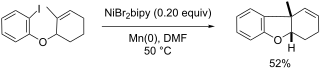
- outcome of the cyclization differs. While allylic ethers are relatively poor substrates that undergo a side elimination and need an intracyclic double bond to proceed, allylic amines react well and afford indoline and indole derivatives. Finally, the synthesis of the trinuclear ACE core of a morphine-like
- pathway affording indoline 3c is slightly increased, and a (2c + 2c’)/3c ratio of 62/38 is observed (Table 1, entry 4). In conclusion to the first part of this study, the formation and cyclization of arylnickel intermediates 1-Ni is observed in all cases. Afterward, the stability of the exo-methylene
- , with a lesser amount of indoline 3 being obtained above when this protecting group was employed. The carbonickelation protocol was applied to the cyclization of crotyl derivatives 5 (Scheme 3). When applied to ether 5a, as expected, the substitution of the allyl moiety at the terminal position by a


Some aspects of radical chemistry in the assembly of complex molecular architectures
Beilstein J. Org. Chem. 2013, 9, 557–576, doi:10.3762/bjoc.9.61

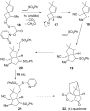
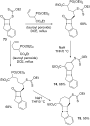
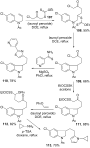
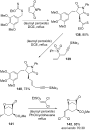
- –cyclisation leading to indoline 97 with an intramolecular Friedel–Crafts reaction to afford a tricyclic derivative 98 substituted by a trifluoromethyl group [44]. The second exploits the presence of both a protected primary amine and an easily substitutable chlorine on the pyrimidine ring in 99a,b to afford
- and cyclisation of the latter into indoline 109 [47]. Diverse otherwise inaccessible chloroketones become readily available. Haloketones in general are ideal precursors for the synthesis of numerous heteroaromatic derivatives. For example, Hantzsch condensation of indoline 109 with thionicotinamide
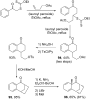
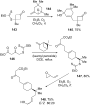
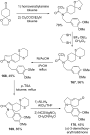
- . Synthesis of bicyclic cyclobutane motifs. Construction of the CD rings of steroids. Rapid assembly of polyquinanes. Formation of a polycyclic structure via an allene intermediate. A polycyclic structure via the alkylative Birch reduction. Synthesis of polycyclic pyrimidines and indoline structures













Inter- and intramolecular enantioselective carbolithiation reactions
Beilstein J. Org. Chem. 2013, 9, 313–322, doi:10.3762/bjoc.9.36

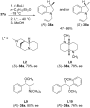
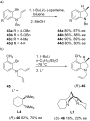
- L8, leading to the indoline of opposite configuration. Unfortunately, this diamine is not commercially available, and its synthesis requires resolution. More recently, O’Brien [48] has reported that (+)-sparteine surrogate L2 gave a similar degree of enantioselectivity and indoline (S)-38a of 85:15





Synthesis of spiro[dihydropyridine-oxindoles] via three-component reaction of arylamine, isatin and cyclopentane-1,3-dione
Beilstein J. Org. Chem. 2013, 9, 8–14, doi:10.3762/bjoc.9.2
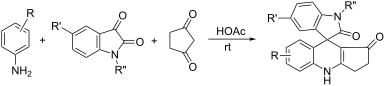
- three-component reaction of arylamine, isatin and cyclopentane-1,3-dione. Results and Discussion Recently we found that the four-component reactions of arylamine, acetylenedicarboxylate, isatin and dimedone in acetic acid resulted in the novel functionalized tetrahydrospiro[indoline-3,2’-quinoline


Organocatalytic C–H activation reactions
Beilstein J. Org. Chem. 2012, 8, 1374–1384, doi:10.3762/bjoc.8.159
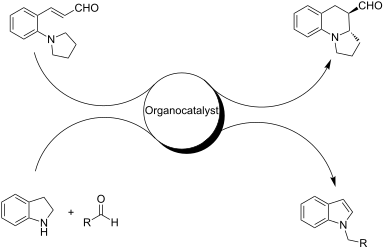
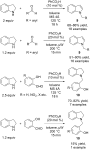
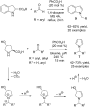
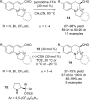
- as the substrate, and the N-alkyl-indoline product 10 was obtained in good yields (70–82%) mainly by the method of the Pan group (Scheme 7). In this case, another molecule of indoline acts as the hydride donor and is converted to indole. Both Tunge and Pan suggested redox isomerization in the
- azomethine ylide intermediates in the Tunge pyrrole formation and in the formation of N-alkylindoles from indoline [19]. These reactions are considered C–H activation reactions, as during the azomethine ylide formation, the C–H bond that is cleaved is not activated by electron-withdrawing (such as ester





Recent developments in gold-catalyzed cycloaddition reactions
Beilstein J. Org. Chem. 2011, 7, 1075–1094, doi:10.3762/bjoc.7.124
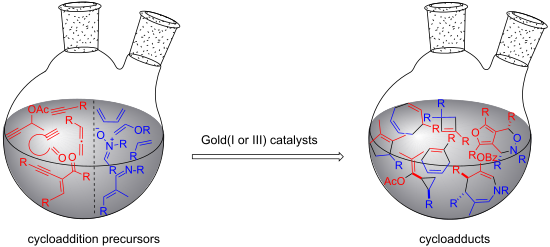
- , when PtCl2 (under an atmosphere of CO) is used, the major products are 2,3-indoline-fused cyclopentenes 44, which arise from a formal (3 + 2) cycloaddition (lower arrow) [86]. Thus, the appropriate choice of a Pt or Au catalyst determines whether the allenyl intermediate 42 participates as a 2C- or as


Mitomycins syntheses: a recent update
Beilstein J. Org. Chem. 2009, 5, No. 33, doi:10.3762/bjoc.5.33

- the p-quinone are called mitosanes or mitosenes depending whether they are at the oxidation state of an indoline (Y1 or Y2 = H) or an indole (Y1 = Y2 = C=C). Compounds bearing an aziridine at C1 and C2 are described specifically as aziridinomitosanes and aziridinomitosenes respectively. Compounds
- reagent, N-phenylselenophthalimide (N-PSP) [83][84]. The attack of this reagent upon the double bond led to indoline 81 which underwent a second alkylation to generate the complete pyrroloindole system 82. It is noteworthy that the cyclization reaction was completely stereospecific. Indeed, one could
- argue that the addition of N-PSP to the olefin 80 to form a selenonium ion is reversible and that the attack of the nitrogen is favored when the two large groups emerge trans relative to the indoline ring. Treatment with m-CPBA then created the double bond which was later fashioned into aziridine 84






Reduction of arenediazonium salts by tetrakis(dimethylamino)ethylene (TDAE): Efficient formation of products derived from aryl radicals
Beilstein J. Org. Chem. 2009, 5, No. 1, doi:10.3762/bjoc.5.1
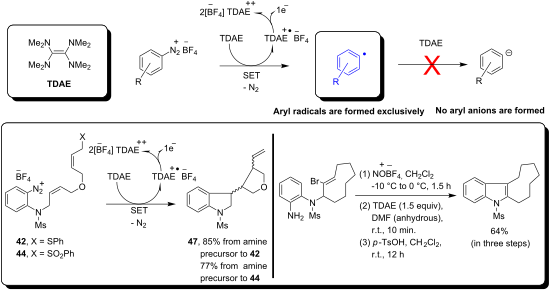
- : cyclization; electron transfer; indole; indoline; radical; Introduction Arenediazonium salts have long proved useful as sources of aryl radicals in many reactions featuring carbon-carbon (e.g., Meerwein [1], Pschorr [2][3], Gomberg [3] reactions) and carbon-heteroatom bond (e.g., Sandmeyer [4]) formation
- vinblastine (58a) and vincristine (58b) contain such a system. Aryl C-C bond formation As a final extension of this methodology, we probed the feasibility of this methodology in aryl-aryl C-C bond formation reactions. Accordingly, the diazonium salt 62 was prepared from indoline (59), and treated with one
- translocation) by the aryl radical 67 from the carbon atom in the α-position to the nitrogen atom of the indoline nucleus within the same molecule. The indolinyl radical 71 might follow pathway A and undergo radical fragmentation to the intermediate 75 which would eventually tautomerise to indole (63). The


Other Beilstein-Institut Open Science Activities



