


Search results
Search for "overall yield" in Full Text gives 525 result(s) in Beilstein Journal of Organic Chemistry. Showing first 200.
Access to cyclopropanes with geminal trifluoromethyl and difluoromethylphosphonate groups
Beilstein J. Org. Chem. 2023, 19, 541–549, doi:10.3762/bjoc.19.39
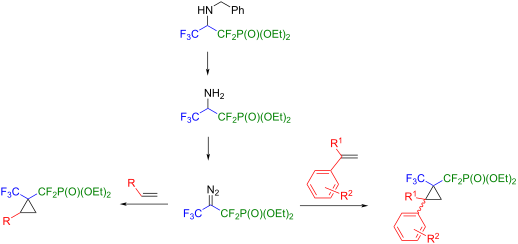
- (5). This compound was synthesized smoothly within three steps in 16.6% overall yield. The synthetic route commenced from the preparation of N-protected amine 3, followed by the deprotection of benzylamine 3 to furnish 4 and ended with the diazotization of 4 using tert-butyl nitrite. As a result, the



Mechanochemical solid state synthesis of copper(I)/NHC complexes with K3PO4
Beilstein J. Org. Chem. 2023, 19, 440–447, doi:10.3762/bjoc.19.34
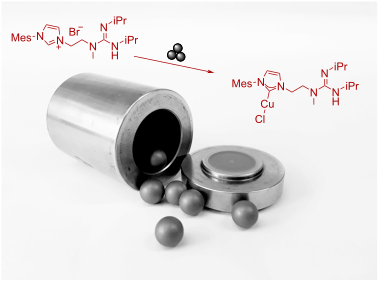
- ]. First, the silver(I)/NHC complex 4 had to be synthesized and isolated prior to transmetallation with copper(I) chloride [48][49]. The required formation of silver(I) complex 4 diminishes the overall yield of copper complex 5. As an additional disadvantage, the silver(I) byproducts have to be carefully


Asymmetric synthesis of a stereopentade fragment toward latrunculins
Beilstein J. Org. Chem. 2023, 19, 428–433, doi:10.3762/bjoc.19.32
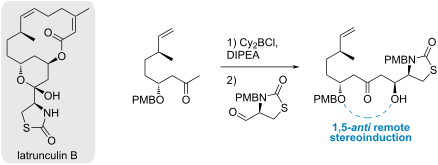
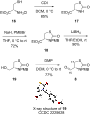
- reduced on its primary carbon in presence of LiAlH4, and the resulting secondary alcohol was oxidized in presence of Dess–Martin periodinane (DMP), giving ketone 15 in 78% yield over the two steps. This six-step sequence to 15 was performed in a 35% overall yield from starting material 10. The aldehyde




Combretastatins D series and analogues: from isolation, synthetic challenges and biological activities
Beilstein J. Org. Chem. 2023, 19, 399–427, doi:10.3762/bjoc.19.31
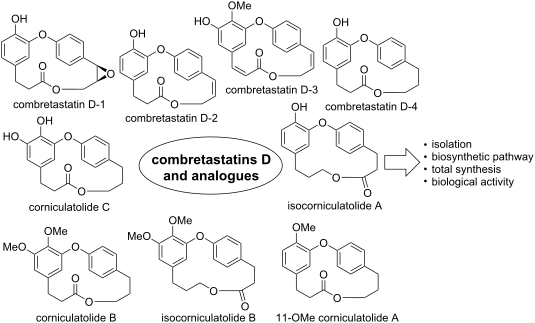
- compound 2 in an overall yield of 25% after 5 steps, bypassing the macrolactonization problem evidenced in the previously envisaged route. Intrigued by the problem encountered by Boger, Deshpande decided to investigate different reaction conditions for the formation of the macrocycle using the Mitsunobu
- , and the formal synthesis of 2 was achieved after 8 steps with an overall yield of 4.5%. Rychnovsky and Hwang hypothesized that the low yields from the Mitsunobu reaction in the previous synthesis of compound 2 were linked to the instability of the allylic oxyphosphonium ion formed with intermediates
- acetic anhydride followed by epoxidation using m-CPBA gave protected epoxide 50. Subsequent removal of the acetate group using ammonia led to racemic compound 1 (Scheme 8). Rychnovsky and Hwang succeeded in the total syntheses of combretastatin D-2 (2) in a 36% overall yield after 13 steps and




CuAAC-inspired synthesis of 1,2,3-triazole-bridged porphyrin conjugates: an overview
Beilstein J. Org. Chem. 2023, 19, 349–379, doi:10.3762/bjoc.19.29
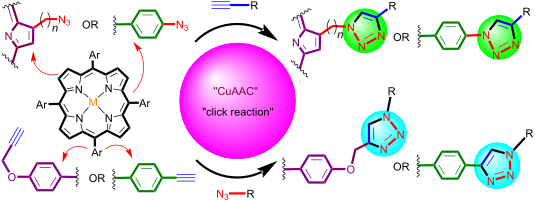
- reaction and was subjected to deprotection of the triisopropylsilyl group with tetra-n-butylammonium fluoride (Bu4NF). Similarly triad 121 was prepared by the click reaction between dyads 119 and azido-ferrocene 120 in a 40% overall yield. The photophysical investigation revealed that dyad 119 exhibited




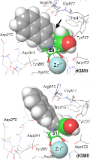
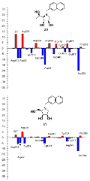
Synthesis, α-mannosidase inhibition studies and molecular modeling of 1,4-imino-ᴅ-lyxitols and their C-5-altered N-arylalkyl derivatives
Beilstein J. Org. Chem. 2023, 19, 282–293, doi:10.3762/bjoc.19.24
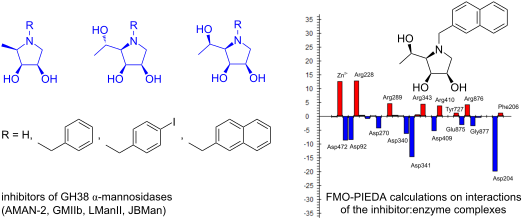
- in two steps from known ʟ-ribitol 1 [34] in good overall yield. Next, it was converted to the C-5 deoxygenated N-benzylpyrrolidine 6 via trityl ether cleavage, tosylation of the deprotected OH group, and reduction of the tosylate 5. Hydrogenolysis of the N-benzyl group in 6 followed by a removal of


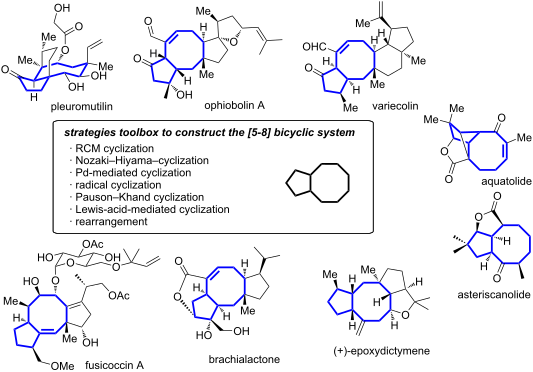
Strategies to access the [5-8] bicyclic core encountered in the sesquiterpene, diterpene and sesterterpene series
Beilstein J. Org. Chem. 2023, 19, 245–281, doi:10.3762/bjoc.19.23
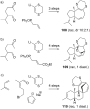
- note, this compound entails the oxabicyclo[4.2.1]nonane core present in schindilactone A (68). The synthesis of schindilactone A (68) was achieved in 29 steps (0.11% overall yield). 1.1.2.2 Late-stage introduction of cyclooctene: The marine sesquiterpene dactylol (72), isolated from both sea hare
- protection of the alcohol function as a silyl ether leading to diene 71, the RCM was performed in refluxing hexane and dactylol (72) was isolated in 17% overall yield after silyl ether removal [18][37]. Asteriscanolide (2), isolated in 1985 from the hexane extract of the plant Astericus aquaticus, is a
- , the total synthesis included 24 steps, with an overall yield of 5% and 4% for albolic acid (178) and ceroplastol II (179), respectively. To synthesize these 3 complex natural products, they used the same method to access the [5-8-5] tricyclic advanced intermediate 184. After that, different strategies


Sequential hydrozirconation/Pd-catalyzed cross coupling of acyl chlorides towards conjugated (2E,4E)-dienones
Beilstein J. Org. Chem. 2023, 19, 176–185, doi:10.3762/bjoc.19.17
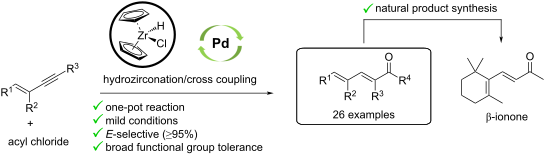
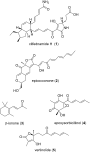
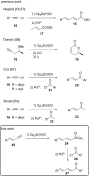
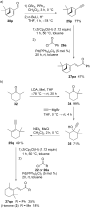
- analogues, whereas the variation of the acyl chlorides did not affect the reaction significantly. The synthetic application is demonstrated by formation of non-natural and natural dienone-containing terpenes such as β-ionone which was available in 4 steps and 6% overall yield. Keywords: cross coupling
- the alkyne terminus significantly decreased the yield. Finally, non-natural and natural dienone-containing terpenes were synthesized such as β-ionone (3), which was available in 4 steps (6% overall yield). Thereby, the synthetic utility was demonstrated by a late-stage introduction of the dienone unit



1,4-Dithianes: attractive C2-building blocks for the synthesis of complex molecular architectures
Beilstein J. Org. Chem. 2023, 19, 115–132, doi:10.3762/bjoc.19.12
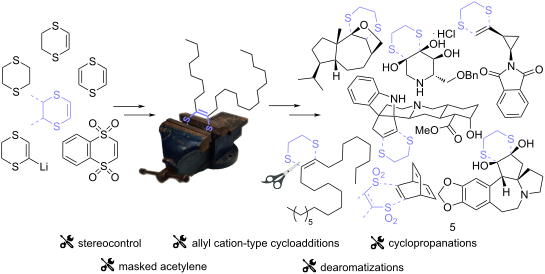
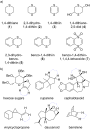
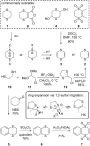
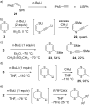
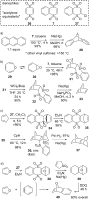
- at room temperature to form the expected Diels–Alder adduct 32, while non-cyclic vinyl disulfones require heating to 80 °C for 20–48 h. Deoxygenation of the epoxide and desulfonylation with sodium amalgam affords barrelene (33) in an excellent overall yield from oxepin. The chlorinated 1,4-dithiin











Two-step continuous-flow synthesis of 6-membered cyclic iodonium salts via anodic oxidation
Beilstein J. Org. Chem. 2023, 19, 27–32, doi:10.3762/bjoc.19.2
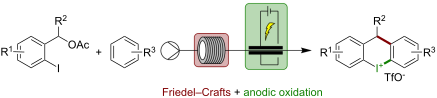
- effect (Table 3, entry 3). We then investigated longer reaction times (4 × 50 min, 4 × 0.500 mmol), but without additional electrolyte the overall yield of 38% was significantly lower. It was possible to compensate for this to some degree by using TBABF4 as shown in Table 3, entry 2. This adjustment
- improved the overall yield to 43%. Finally, we investigated a variety of substituted benzyl acetates 3 (Figure 1). Substitutions para to the iodine led with F- and Cl-derivatives 1b and 1c to strongly diminished yields of 15% and 26%, respectively, due to expected lower yields in the Friedel–Crafts step


Combining the best of both worlds: radical-based divergent total synthesis
Beilstein J. Org. Chem. 2023, 19, 1–26, doi:10.3762/bjoc.19.1
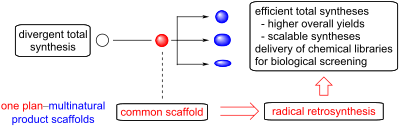
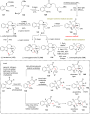
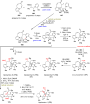
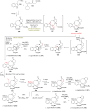
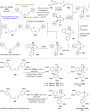
- the latter, which is proven in the number of steps and the overall yield, hence establishing it as highly appealing for further development (Scheme 1). In order to identify the new pharmaceutical leads of tomorrow, drug discovery relies on the available chemical space rising from existing chemical
- chiral aldehyde 127 and Boc-protected amine 128, followed by zinc reduction of the nitro group and subsequent protection of the amine by a tosyl group in 27% overall yield. Irradiating 129 with blue light at 30 W in the presence of 1 mol % of [Ir(dtbbpy)(ppy)2]PF6 and 5 equiv of KHCO3 in THF resulted in

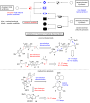


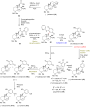


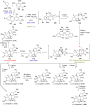






Total synthesis of grayanane natural products
Beilstein J. Org. Chem. 2022, 18, 1707–1719, doi:10.3762/bjoc.18.181
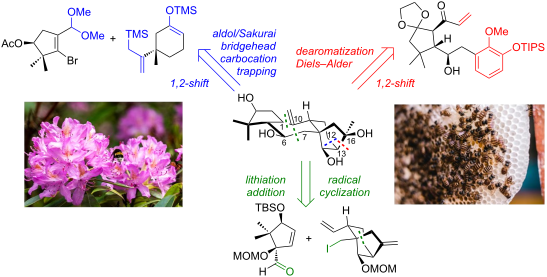
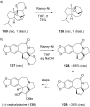
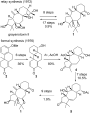
- required. Luo's team used Davis’ oxaziridine followed by treatment with K2CO3 to equilibrate the hydroxyketone, delivering an inseparable epimeric mixture (1:3) of 63 in 31% overall yield. An additional TBS protection allowed separation of the epimers. After acidic treatment, pure rhodomollein XX and 3-epi
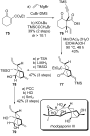
- -membered triflate 71 was synthesized from diketone 26 in 5 steps and 37% overall yield. Both fragments were assembled by a Sonogashira cross-coupling, affording 72 in 72% yield. In a first attempt, TBS protection was considered on the bicylo[3.2.1]octane. However, later in the strategy, the deprotection





Synthesis of (−)-halichonic acid and (−)-halichonic acid B
Beilstein J. Org. Chem. 2022, 18, 1629–1635, doi:10.3762/bjoc.18.174
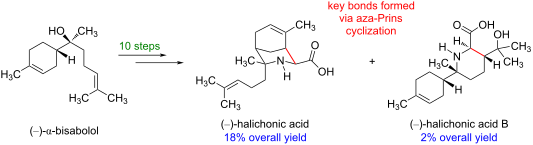
- multigram scale, affording (−)-7-amino-7,8-dihydrobisabolene (4) and its C7-epimer as an 83:17 mixture of diastereomers in 87% overall yield. Unfortunately, these diastereomers were not separable by conventional column chromatography. Although this diastereomeric mixture could be converted into a variety of


A new route for the synthesis of 1-deazaguanine and 1-deazahypoxanthine
Beilstein J. Org. Chem. 2022, 18, 1617–1624, doi:10.3762/bjoc.18.172
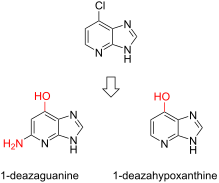
- desired triamine 9. After cyclization of the resulting 4-ethoxy-2,3,6-triaminopyridine (9) with formic acid leading to ethyl-protected compound 10 and liberation of the O6 with hydrogen bromide, 1-deazaguanine (11) was formed in 2 to 4% overall yield (Scheme 2) [18]. The approach by Gorton and Shive
- was carried out to obtain the desired 4-hydroxy-2,3,6-triaminopyridine (15) in unspecified yield (Scheme 3). This approach was optimized in 1975 by Schelling and Salemink using benzyl ether protection of the O4 during the imidazopyridine formation to increase the overall yield up to 37% [20]. The last
- attempt to refine the synthesis of Gorton and Shive, was described by Temple and co-workers in 1976 by their preparation of 1-deaza-6-thioguanine analogues with 28% overall yield [21]. Synthesis of 1-deazaguanine Our route to 1-deazaguanine 11 started from 6-iodo-1-deazapurine (16) (Scheme 4), which can


Formal total synthesis of macarpine via a Au(I)-catalyzed 6-endo-dig cycloisomerization strategy
Beilstein J. Org. Chem. 2022, 18, 1589–1595, doi:10.3762/bjoc.18.169
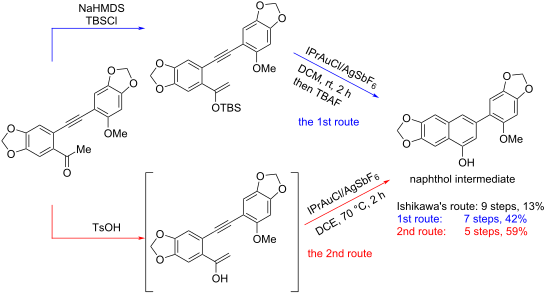
- deprotection of the silyl group was accomplished in the presence of potassium carbonate (K2CO3) and methanol to provide the terminal alkyne 5 in 96% yield in two steps. The iodoarene 8 [12][16] was facilely synthesized from sesamol (6) via methylation and iodination in an overall yield of 67%. With the


Design, synthesis, and evaluation of chiral thiophosphorus acids as organocatalysts
Beilstein J. Org. Chem. 2022, 18, 1471–1478, doi:10.3762/bjoc.18.154
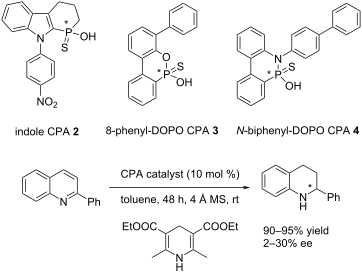
- . The resolution of compound 1 was not conducted at this point because its synthesis was deemed problematic. While relatively short (5 steps), the overall yield was only 20% due to a low-yielding key step and a problematic thionation step immediately following. Unfortunately, thionation of 8 with an
- obtained in moderate yield. Crystallization gave a single diastereoisomer in 20% yield. Stec reaction [38][39][40] finally gave the desired CPA 4. Although the entire sequence proceeded in only 6% overall yield, it was conducted on a multigram-scale so that more than 0.4 g of 4 was obtained. Evaluation of


Mechanochemical synthesis of unsymmetrical salens for the preparation of Co–salen complexes and their evaluation as catalysts for the synthesis of α-aryloxy alcohols via asymmetric phenolic kinetic resolution of terminal epoxides
Beilstein J. Org. Chem. 2022, 18, 1416–1423, doi:10.3762/bjoc.18.147
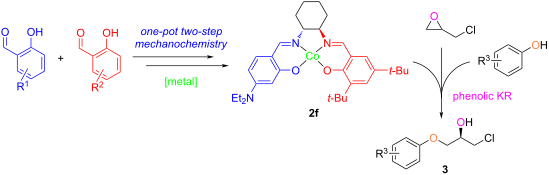
- were summarized in Table 1. We were surprised that the overall yield from ball milling was lower than the overall yield from grinding, suggesting a higher revolution per minute (RPM) could be necessary to increase the reaction yield using ball milling. It is assumed that the forces are not equivalent


Preparation of an advanced intermediate for the synthesis of leustroducsins and phoslactomycins by heterocycloaddition
Beilstein J. Org. Chem. 2022, 18, 1385–1395, doi:10.3762/bjoc.18.143
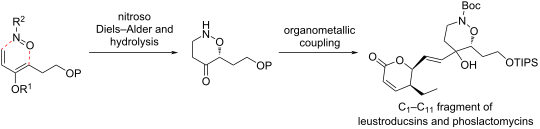
- we wondered whether it was possible to perform the whole synthetic sequence with this protecting group. Accordingly, the enol phosphate 13 was synthesized in five steps (26% overall yield) from 1,4-butanediol (Scheme 5). Since cycloaddition with the Wightman reagent 6 releases hydrogen chloride in


Synthesis of C6-modified mannose 1-phosphates and evaluation of derived sugar nucleotides against GDP-mannose dehydrogenase
Beilstein J. Org. Chem. 2022, 18, 1379–1384, doi:10.3762/bjoc.18.142
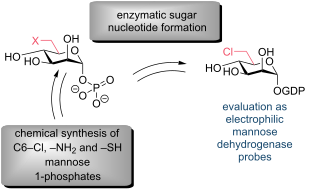
- -phosphate 17 as the sodium triethylamine salt. Overall, the synthesis of 17 was developed in 4 steps and 46% overall yield from 14. With the required C6-modified glycosyl 1-phosphates in hand, we next evaluated them as substrates for enzymatic sugar nucleotide synthesis. Enzymatic synthesis of C6-modified


Ionic multiresonant thermally activated delayed fluorescence emitters for light emitting electrochemical cells
Beilstein J. Org. Chem. 2022, 18, 1311–1321, doi:10.3762/bjoc.18.136
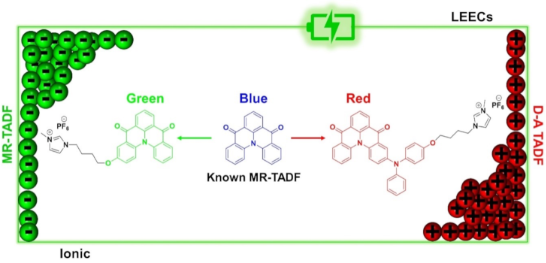
- 23% overall yield. First, hydrolysis of 1, in situ conversion to the acyl chloride and subsequent Lewis acid-promoted Friedel–Crafts acylation reaction produced compound 2 (Scheme 1), where the AlCl3 was also responsible for the demethylation. Compound 2 was then subjected to monoalkylation with 1,4
- -dibromobutane in moderate yield, followed by a second alkylation step with 1-methylimidazole in very good yield. DiKTa-OBuIm was isolated as its hexafluorophosphate salt following anion metathesis with NH4PF6. DiKTa-DPA-OBuIm was obtained also in three steps at 35% overall yield from compound 4 using a similar



Enantioselective total synthesis of putative dihydrorosefuran, a monoterpene with an unique 2,5-dihydrofuran structure
Beilstein J. Org. Chem. 2022, 18, 1264–1269, doi:10.3762/bjoc.18.132
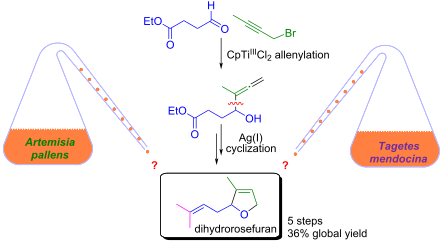
- dihydrorosefuran, a compound allegedly identified in Artemisia pallens and Tagetes mendocina, has been developed. The key steps in the five-step 36% overall yield synthesis are a CpTiIIICl2 mediated Barbier-type allenylation of a linear aldehyde and the formation of a 2,5-dihydrofuran scaffold through a Ag(I


Vicinal ketoesters – key intermediates in the total synthesis of natural products
Beilstein J. Org. Chem. 2022, 18, 1236–1248, doi:10.3762/bjoc.18.129
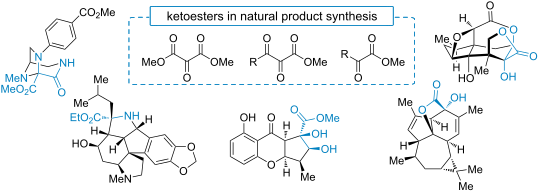
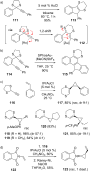
- with a medium pressure mercury lamp in Pyrex® glassware triggered a 1,6-HAT leading to biradical X which combined to the racemic pyrrolizidine 68 as a 1:1 mixture of diastereomers. Three more steps gave the target compound 69 in 31% overall yield. Corynoxine Hiemstra et al. used the α-ketoester moiety
- aniline 94 in three steps (Scheme 16). Subsequent deprotection and condensation with dimethyl mesoxalate (90b) gave imidazolidine 95. With compound 95 at hands, five further steps gave (−)-aplaminal (96) in a good overall yield of 19%. Cladoniamide G The unsymmetrical mesoxalic acid amide 102 was used by


Synthesis of tryptophan-dehydrobutyrine diketopiperazine and biological activity of hangtaimycin and its co-metabolites
Beilstein J. Org. Chem. 2022, 18, 1159–1165, doi:10.3762/bjoc.18.120
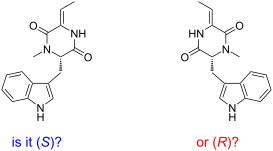
- diminished yield for 15 (70%), lowering the overall yield of TDD to 33% over eight steps. The major enantiomer of 4 obtained from this second route was identical to natural TDD (Figure 1D) which is thus S-configured, i.e., derived from ʟ-tryptophan. Moreover, the olefinic double bond in 4 is Z-configured as


Synthesis and HDAC inhibitory activity of pyrimidine-based hydroxamic acids
Beilstein J. Org. Chem. 2022, 18, 837–844, doi:10.3762/bjoc.18.84
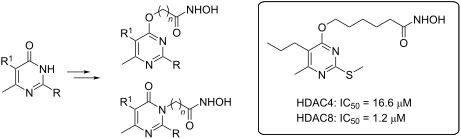
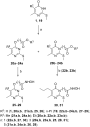
- increase in the overall yield (from 52 to 71%) and selectivity (from 1.4:1 to 2.5:1) in favor of the O-isomer 24a were observed (compare entries 5 and 6 in Table 1). The best alkylation results were obtained when the alkylation reaction was carried out at 50–60 °C. These reaction conditions proved to be



Synthesis of odorants in flow and their applications in perfumery
Beilstein J. Org. Chem. 2022, 18, 754–768, doi:10.3762/bjoc.18.76
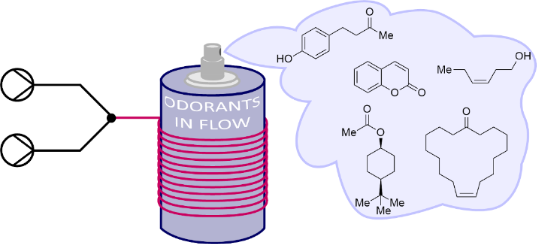
- . For compound 6, both individual steps were combined for a two-step aldol condensation/hydrogenation flow sequence providing raspberry ketone methyl ether (6) on a gram scale in 75% overall yield. Interestingly, also alternative flow protocols for the synthesis of 4-aryl-3-buten-2-ones 3 and 4 were





