


Search results
Search for "ozonolysis" in Full Text gives 78 result(s) in Beilstein Journal of Organic Chemistry.
Synthesis of the Benzo- fused Indolizidine Alkaloid Mimics
Beilstein J. Org. Chem. 2007, 3, No. 42, doi:10.1186/1860-5397-3-42
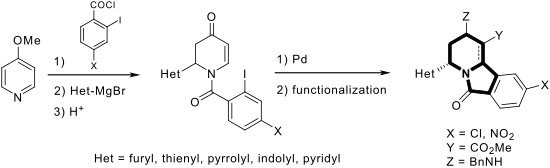
- 14 in 22% yield. The furan ring of 8a was converted to a carboxylic acid by ozonolysis to afford 15. The reductive amination of 8a with benzylamine provided 16α and 16β in good yield. The stereochemistry of these compounds was determined by NOESY NMR analysis. These functional groups, such as


A convenient allylsilane- N-acyliminium route toward indolizidine and quinolizidine alkaloids
Beilstein J. Org. Chem. 2007, 3, No. 32, doi:10.1186/1860-5397-3-32
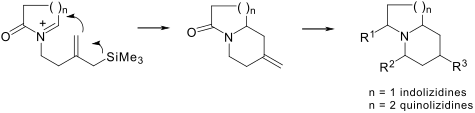
- diastereomers which were not separated. The hydroxylactam 34 was then cyclised to the quinolizidine isomers 35a and 35b on treatment with 4 equiv. of trifluoroacetic acid in a 7:3 ratio. Then, ozonolysis of 35a and 35b followed by reduction with dimethylsulfide furnished respectively 36a and 36b. Protection of
- two routes to the quinolizidine alkaloids lasubine I and lasubine II from methylenquinolizidinones 42a and 42b. They involved oxidation of the methylene group into a carbonyl which was then stereoselectively reduced to the hydroxyl group. The shortest route consisted of the ozonolysis of the methylene
- group followed by the simultaneous reduction of the two carbonyl groups of keto lactams 43a and 43b. Thus, treatment of 42a with ozone then with dimethyl sulfide afforded the expected keto lactam 43a in 91% yield. Ozonolysis of 42b led to keto lactam 43b in 63% yield. Reduction of 43a with lithium


The vicinal difluoro motif: The synthesis and conformation of erythro- and threo- diastereoisomers of 1,2-difluorodiphenylethanes, 2,3-difluorosuccinic acids and their derivatives
Beilstein J. Org. Chem. 2006, 2, No. 19, doi:10.1186/1860-5397-2-19
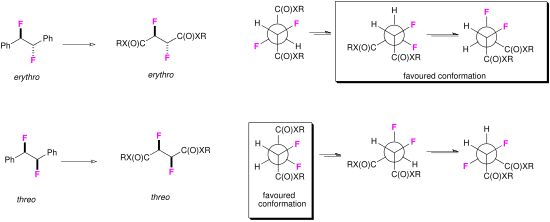
- lead to poor conversions and a complex product mixture. As an alternative strategy ozonolysis in acetic acid, with a hydrogen peroxide work-up was explored [27][28], and this proved successful as illustrated in Scheme 8. For example, reaction of a 4:1 mixture of erythro- and threo- 13 led to the
- an extended chain conformation with both of the C-F bonds gauche to each other. One molecule of water is bound for every succinic acid molecule and this water clearly participates in hydrogen bonding to the carboxylic acid groups. The major by-product of the ozonolysis reaction of 13 was the vicinal
- . Hypothesis for the predominent retention of configuration during fluoride substitution via phenonium intermediate 18. Proposed C-C bond rotation during the preparation of 14 from cis-stilbene. Synthesis of erythro-19 via ozonolysis of erythro-13. Strategy for the preparation of diastereoisomers of erythro




Other Beilstein-Institut Open Science Activities



