


Search results
Search for "radical reactions" in Full Text gives 79 result(s) in Beilstein Journal of Organic Chemistry.
Radical cascades using enantioenriched 7-azabenzonorbornenes and their applications in synthesis
Beilstein J. Org. Chem. 2008, 4, No. 38, doi:10.3762/bjoc.4.38
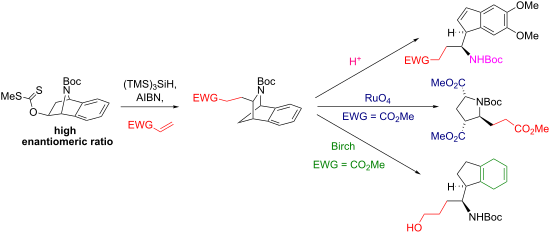
- also considered, however the practical difficulties of using this reagent (prone to polymerisation in the absence of a radical inhibitor) precluded its application. Using 3-methyl-2-butenal led to only rearranged–reduced product 8 (79%). In many cases, radical reactions are considered to proceed


The use of silicon- based tethers for the Pauson- Khand reaction
Beilstein J. Org. Chem. 2007, 3, No. 21, doi:10.1186/1860-5397-3-21
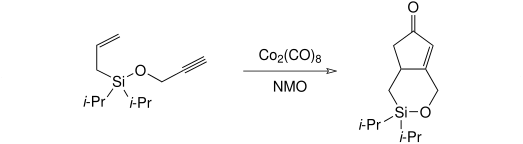
- sequences. Recent examples of the use of silicon-containing tethers have centred upon the Diels-Alder reaction,[4][5] radical reactions[6] and olefin metathesis reactions. There have been reports of applying the temporary tethering methodology of silicon species to the P-K reaction, but with limited success


The Elbs and Boyland- Sims peroxydisulfate oxidations
Beilstein J. Org. Chem. 2006, 2, No. 22, doi:10.1186/1860-5397-2-22
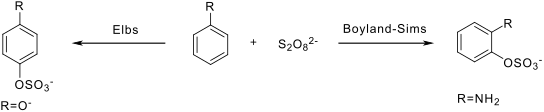
- solvent. The sulfate ester remains in the aqueous phase. Hydrolysis of the sulfate ester in aqueous acid produces the (usually) organic-soluble dihydric phenol. Reactions are usually run at room temperature or below to reduce the incursion of free radical reactions. The rates are rather slow with typical


Do α-acyloxy and α-alkoxycarbonyloxy radicals fragment to form acyl and alkoxycarbonyl radicals?
Beilstein J. Org. Chem. 2006, 2, No. 10, doi:10.1186/1860-5397-2-10
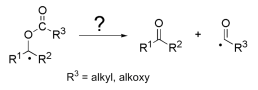
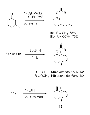
- whether this product arises through a slow radical fragmentation process or an inefficient, chain-breaking oxidative process. Introduction Most organic radical reactions occur through a cascade of two or more individual steps [1][2]. Knowledge of the nature and rates of these steps – in other words, the
- mechanism of the reaction – is of fundamental interest and is also important in synthetic planning. In synthesis, both the generation of the initial radical of the cascade and the removal of the final radical are crucial events [3]. Many useful radical reactions occur through chains that provide a naturally
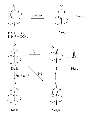
- have classed as "self-terminating radical reactions" [5][6][7][8][9][10]. For example, addition of broad assortment of oxygen-centered radicals to cyclodecyne 1 provides isomeric ketones 2 (major) and 3 (minor) in variable yields, depending on the specific radical involved and the reaction conditions





Other Beilstein-Institut Open Science Activities



