


Search results
Search for "N-alkylation" in Full Text gives 104 result(s) in Beilstein Journal of Organic Chemistry.
Synthesis of lipophilic 1-deoxygalactonojirimycin derivatives as D-galactosidase inhibitors
Beilstein J. Org. Chem. 2010, 6, No. 21, doi:10.3762/bjoc.6.21
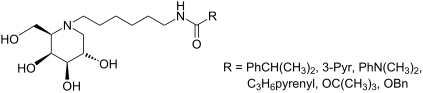
- Kids Hospital, 555 University Avenue, University of Toronto, Ont., Canada M5G 1X81 10.3762/bjoc.6.21 Abstract N-Alkylation at the ring nitrogen of the D-galactosidase inhibitor 1-deoxygalactonojirimycin with a functionalised C6 alkyl chain followed by modification with different aromatic substituents


Synthesis of imidazol- 1-yl-acetic acid hydrochloride: A key intermediate for zoledronic acid
Beilstein J. Org. Chem. 2008, 4, No. 42, doi:10.3762/bjoc.4.42

- -acetic acid hydrochloride was achieved via N-alkylation of imidazole using tert-butyl chloroacetate followed by a non-aqueous ester cleavage of the resulting imidazol-1-yl-acetic acid tert-butyl ester in the presence of titanium tetrachloride. The synthesized imidazol-1-yl-acetic acid hydrochloride was
- then utilized to prepare zoledronic acid. Keywords: ester; N-alkylation; imidazol-1-yl-acetic acid hydrochloride; zoledronic acid; Introduction Zoledronic acid (Z, Figure 1) [1][2][3][4][5][6][7] is a third-generation bisphosphonate (or diphosphonate) derivative characterized by a side chain that


N-1 regioselective Michael- type addition of 5-substituted uracils to (2-hydroxyethyl) acrylate
Beilstein J. Org. Chem. 2007, 3, No. 40, doi:10.1186/1860-5397-3-40
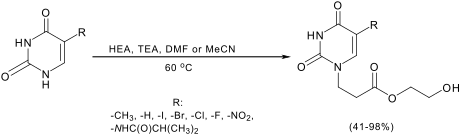
- against numerous DNA-viruses.[5] One of the most convenient methods of uracil ring N-alkylation is the Michael-type addition. Other general ways of alkylation are: nucleophilic substitution of halogenoalkyl substrates by activated uracil rings (in the N-anionic or O-persililated derivatives);[6][7


Reactions of glycidyl derivatives with ambident nucleophiles; part 2: amino acid derivatives
Beilstein J. Org. Chem. 2007, 3, No. 28, doi:10.1186/1860-5397-3-28

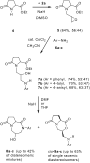
- model compound (Scheme 2, see Supporting Information File 1 for full experimental data), readily accessible as a mixture of diastereoisomers by N-alkylation of racemic 4 [8] with epibromohydrin (2a) in DMSO. Again, under basic as well as acidic conditions (for instance heating in trifluoroacetic acid




Other Beilstein-Institut Open Science Activities



