


Search results
Search for "deacetylation" in Full Text gives 113 result(s) in Beilstein Journal of Organic Chemistry.
Facile synthesis of nitrophenyl 2-acetamido-2-deoxy-α-D-mannopyranosides from ManNAc-oxazoline
Beilstein J. Org. Chem. 2012, 8, 428–432, doi:10.3762/bjoc.8.48
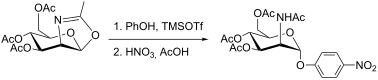
- 5 (22% yield) and p-nitrophenyl glycoside 6 (34% yield) in approximately 2:3 ratio, which was separated by flash chromatography. Zemplén deacetylation of 4 and 5 afforded the title compounds 7 and 8 in almost quantitative yields. Conclusion In conclusion, a simple and robust procedure for the


Acceptor-influenced and donor-tuned base-promoted glycosylation
Beilstein J. Org. Chem. 2012, 8, 413–420, doi:10.3762/bjoc.8.46
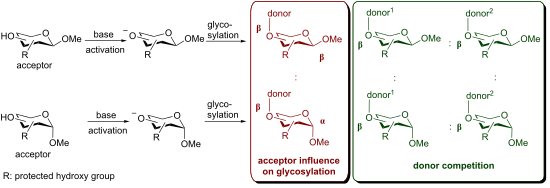
- derivatives 22 and 23, a five-step synthesis was performed in each case to obtain the galacto- and glucopyranosyl donors 8 and 9 (Scheme 3). Initially, peracetates 22 and 23 were converted into the thioglycopyranosides 24 and 25 with BF3∙Et2O/thiophenole [7]. Subsequent deacetylation [8] and benzylation [9



Directed aromatic functionalization in natural-product synthesis: Fredericamycin A, nothapodytine B, and topopyrones B and D
Beilstein J. Org. Chem. 2011, 7, 1475–1485, doi:10.3762/bjoc.7.171
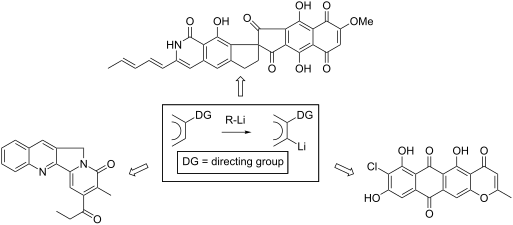
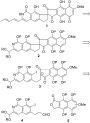
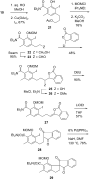
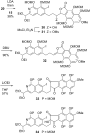
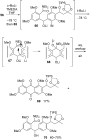
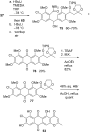
- converted into an acetate ester (Fischer-type esterification). Compound 15, a form of 4 suitable for the conduction of subsequent operations, was secured by deacetylation of 14 and Swern oxidation. Fragment 5 was best produced in the guise of compound 20, the construction of which also relied upon DAF







Convergent synthesis of the tetrasaccharide repeating unit of the O-antigen of Shigella boydii type 9
Beilstein J. Org. Chem. 2011, 7, 1182–1188, doi:10.3762/bjoc.7.137

- (br s, H-1C), 4.95 (d, J = 3.6 Hz, H-1D) in the 1H NMR and signals at δ 92.8 (C-1D), 81.0 (C-1C) in the 13C NMR spectrum). Compound 6 was transformed into disaccharide thioglycoside donor 7 in 91% yield under a one-pot deacetylation–benzylation reaction condition [22] (Scheme 2). In this case, the
- subjected to a reaction sequence involving (a) deacetylation using 0.1 M sodium methoxide in methanol; (b) TEMPO mediated selective oxidation [27][28][29] of the primary hydroxy group leaving secondary hydroxy groups unaffected in a phase transfer reaction condition and (c) removal of benzyl groups for


Amine-linked diglycosides: Synthesis facilitated by the enhanced reactivity of allylic electrophiles, and glycosidase inhibition assays
Beilstein J. Org. Chem. 2011, 7, 1115–1123, doi:10.3762/bjoc.7.128

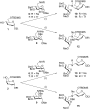
- unsaturated glycoside 4 to be achieved; phosphomolybdic acid [32] gave the product (α:β, 8:1) in 63% yield. Deacetylation of 4 and regioselective silylation of the primary alcohol gave the threo allylic alcohol 2. The sulfonamide nucleophiles 6, 7 and 9 were prepared from the corresponding amines 5 [33] and 8




Synthesis, reactivity and biological activity of 5-alkoxymethyluracil analogues
Beilstein J. Org. Chem. 2011, 7, 678–698, doi:10.3762/bjoc.7.80
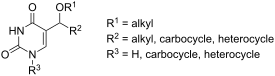
- 84 was prepared by a previously described procedure [23]. Next 5-bromovinyluracil (BVUr) was silylated and reacted with 84 in the presence of TMSOTf as the Lewis acid. This was followed by deacetylation with anhydrous K2CO3 in MeOH to provide the di-O-benzylated nucleoside 85 in 73% yield. For the


Synthesis of glycoconjugate fragments of mycobacterial phosphatidylinositol mannosides and lipomannan
Beilstein J. Org. Chem. 2011, 7, 369–377, doi:10.3762/bjoc.7.47

- catalytic NaOMe in MeOH/CH2Cl2 provided 1 and 2 in yields of 99% and 94%, respectively. Our strategy towards the synthesis of the trisaccharide 3 sought to utilize a glycosyl donor possessing a 2-O-acetyl group with benzoyl groups at the remaining positions, anticipating that selective deacetylation post
- outcome was obtained using NIS/TfOH activation of thioglycoside donor 17 to furnish disaccharide 26 in 72% yield. Selective deacetylation of 26 was achieved by acidic transesterification using 3% AcCl in MeOH/CH2Cl2 to give the secondary alcohol 27 in 73% yield. Mannosylation of 27 using donor 21 under


Bioorthogonal metabolic glycoengineering of human larynx carcinoma (HEp-2) cells targeting sialic acid
Beilstein J. Org. Chem. 2010, 6, No. 24, doi:10.3762/bjoc.6.24
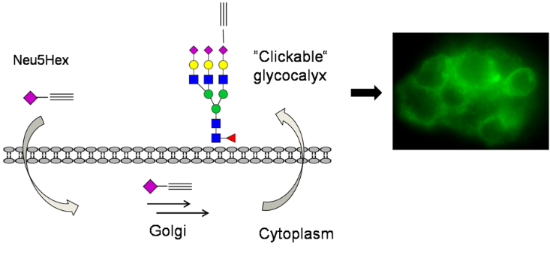
- with HEp-2 cells. Ac4GlcNAz 16 is believed to enter the cell by diffusion through the membrane, to undergo deacetylation in the cytoplasm and then incorporated into the cell surface glycoproteins and glycolipids. Alternatively, it is metabolically converted to Neu5Az [14]. Neu5Hex may enter the cell by




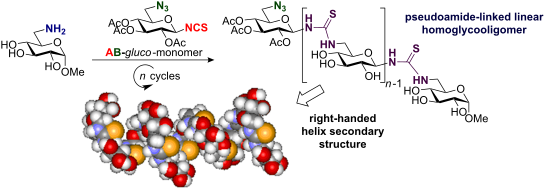
(Pseudo)amide-linked oligosaccharide mimetics: molecular recognition and supramolecular properties
Beilstein J. Org. Chem. 2010, 6, No. 20, doi:10.3762/bjoc.6.20
- hydrochloride and subsequent deacetylation (Scheme 6). Structural and conformational studies on 50 were carried out by NMR, which showed that the structure was stabilised by two anti-parallel seven-membered ring intramolecular hydrogen bonds, resulting in relatively high rotational barriers for the Z,E:E,Z/E



Convergent syntheses of LeX analogues
Beilstein J. Org. Chem. 2010, 6, No. 17, doi:10.3762/bjoc.6.17
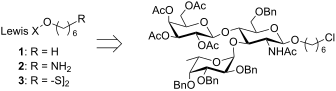
- (NaN3, DMF, 80 °C) gave the known [46] 6-azidohexyl glycoside 15 quantitatively. Zemplén deacetylation of triacetate 15 followed by conversion of the triol to the 4,6-benzylidene acetal (16) and then chloroacetylation at O-3 gave intermediate 17 that was submitted to reductive opening of the benzylidene
- group (NaCNBH3, HCl·Et2O) to yield acceptor 6. The triacetate 15 was also converted in seven steps to acceptor 5. The phthalimido group was first removed (ethylenediamine, EtOH) and the free amine acetylated. Zemplén deacetylation was followed by conversion of the triol to the 4,6-benzylidene acetal 18
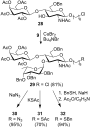
- well as to some deacetylation of the galactose residue. Thus, after acetylation of the crude product, the desired 6-benzylthiohexyl trisaccharide 32 was isolated in excellent yield (Scheme 3). It is important to point out that the 6-chlorohexyl glycoside 29 and the 6-benzylthiohexyl glycoside 32 co



Synthesis of densely functionalized enantiopure indolizidines by ring- closing metathesis (RCM) of hydroxylamines from carbohydrate- derived nitrones
Beilstein J. Org. Chem. 2007, 3, No. 44, doi:10.1186/1860-5397-3-44

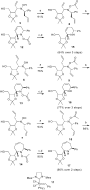
- this reason the crude reaction mixtures were directly employed in the following steps. Identity of compounds 12 and 13 was firmly established after their transformation into the corresponding amines and further elaboration. After deacetylation with KHCO3, in situ reduction of the N-O bond with zinc



2-Arylhydrazononitriles as building blocks in heterocyclic synthesis: A novel route to 2-substituted- 1,2,3-triazoles and 1,2,3-triazolo[4,5-b]pyridines
Beilstein J. Org. Chem. 2007, 3, No. 12, doi:10.1186/1860-5397-3-12
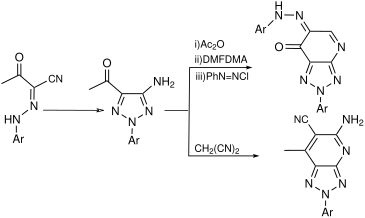
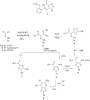
- . [15] Compound 9 was coupled with benzenediazonium chloride most likely through the intermediate 11a. The latter intermediate cyclized into 11b. Deacetylation of 11b followed by hydrogen shift produced 10. This again confirms that the acetyl and the amino functions in cyclization product are adjacent



8-epi-Salvinorin B: crystal structure and affinity at the κ opioid receptor
Beilstein J. Org. Chem. 2007, 3, No. 1, doi:10.1186/1860-5397-3-1
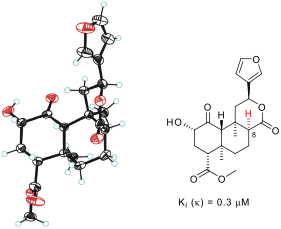
- -salvinorin A (1b).[12] Brown also reported that deacetylation of 1a under basic conditions gave 8-epi-salvinorin B (2b), but did not characterize either compound. Several further reports of epimerization at C-8 appeared over the following decade, [13][14] but no characterization data was presented. Valdés





