


Search results
Search for "gold-catalyzed" in Full Text gives 103 result(s) in Beilstein Journal of Organic Chemistry.
Gold-catalyzed regioselective oxidation of terminal allenes: formation of α-methanesulfonyloxy methyl ketones
Beilstein J. Org. Chem. 2011, 7, 596–600, doi:10.3762/bjoc.7.69
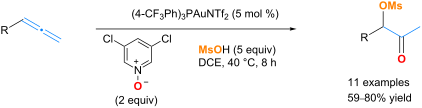
- from terminal allenes in fair to good yields. The chemistry relies on a gold-catalyzed intermolecular oxidation of the 1,2-diene unit using 3,5-dichloropyridine N-oxide as the oxidant. The reaction tolerates a range of functional groups and shows excellent regioselectivity. Keywords: allene; catalysis
- , whilst the latter suffers from low regioselectivities. This gold-catalyzed approach offers an attractive alternative that is highly regioselective, catalytic on gold and takes place under relatively mild reaction conditions. The mechanism of this highly regioselective gold-catalyzed oxidation of allenes
- first gold-catalyzed intermolecular oxidation of allenes. With 3,5-dichloropyridine N-oxide as the oxidant and in the presence of MsOH, α-methanesulfonyloxy methyl ketones are formed in one step in fair to good yield with excellent regioselectivities under relatively mild reaction conditions. The


A gold-catalyzed alkyne-diol cycloisomerization for the synthesis of oxygenated 5,5-spiroketals
Beilstein J. Org. Chem. 2011, 7, 570–577, doi:10.3762/bjoc.7.66
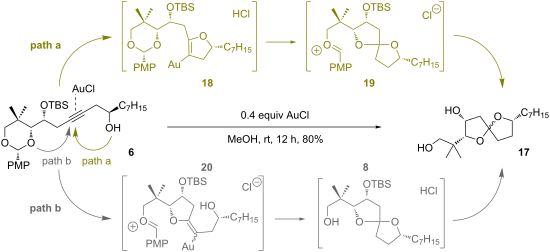
- less effective. The use of methanol as solvent helped suppress the formation of the undesired furan by-product. This study provides yet another example of the advantages of gold catalysis in the activation of alkyne π-systems. Keywords: alkynes; cyclocondensation; cycloisomerization; gold-catalyzed
- selectivity using the Utimoto conditions to prepare 6,6-spiroketals. Therefore, he suggested the preferred use of Ziese’s dimer, a platinum catalyst (Scheme 3, Reaction 2), for such cyclizations [9]. In an unrelated study that also bears on the current work, Aponick and co-workers described a gold-catalyzed
- methanol, as pre-mixing the gold(I) chloride with methanol and aging this mixture prior to adding the substrate results in a less efficient reaction. This is not the first time that we have observed the importance of the order of addition in a gold-catalyzed reaction in a protic solvent [38], but


One-pot gold-catalyzed synthesis of 3-silylethynyl indoles from unprotected o-alkynylanilines
Beilstein J. Org. Chem. 2011, 7, 565–569, doi:10.3762/bjoc.7.65
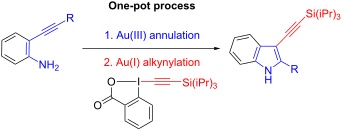
- capable of promoting nucleophilic attack on acetylenes, gold has recently attracted interest from the synthetic chemistry community [11][12][13][14]. Gold catalysts have also been used in domino sequences starting from o-alkynylanilines. Arcadi and Marinelli reported that gold-catalyzed cyclization of 2
- first results on the direct alkynylation reaction combined in a one-pot procedure with gold-catalyzed indole ring formation are promising, and analogous strategies combining palladium-catalyzed synthesis of indoles [3] and gold-catalyzed alkynylation could also be envisaged. The next step will be to
- reactions of 2-alkynylanilines. Gold-catalyzed direct alkynylation of indoles with TIPS-EBX (1). One-pot alkynylaniline cyclization/direct alkynylation. Synthesis of 2-alkynylanilines 2. Domino cyclization–alkynylation of aniline 2a. Scope of the reaction. Supporting Information Supporting Information File


Other Beilstein-Institut Open Science Activities



