


Search results
Search for "kinetic resolution" in Full Text gives 105 result(s) in Beilstein Journal of Organic Chemistry.
Diastereoselective and enantioselective reduction of tetralin- 1,4-dione
Beilstein J. Org. Chem. 2008, 4, No. 37, doi:10.3762/bjoc.4.37
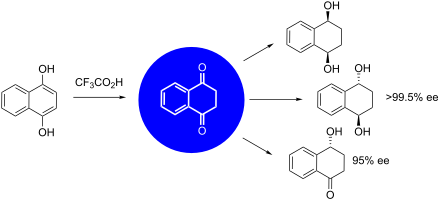
- precedent for procedures for the asymmetric synthesis of 9. The first involves as the key step kinetic resolution by enzymatic hydrolysis of the corresponding acetate with porcine pancreatic lipase giving (−)-9 in 47% yield and 95% ee [13]. A second approach uses a Pd-catalyzed asymmetric oxidation of meso


Large- scale ruthenium- and enzyme- catalyzed dynamic kinetic resolution of (rac)-1-phenylethanol
Beilstein J. Org. Chem. 2007, 3, No. 50, doi:10.1186/1860-5397-3-50

- Krisztian Bogar Belen Martin-Matute Jan-E. Backvall Department of Organic Chemistry, Arrhenius Laboratory, Stockholm University, SE-106 91 Stockholm, Sweden 10.1186/1860-5397-3-50 Abstract The scale-up of the ruthenium- and enzyme-catalyzed dynamic kinetic resolution (DKR) of (rac)-1
- ][28] and recently this approach has been extended to dynamic kinetic resolution (DKR) by combining the enzymatic resolution with a metal-catalyzed racemization. [29][30][31][32][33][34][35][36][37] Today, many stable lipases are commercially available and they are frequently used in synthetic organic
- . Experimental See Supporting Information File 1 for experimental data. Racemization catalyst 1. DKR of 1-phenylethanol under an Ar atmosphere (top) and DKR of 1-phenylethanol under an O2 atmosphere (bottom). Dynamic kinetic resolution of 1-phenylethanol (2) under different reaction conditions.a Supporting


Conformational rigidity of silicon- stereogenic silanes in asymmetric catalysis: A comparative study
Beilstein J. Org. Chem. 2007, 3, No. 9, doi:10.1186/1860-5397-3-9
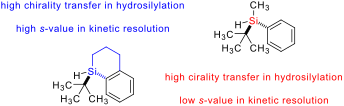
- metal-catalyzed asymmetric transformations as exemplified by (1) the hydrosilylation of alkenes constituting a chirality transfer from silicon to carbon and (2) the kinetic resolution of racemic mixtures of alcohols by dehydrogenative silicon-oxygen coupling. In this investigation, a cyclic and a
- were reported, [6] namely the inter- [7] as well as intramolecular [8] chirality transfers from silicon to carbon. Moreover, we had demonstrated that chiral silanes resolve racemic mixtures of alcohols in a non-enzymatic, transition metal-catalyzed kinetic resolution. [9] During our ongoing
- -catalyzed kinetic resolution of donor-functionalized alcohols capable of two-point binding. The reagent-controlled hydrosilylation of norbornene derivative 2 with silane 1a proceeds with a perfect chirality transfer (rac-1a → rac-3a, Scheme 1). [8] Mechanistic investigation of the nature of the


Towards practical biocatalytic Baeyer- Villiger reactions: applying a thermostable enzyme in the gram- scale synthesis of optically- active lactones in a two-liquid- phase system
Beilstein J. Org. Chem. 2005, 1, No. 10, doi:10.1186/1860-5397-1-10
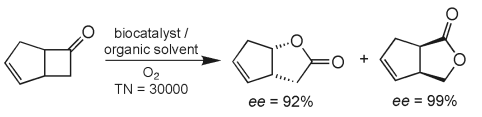
- catalysis (Table 1). We were pleased to observe essentially identical enantioselectivities when applying in vitro catalysis (for ketone 1 compare Table 1; the kinetic resolution of ketone 6 is characterized by a selectivity factor of E = 100, the enantiopurity of lactone 7 being 95.4% ee (R)). Ketone 1
- substrate in cyclohexane. The kinetic resolution reached the optimal 50% conversion after about 24 h. Upscaling to gram-quantities was straight-forward without changes in the procedure. Overall we obtained turnover numbers (TONs) of more than 30000 for the P3-PAMO-catalyzed BV-oxidation of ketone 1, which


Mixtures of monodentate P-ligands as a means to control the diastereoselectivity in Rh-catalyzed hydrogenation of chiral alkenes
Beilstein J. Org. Chem. 2005, 1, No. 3, doi:10.1186/1860-5397-1-3
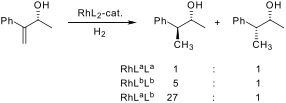
- described earlier.[34] Since the substrates 1 and 5 were used as racemates, kinetic resolution may be involved when the chiral ligands are employed, i.e., diastereoselectivity may change with conversion. This aspect was not a subject of the present study. In all hydrogenation reactions the standard


Other Beilstein-Institut Open Science Activities



