


Search results
Search for "lithiation" in Full Text gives 107 result(s) in Beilstein Journal of Organic Chemistry.
Synthesis of bis(3-{[2-(allyloxy)ethoxy]methyl}-2,4,6-trimethylbenzoyl)(phenyl)phosphine oxide – a tailor-made photoinitiator for dental adhesives
Beilstein J. Org. Chem. 2010, 6, No. 26, doi:10.3762/bjoc.6.26
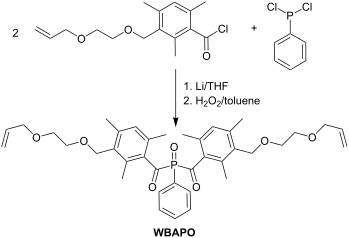
- under analogous conditions. The lithiation step was carried out in the presence of different model compounds for the reactive sites of the [2-(allyloxy)ethoxy]methyl substituent, such as benzyl methyl ether, allyl ethyl ether or diethylene glycol dimethyl ether. In the case of benzyl methyl ether and
- allyl ethyl ether, BAPO was formed in a lower yield showing that benzyl and allyl groups had a negative effect on the yield of BAPO. Probably, these groups initiate side reactions during the lithiation step. Furthermore, it was found that the temperature of the phosphine oxidation significantly
- WBAPO was synthesized via the dichlorophosphine route in a satisfactory yield. Benzyl and allyl groups of the introduced [2-(allyloxy)ethoxy]methyl substituent probably initiate side reactions during the lithiation step and have a negative effect on the yield of the synthesis. WBAPO, a yellow liquid


Diastereoselective functionalisation of benzo-annulated bicyclic sultams: Application for the synthesis of cis-2,4-diarylpyrrolidines
Beilstein J. Org. Chem. 2009, 5, No. 69, doi:10.3762/bjoc.5.69

- vinyl bromide 24a in lithiation and Pd-coupling chemistry is described. In the case of the latter, hydrogenation of the styryl products afforded a single diastereoisomer. These compounds were then studied under dissolved metal reduction conditions, in which the cleavage of both N–S and C–S bonds takes
- vinyl bromides 24a and 24b in good yields, respectively (Scheme 7). Vinyl bromide 24a was then subjected to lithiation with t-BuLi, followed by a CO2 quench. The desired carboxylic acid recovered from this reaction was only formed in low yields possibly due to issues with competing directed ortho
- -lithiation [25]. Notwithstanding, this acid was transformed into the corresponding methyl ester 25 using a Steglich-type esterification. Alkenyl reduction of the α,β-unsaturated ester under standard conditions gave the product of hydrogenation as an undetermined 3:1 mixture of diastereoisomers. The likely


Synthesis of unsymmetrically substituted biaryls via sequential lithiation of dibromobiaryls using integrated microflow systems
Beilstein J. Org. Chem. 2009, 5, No. 16, doi:10.3762/bjoc.5.16
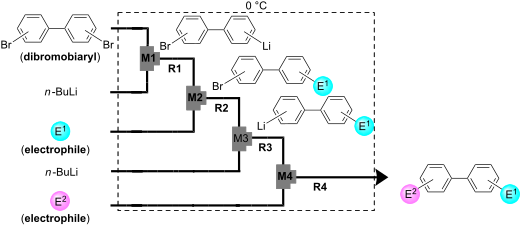
- micromixers and four microtube reactors to obtain unsymmetrically substituted biaryl compounds. Keywords: dibromobiaryls; fast mixing; integrated microflow system; selective lithiation; unsymmetrically substituted biaryls; Introduction Unsymmetrical biaryls have received significant research interest
- lithiation of dibromobiaryls using an integrated microflow system. These observations may open a new aspect of the synthesis of unsymmetrically substituted biaryls (Scheme 1), and herein we report full details of this study. Results and Discussion Br-Li Exchange Reaction of 2,2′-Dibromobiphenyl First, we


Convenient methods for preparing π-conjugated linkers as building blocks for modular chemistry
Beilstein J. Org. Chem. 2009, 5, No. 11, doi:10.3762/bjoc.5.11
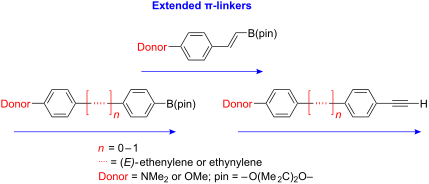
- ′-bromobiphenyl intermediates necessary for the preparation of 4a–c were synthesized by the Suzuki–Miyaura cross-coupling of 1-bromo-4-iodobenzene with the corresponding boronic acids/esters 1a–c in the yields of 82, 84, and 91%, respectively. A routine procedure involving a lithiation and reaction with
- % yield). Since the Sonogashira reaction between bromo derivatives and trimethylsilylacetylene proved to be sluggish and low yielding (even with a large excess of acetylene and elevated temperature), the bromo derivatives were converted to the corresponding iodo derivatives by lithiation and quenched with
- . Overall 12 extended π-linkers have been easily synthesized (8 of them are new compounds) utilizing procedures such as a lithiation/reaction with triisopropyl borate/esterification with pinacol, Mizoroki–Heck coupling with vinylboronate pinacol ester, borylation with bis(pinacolato)diboron or Sonogashira


Enantiospecific synthesis of [2.2]paracyclophane- 4-thiol and derivatives
Beilstein J. Org. Chem. 2009, 5, No. 9, doi:10.3762/bjoc.5.9
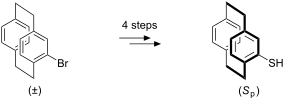
- by sulfinyl-directed ortho lithiation with n-butyllithium followed by reaction with tosyl azide. The resulting azo[2.2]paracyclophane was reduced in situ to give the amine (Rp,RS)-8 in good yield for the two steps (Scheme 2). Trichlorosilane-mediated deoxygenation proceeded uneventfully to furnished


Trifluoromethyl ethers – synthesis and properties of an unusual substituent
Beilstein J. Org. Chem. 2008, 4, No. 13, doi:10.3762/bjoc.4.13

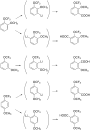
- potassium tert-butoxide (KOR) in tetrahydrofuran at −100 °C. Upon trapping with molecular iodine, 3-iodo-4-trifluoromethoxybiphenyl was isolated in 90% yield [73]. Under the same conditions as employed with trifluoromethoxybenzene, 1- and 2-trifluoromethoxynaphthalene undergo selective lithiation at the 2
- lithiation next to the OCF3 substituent is favoured, probably due to steric reasons. In fact, 1-trifluoromethoxy-4-(trifluoromethyl)benzene (Scheme 15) affords 2-trifluoromethoxy-5-(trifluoromethyl)benzoic acid after lithiation and carboxylation [75]. When the OCF3 substituent is in competition with fluorine




Development of potential manufacturing routes for substituted thiophenes – Preparation of halogenated 2-thiophenecarboxylic acid derivatives as building blocks for a new family of 2,6-dihaloaryl 1,2,4-triazole insecticides
Beilstein J. Org. Chem. 2007, 3, No. 23, doi:10.1186/1860-5397-3-23
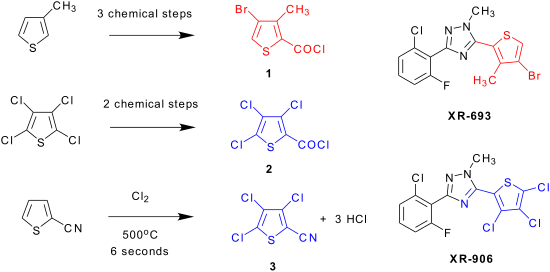
- -thiophenecarbonyl chloride 2 was developed from tetrachlorothiophene via either a lithiation reaction with n-butyllithium in MTBE solvent, or by a previously reported Grignard method using 1,2-dibromoethane as activator, followed by carbonation of the anion with CO2 to give the trichloro-2-thiophenecarboxylic acid
- with CO2, 3,4,5-trichloro-2-thiophenecarboxylic acid 23 was isolated and dried prior to its conversion to 2 with thionyl chloride. Thus, 2 can be prepared in two chemical steps from the inexpensive chlorinated thiophene 22 using either lithiation or Grignard chemistry. [28] A comparison of some key
- manufacturing issues surrounding the two proposed routes to 2 via 23 is summarized in Table 2. The two routes are dramatically different and lead to significantly different yields. At first glance, the lithiation route is clearly superior due to the 92% isolated yield, and the formation of only one equivalent


Other Beilstein-Institut Open Science Activities



