


Search results
Search for "oxazoline" in Full Text gives 107 result(s) in Beilstein Journal of Organic Chemistry.
Efficient and improved synthesis of Telmisartan
Beilstein J. Org. Chem. 2010, 6, No. 25, doi:10.3762/bjoc.6.25
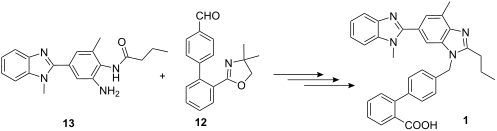
- -formylphenylboronic acid 10 with 2-(2-bromophenyl)-4,4-dimethyl-2-oxazoline (11) as the key step (90% yield). The benzimidazole moiety 15 was constructed regioselectively via a reductive amination-condensation sequence, replacing the alkylation of the preformed benzimidazole step in the previously published route
- . This methodology overcomes many of drawbacks associated with previously reported syntheses. Keywords: antihypertensive drug; oxazoline hydrolysis; Suzuki coupling; Telmisartan; Introduction Telmisartan (1) is an angiotensin II receptor antagonist useful in the treatment of hypertension, heart
- major bond disconnections. We realized biaryl synthesis and reductive amination are the key steps, and have the potential to overcome both of these weaknesses. Results and Discussion We identified 4-formylphenylboronic acid (10) and 2-(2-bromophenyl)-4,4-dimethyl-2-oxazoline (11) [12] as the ideal


Bis(oxazolines) based on glycopyranosides – steric, configurational and conformational influences on stereoselectivity
Beilstein J. Org. Chem. 2010, 6, No. 23, doi:10.3762/bjoc.6.23
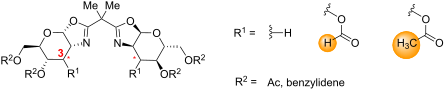
- though N-acylated derivatives of D-glucosamine easily form bicyclic carbohydrate oxazolines, until recently only a few examples of mono(oxazoline) ligands [15][16][17] and the corresponding bis(oxazolines) [18] based on this monosaccharide have appeared in the literature. In the course of our work we
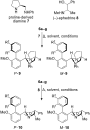
- -configured ligand scaffold, will bring the 3-O-substituent into a syn-relationship with the oxazoline nitrogen atom and therefore into very close proximity to a coordinated metal centre (Figure 1, I). Deoxygenation of the 3-postion on the other hand will lead to a ligand with comparably little steric
- shielding of metal centres coordinated by the oxazoline nitrogen atoms (Figure 1, II). As the stereoselectivity of the model reaction for ligands 3a–f improved with decreasing steric demand of the 3-O-substituent and since the best results were obtained with acyl-modified ligands, we also set out to prepare



(Pseudo)amide-linked oligosaccharide mimetics: molecular recognition and supramolecular properties
Beilstein J. Org. Chem. 2010, 6, No. 20, doi:10.3762/bjoc.6.20
- , Chiara and co-workers have described a novel complementary approach in which the oxazoline ring is generated by SN2 nucleophilic displacement reaction from the β-hydroxyurea 30 via the triflate intermediate 31 (Scheme 3) [65]. A similar methodology was used by the same authors to prepare the trehazolin



Mitomycins syntheses: a recent update
Beilstein J. Org. Chem. 2009, 5, No. 33, doi:10.3762/bjoc.5.33

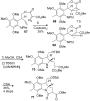
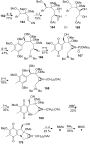
- between the methoxy ether and the olefin were probably responsible for this unexpected outcome. However, introduction of a carboethoxy group on the terminus of the olefin 129 restored the regioselectivity observed by Kozikowski to give oxazoline 130. 5.2. Reinhoudt. Rearrangement of 1-(1-pyrrolidinyl)-1,3
- tributyltin fluoride [112]. After protecting group manipulations and formation of the diazoester 138 with p-nitrobenzenesulfonylazide (PNBSA), the key carbene insertion was achieved using copper(I) in the presence of bis-oxazoline 139. A 9:1 ratio of 141 and 142 was obtained after direct chloranil oxidation






Asymmetric synthesis of biaryl atropisomers by dynamic resolution on condensation of biaryl aldehydes with (−)-ephedrine or a proline- derived diamine
Beilstein J. Org. Chem. 2008, 4, No. 47, doi:10.3762/bjoc.4.47

- . A family of starting aldehydes 6a–f was made by the method of Meyers [36]. 2,3-Dimethoxybenzoic acid (1) was converted via its acyl chloride to oxazoline 3, from which the 2-methoxy group was displaced with a series of aryl Grignard reagents 4, yielding biaryloxazolines 5a–f (Scheme 1 and Table 1
- ). Removal of the oxazoline by methylation, reduction and hydrolysis returned the aldehydes 6a–f. Screening for selectivity by NMR In order to investigate the ratios of diastereoisomers formed as these aldehydes condensed with the resolving agents, 6a was mixed with 1 equiv of either 7 or 8 in toluene-d8 or




DBFOX- Ph/metal complexes: Evaluation as catalysts for enantioselective fluorination of 3-(2-arylacetyl)-2-thiazolidinones
Beilstein J. Org. Chem. 2008, 4, No. 16, doi:10.3762/bjoc.4.16
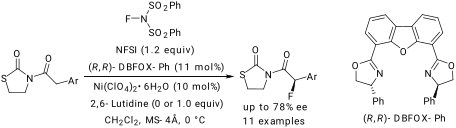
- availability of commonly used classes of ligands for asymmetric catalysis, such as, TADDOLs [37][39][41][47], BINAPs [38][40][43][44][46][49][51][53][55][56][57] and bis(oxazoline) [33][34][36][42][45]. Of particular importance are BINAP ligands. Sodeoka et al. have used the latter ligands in asymmetric
- enantioselectivities [57]. This study is useful because, up until now, the fluorinated products obtained by Sodeoka's method have been prepared by diastereoselective methods [65][66][67]. Independently, our group has focused on the development of enantioselective fluorination and related reactions using bis(oxazoline
- ) ligands, Box-Ph [(S,S)-2,2'-isopropylidene-bis(4-phenyl-2-oxazoline)] and DBFOX-Ph [(R,R)-4,6-dibenzofurandiyl-2,2'-bis(4-phenyloxazoline)] [33][34][36]. As an extension of this study, we herein evaluate our DBFOX-Ph/metal catalysis for the enantioselective fluorination of 3-(2-arylacetyl)-2


A superior P-H phosphonite: Asymmetric allylic substitutions with fenchol- based palladium catalysts
Beilstein J. Org. Chem. 2006, 2, No. 7, doi:10.1186/1860-5397-2-7
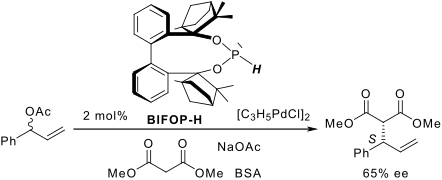
- product by employing electron withdrawing substituents on the P-donor atoms in P, N-oxazoline ligands[5] (Scheme 2) [6]. Such phosphites were thought to favor a more SN1-like addition at the substituted, allylic C-atom. High regio- and enantioselectivities were also achieved with biphenylphosphites by


Other Beilstein-Institut Open Science Activities



