


Search results
Search for "solvent-free conditions" in Full Text gives 149 result(s) in Beilstein Journal of Organic Chemistry.
Tunable microwave-assisted method for the solvent-free and catalyst-free peracetylation of natural products
- Manuela Oliverio,
- Paola Costanzo,
- Monica Nardi,
- Carla Calandruccio,
- Raffaele Salerno and
- Antonio Procopio
Beilstein J. Org. Chem. 2016, 12, 2222–2233, doi:10.3762/bjoc.12.214
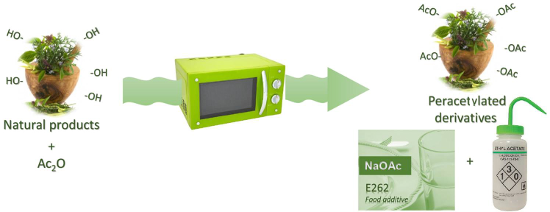
- preferably acetic anhydride in solvent free conditions, in presence of non-toxic homogeneous catalysts such as environmental safe Lewis acids [13][14]. Moreover, the need to easily recover and reuse the catalyst, thus reducing the work-up procedure to a simple filtration, resulted in the growing use of

Graphical Abstract

Figure 1: Chemical structures of bioactive substrates and their partition in subsets.

Scheme 1: Solvent-free and catalyst-free MW-assisted acetylation protocol.

Figure 2: MW-assisted acetylation T-program for different subset of substrates.

Figure 3: LCHRMS (m/z, [M + Na]+ and [M − H]− only for entry F) spectrum of O-acetylated quercetin (reaction ...
Silica-supported sulfonic acids as recyclable catalyst for esterification of levulinic acid with stoichiometric amounts of alcohols
- Raimondo Maggi,
- N. Raveendran Shiju,
- Veronica Santacroce,
- Giovanni Maestri,
- Franca Bigi and
- Gadi Rothenberg
Beilstein J. Org. Chem. 2016, 12, 2173–2180, doi:10.3762/bjoc.12.207
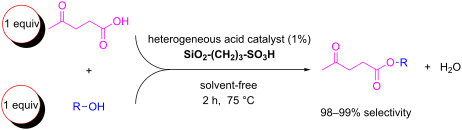
- sulfonated catalyst (1%), an equimolecular amount of reagents under solvent free conditions, and varying the temperature between 50–100 °C. Results are reported in Table 3. In all cases, the selectivity towards the esterification product 3a remained complete. A comparable yield of 3a was recovered reducing

Graphical Abstract
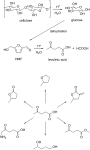
Scheme 1: Synthesis of levulinic acid from ligno-cellulosic feedstocks and its principal uses to access fine ...

Figure 1: Anchoring methodologies: a) impregnation; b) covalent binding.

Figure 2: Activity of the supported sulfonic acid catalyst within the first six cycles. Reaction conditions: ...
Solvent-free synthesis of novel para-menthane-3,8-diol ester derivatives from citronellal using a polymer-supported scandium triflate catalyst
- Lubabalo Mafu,
- Ben Zeelie and
- Paul Watts
Beilstein J. Org. Chem. 2016, 12, 2046–2054, doi:10.3762/bjoc.12.193
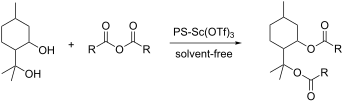
- was used. Moreover, all the reactions were carried-out under solvent-free conditions. Reaction parameters such as temperature, reaction time and reagent molar ratio were studied towards the substrate conversion and product selectivity. Effect of reaction temperature and reaction time In order to

Graphical Abstract

Scheme 1: Synthesis of menthol.

Scheme 2: Synthesis of para-menthane-3,8-diol.

Scheme 3: Synthesis of para-menthane diester derivatives.

Figure 1: PMD conversion using stoichiometric quantities of acetic anhydride.

Figure 2: Product distribution as a function of time.

Figure 3: Product distribution as a function of time.

Figure 4: Effect of molar ratio in product distribution.

Scheme 4: Synthesis of para-menthane mono-ester derivatives.
Microwave-assisted cyclizations promoted by polyphosphoric acid esters: a general method for 1-aryl-2-iminoazacycloalkanes
- Jimena E. Díaz,
- María C. Mollo and
- Liliana R. Orelli
Beilstein J. Org. Chem. 2016, 12, 2026–2031, doi:10.3762/bjoc.12.190
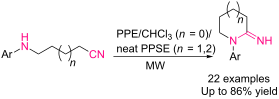
- trimethylsilyl polyphosphate (PPSE) in solvent-free conditions allowed for the synthesis of 1-aryl-2-iminopiperidines and hitherto unreported 1-aryl-2-iminoazepanes. The cyclization reaction involves good to high yields and short reaction times, and represents a novel application of PPA esters in heterocyclic
- under certain conditions [45][46]. Using a dichloromethane solution of PPSE, compound 4a was obtained exclusively (Table 2, entries 4–6), while working under solvent-free conditions further improved the yield (Table 2, entry 7). Employing the optimized reaction conditions (neat PPSE, 30 min at 150 °C
- reaction under solvent-free conditions at 150 °C, compound 7a was obtained in modest yield (Table 4, entry 5). Significantly better results were achieved by increasing the temperature to 200 °C (Table 4, entry 6). Employing the optimized reaction conditions, we synthesized some novel 1-aryl-2-iminoazepanes


Ionic liquids as transesterification catalysts: applications for the synthesis of linear and cyclic organic carbonates
- Maurizio Selva,
- Alvise Perosa,
- Sandro Guidi and
- Lisa Cattelan
Beilstein J. Org. Chem. 2016, 12, 1911–1924, doi:10.3762/bjoc.12.181
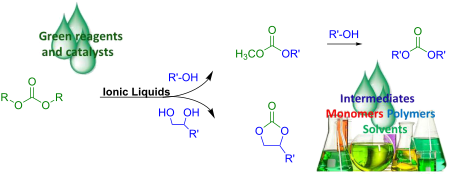
- -value chemicals. This holds true also for enzyme-catalyzed transesterification reactions. To cite a few examples, the literature claims the use of lipase as a biocatalyst for i) the reaction of glycerol with DMC for the synthesis of glycerol carbonate (GlyC) under solvent-free conditions. A 60% yield

Graphical Abstract

Scheme 1: The transesterification of diethyl oxalate (DEO) with phenol catalyzed by MoO3/SiO2.

Scheme 2: Transesterification of a triglyceride (TG) with DMC for biodiesel production using KOH as the base ...

Scheme 3: Top: Green methylation of phosphines and amines by dimethyl carbonate (Q = N, P). Bottom: anion met...

Figure 1: Structures of some representative SILs and PILs systems. MCF is a silica-based mesostructured mater...

Scheme 4: Synthesis of the acid polymeric IL. EGDMA: ethylene glycol dimethacrylate.

Scheme 5: The transesterification of sec-butyl acetate with MeOH catalyzed by some acidic imidazolium ILs.

Figure 2: Representative examples of ionic liquids for biodiesel production.

Scheme 6: Top: phosgenation of methanol; middle: EniChem and Ube processes; bottom: Asahi process for the pro...

Scheme 7: The transesterification in the synthesis of organic carbonates.

Scheme 8: The transesterification of DMC with alcohols and diols.

Scheme 9: Transesterification of glycerol with DMC in the presence of 1-n-butyl-3-methylimidazolium-2-carboxy...

Scheme 10: Synthesis of the BMIM-2-CO2 catalyst from butylimidazole and DMC.

Scheme 11: Plausible cooperative (nucleophilic–electrophilic) mechanism for the transesterification of glycero...

Scheme 12: Synthesis of diazabicyclo[5.4.0]undec-7-ene-based ionic liquids.

Scheme 13: Synthesis of the DABCO–DMC ionic liquid.

Scheme 14: Cooperative mechanism of ionic liquid-catalyzed glycidol production.

Scheme 15: [TMA][OH]-catalyzed synthesis of glycidol (GD) from glycerol and dimethyl carbonate [46].

Scheme 16: [BMIM]OH-catalyzed synthesis of DPC from DMC and 1-pentanol.

Figure 3: Representative examples of ionic liquids for biodiesel production.

Figure 4: Acyclic non-symmetrical organic carbonates synthetized with 1-(trimethoxysilyl)propyl-3-methylimida...

Scheme 17: A simplified reaction mechanism for DMC production.

Scheme 18: [P8881][MeOCO2] metathesis with acetic acid and phenol.

Figure 5: Examples of carbonates obtained through transesterification using phosphonium salts as catalysts.

Scheme 19: Examples of carbonates obtained from different bio-based diols using [P8881][CH3OCO2] as catalyst.

Scheme 20: Ambiphilic catalysis for transesterification reactions in the presence of carbonate phosphonium sal...
TMSBr-mediated solvent- and work-up-free synthesis of α-2-deoxyglycosides from glycals
- Mei-Yuan Hsu,
- Yi-Pei Liu,
- Sarah Lam,
- Su-Ching Lin and
- Cheng-Chung Wang
Beilstein J. Org. Chem. 2016, 12, 1758–1764, doi:10.3762/bjoc.12.164

- University, Taipei 106, Taiwan Department of Chemistry, National Central University, Jhongli 320, Taiwan 10.3762/bjoc.12.164 Abstract The thio-additions of glycals were efficiently promoted by a stoichiometric amount of trimethylsilyl bromide (TMSBr) to produce S-2-deoxyglycosides under solvent-free
- conditions in good to excellent yields. In addition, with triphenylphosphine oxide as an additive, the TMSBr-mediated direct glycosylations of glycals with a large range of alcohols were highly α-selective. Keywords: 2-deoxyglycosides; glycals; trimethylsilyl bromide (TMSBr); triphenylphosphine oxide (TPPO

Graphical Abstract

Scheme 1: Iterative synthesis of trisaccharide 66.

Scheme 2: Proposed mechanisms for TMSBr-mediated synthesis of 2-deoxyglycosides in the presence of TPPO.
Rearrangements of organic peroxides and related processes
- Ivan A. Yaremenko,
- Vera A. Vil’,
- Dmitry V. Demchuk and
- Alexander O. Terent’ev
Beilstein J. Org. Chem. 2016, 12, 1647–1748, doi:10.3762/bjoc.12.162
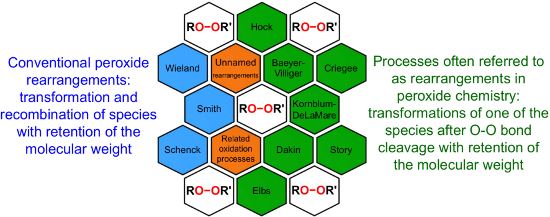
- -dioxolanes 151 are rearranged similarly to the Criegee mechanism into diketone derivatives 152 (Scheme 44) [298]. Unlike the Baeyer–Villiger rearrangement, in which only mono-O-insertion can take place, the Criegee rearrangement of peroxide 153 in an acidic medium and under solvent-free conditions does not

Graphical Abstract
Figure 1: The named transformations considered in this review.

Scheme 1: The Baeyer–Villiger oxidation.

Scheme 2: The general mechanism of the peracid-promoted Baeyer–Villiger oxidation.

Scheme 3: General mechanism of the Lewis acid-catalyzed Baeyer–Villiger rearrangement.

Scheme 4: The theoretically studied mechanism of the BV oxidation reaction promoted by H2O2 and the Lewis aci...

Scheme 5: Proton movements in the transition states of the Baeyer–Villiger oxidation.

Scheme 6: The dependence of the course of the Baeyer–Villiger oxidation on the type of O–O-bond cleavage in t...
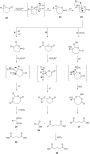
Scheme 7: The acid-catalyzed Baeyer–Villiger oxidation of cyclic epoxy ketones 22.

Scheme 8: Oxidation of isophorone oxide 29.

Scheme 9: Synthesis of acyl phosphate 32 from acyl phosphonate 31.

Scheme 10: Synthesis of aflatoxin B2 (36).

Scheme 11: The Baeyer–Villiger rearrangement of ketones 37 to lactones 38.

Scheme 12: Synthesis of 3,4-dimethoxybenzoic acid (40) via Baeyer–Villiger oxidation.

Scheme 13: Oxone transforms α,β-unsaturated ketones 43 into vinyl acetates 44.

Scheme 14: The Baeyer–Villiger oxidation of ketones 45 using diaryl diselenide and hydrogen peroxide.

Scheme 15: Baeyer–Villiger oxidation of (E)-2-methylenecyclobutanones.

Scheme 16: Oxidation of β-ionone (56) by H2O2/(BnSe)2 with formation of (E)-2-(2,6,6-trimethylcyclohex-1-en-1-...

Scheme 17: The mechanism of oxidation of ketones 58a–f by hydrogen peroxide in the presence of arsonated polys...

Scheme 18: Oxidation of ketone (58b) by H2O2 to 6-methylcaprolactone (59b) catalyzed by Pt complex 66·BF4.

Scheme 19: Oxidation of ketones 67 with H2O2 in the presence of [(dppb}Pt(µ-OH)]22+.

Scheme 20: The mechanism of oxidation of ketones 67 in the presence of [(dppb}Pt(µ-OH)]22+ and H2O2.

Scheme 21: Oxidation of benzaldehydes 69 in the presence of the H2O2/MeReO3 system.

Scheme 22: Oxidation of acetophenones 72 in the presence of the H2O2/MeReO3 system.

Scheme 23: Baeyer–Villiger oxidation of 2-adamantanone (45c) in the presence of Sn-containing mesoporous silic...

Scheme 24: Aerobic Baeyer–Villiger oxidation of ketones 76 using metal-free carbon.

Scheme 25: A regioselective Baeyer-Villiger oxidation of functionalized cyclohexenones 78 into a dihydrooxepin...

Scheme 26: The oxidation of aldehydes and ketones 80 by H2O2 catalyzed by Co4HP2Mo15V3O62.

Scheme 27: The cleavage of ketones 82 with hydrogen peroxide in alkaline solution.

Scheme 28: Oxidation of ketones 85 to esters 86 with H2O2–urea in the presence of KHCO3.

Scheme 29: Mechanism of the asymmetric oxidation of cyclopentane-1,2-dione 87a with the Ti(OiPr)4/(+)DET/t-BuO...

Scheme 30: The oxidation of cis-4-tert-butyl-2-fluorocyclohexanone (93) with m-chloroperbenzoic acid.

Scheme 31: The mechanism of the asymmetric oxidation of 3-substituted cyclobutanone 96a in the presence of chi...

Scheme 32: Enantioselective Baeyer–Villiger oxidation of cyclic ketones 98.

Scheme 33: Regio- and enantioselective Baeyer–Villiger oxidation of cyclic ketones 101.

Scheme 34: The proposed mechanism of the Baeyer–Villiger oxidation of acetal 105f.

Scheme 35: Synthesis of hydroxy-10H-acridin-9-one 117 from tetramethoxyanthracene 114.

Scheme 36: The Baeyer–Villiger oxidation of the fully substituted pyrrole 120.

Scheme 37: The Criegee rearrangement.

Scheme 38: The mechanism of the Criegee reaction of a peracid with a tertiary alcohol 122.

Scheme 39: Criegee rearrangement of decaline ethylperoxoate 127 into ketal 128.

Scheme 40: The ionic cleavage of 2-methoxy-2-propyl perester 129.

Scheme 41: The Criegee rearrangement of α-methoxy hydroperoxide 136.
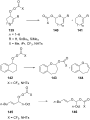
Scheme 42: Synthesis of enol esters and acetals via the Criegee rearrangement.

Scheme 43: Proposed mechanism of the transformation of 1-hydroperoxy-2-oxabicycloalkanones 147a–d.

Scheme 44: Transformation of 3-hydroxy-1,2-dioxolanes 151 into diketone derivatives 152.

Scheme 45: Criegee rearrangement of peroxide 153 with the mono-, di-, and tri-O-insertion.

Scheme 46: The sequential Criegee rearrangements of adamantanes 157a,b.

Scheme 47: Synthesis of diaryl carbonates 160a–d from triarylmethanols 159a–d through successive oxygen insert...

Scheme 48: The synthesis of sesquiterpenes 162 from ketone 161 with a Criegee rearrangement as one key step.

Scheme 49: Synthesis of trans-hydrindan derivatives 164, 165.

Scheme 50: The Hock rearrangement.

Scheme 51: The general scheme of the cumene process.

Scheme 52: The Hock rearrangement of aliphatic hydroperoxides.
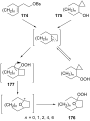
Scheme 53: The mechanism of solvolysis of brosylates 174a–c and spiro cyclopropyl carbinols 175a–c in THF/H2O2....

Scheme 54: The fragmentation mechanism of hydroperoxy acetals 178 to esters 179.

Scheme 55: The acid-catalyzed rearrangement of phenylcyclopentyl hydroperoxide 181.

Scheme 56: The peroxidation of tertiary alcohols in the presence of a catalytic amount of acid.

Scheme 57: The acid-catalyzed reaction of bicyclic secondary alcohols 192 with hydrogen peroxide.

Scheme 58: The photooxidation of 5,6-disubstituted 3,4-dihydro-2H-pyrans 196.

Scheme 59: The oxidation of tertiary alcohols 200a–g, 203a,b, and 206.

Scheme 60: Transformation of functional peroxide 209 leading to 2,3-disubstitued furans 210 in one step.

Scheme 61: The synthesis of carbazoles 213 via peroxide rearrangement.

Scheme 62: The construction of C–N bonds using the Hock rearrangement.

Scheme 63: The synthesis of moiety 218 from 217 which is a structural motif in the antitumor–antibiotic of CC-...

Scheme 64: The in vivo oxidation steps of cholesterol (219) by singlet oxygen.

Scheme 65: The proposed mechanism of the rearrangement of cholesterol-5α-OOH 220.

Scheme 66: Photochemical route to artemisinin via Hock rearrangement of 223.

Scheme 67: The Kornblum–DeLaMare rearrangement.

Scheme 68: Kornblum–DeLaMare transformation of 1-phenylethyl tert-butyl peroxide (225).

Scheme 69: The synthesis 4-hydroxyenones 230 from peroxide 229.

Scheme 70: The Kornblum–DeLaMare rearrangement of peroxide 232.

Scheme 71: The reduction of peroxide 234.

Scheme 72: The Kornblum–DeLaMare rearrangement of endoperoxide 236.

Scheme 73: The rearrangement of peroxide 238 under Kornblum–DeLaMare conditions.

Scheme 74: The proposed mechanism of rearrangement of peroxide 238.

Scheme 75: The Kornblum–DeLaMare rearrangement of peroxides 242a,b.

Scheme 76: The base-catalyzed rearrangements of bicyclic endoperoxides having electron-withdrawing substituent...

Scheme 77: The base-catalyzed rearrangements of bicyclic endoperoxides 249a,b having electron-donating substit...

Scheme 78: The base-catalyzed rearrangements of bridge-head substituted bicyclic endoperoxides 251a,b.

Scheme 79: The Kornblum–DeLaMare rearrangement of hydroperoxide 253.

Scheme 80: Synthesis of β-hydroxy hydroperoxide 254 from endoperoxide 253.

Scheme 81: The amine-catalyzed rearrangement of bicyclic endoperoxide 263.

Scheme 82: The base-catalyzed rearrangement of meso-endoperoxide 268 into 269.

Scheme 83: The photooxidation of 271 and subsequent Kornblum–DeLaMare reaction.

Scheme 84: The Kornblum–DeLaMare rearrangement as one step in the oxidation reaction of enamines.

Scheme 85: The Kornblum–DeLaMare rearrangement of 3,5-dihydro-1,2-dioxenes 284, 1,2-dioxanes 286, and tert-but...

Scheme 86: The Kornblum–DeLaMare rearrangement of epoxy dioxanes 290a–d.

Scheme 87: Rearrangement of prostaglandin H2 292.

Scheme 88: The synthesis of epicoccin G (297).

Scheme 89: The Kornblum–DeLaMare rearrangement used in the synthesis of phomactin A.

Scheme 90: The Kornblum–DeLaMare rearrangement in the synthesis of 3H-quinazolin-4-one 303.

Scheme 91: The Kornblum–DeLaMare rearrangement in the synthesis of dolabriferol (308).

Scheme 92: Sequential transformation of 3-substituted 2-pyridones 309 into 3-hydroxypyridine-2,6-diones 311 in...

Scheme 93: The Kornblum–DeLaMare rearrangement of peroxide 312 into hydroxy enone 313.

Scheme 94: The Kornblum–DeLaMare rearrangement in the synthesis of polyfunctionalized carbonyl compounds 317.

Scheme 95: The Kornblum–DeLaMare rearrangement in the synthesis of (Z)-β-perfluoroalkylenaminones 320.

Scheme 96: The Kornblum–DeLaMare rearrangement in the synthesis of γ-ketoester 322.

Scheme 97: The Kornblum–DeLaMare rearrangement in the synthesis of diterpenoids 326 and 328.

Scheme 98: The synthesis of natural products hainanolidol (331) and harringtonolide (332) from peroxide 329.

Scheme 99: The synthesis of trans-fused butyrolactones 339 and 340.

Scheme 100: The synthesis of leucosceptroid C (343) and leucosceptroid P (344) via the Kornblum–DeLaMare rearra...

Scheme 101: The Dakin oxidation of arylaldehydes or acetophenones.

Scheme 102: The mechanism of the Dakin oxidation.

Scheme 103: A solvent-free Dakin reaction of aromatic aldehydes 356.

Scheme 104: The organocatalytic Dakin oxidation of electron-rich arylaldehydes 358.

Scheme 105: The Dakin oxidation of electron-rich arylaldehydes 361.

Scheme 106: The Dakin oxidation of arylaldehydes 358 in water extract of banana (WEB).

Scheme 107: A one-pot approach towards indolo[2,1-b]quinazolines 364 from indole-3-carbaldehydes 363 through th...

Scheme 108: The synthesis of phenols 367a–c from benzaldehydes 366a-c via acid-catalyzed Dakin oxidation.

Scheme 109: Possible transformation paths of the highly polarized boric acid coordinated H2O2–aldehyde adduct 3...

Scheme 110: The Elbs oxidation of phenols 375 to hydroquinones.

Scheme 111: The mechanism of the Elbs persulfate oxidation of phenols 375 affording p-hydroquinones 376.

Scheme 112: Oxidation of 2-pyridones 380 under Elbs persulfate oxidation conditions.

Scheme 113: Synthesis of 3-hydroxy-4-pyridone (384) via an Elbs oxidation of 4-pyridone (382).

Scheme 114: The Schenck rearrangement.

Scheme 115: The Smith rearrangement.

Scheme 116: Three main pathways of the Schenck rearrangement.

Scheme 117: The isomerization of hydroperoxides 388 and 389.

Scheme 118: Trapping of dioxacyclopentyl radical 392 by oxygen.

Scheme 119: The hypothetical mechanism of the Schenck rearrangement of peroxide 394.

Scheme 120: The autoxidation of oleic acid (397) with the use of labeled isotope 18O2.

Scheme 121: The rearrangement of 18O-labeled hydroperoxide 400 under an atmosphere of 16O2.

Scheme 122: The rearrangement of the oleate-derived allylic hydroperoxides (S)-421 and (R)-425.

Scheme 123: Mechanisms of Schenck and Smith rearrangements.

Scheme 124: The rearrangement and cyclization of 433.

Scheme 125: The Wieland rearrangement.

Scheme 126: The rearrangement of bis(triphenylsilyl) 439 or bis(triphenylgermyl) 441 peroxides.

Scheme 127: The oxidative transformation of cyclic ketones.

Scheme 128: The hydroxylation of cyclohexene (447) in the presence of tungstic acid.

Scheme 129: The oxidation of cyclohexene (447) under the action of hydrogen peroxide.

Scheme 130: The reaction of butenylacetylacetone 455 with hydrogen peroxide.

Scheme 131: The oxidation of bridged 1,2,4,5-tetraoxanes.

Scheme 132: The proposed mechanism for the oxidation of bridged 1,2,4,5-tetraoxanes.

Scheme 133: The rearrangement of ozonides.

Scheme 134: The acid-catalyzed oxidative rearrangement of malondialdehydes 462 under the action of H2O2.
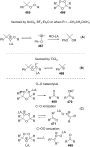
Scheme 135: Pathways of the Lewis acid-catalyzed cleavage of dialkyl peroxides 465 and ozonides 466.

Scheme 136: The mechanism of the transformation of (tert-butyldioxy)cyclohexanedienones 472.

Scheme 137: The synthesis of Vitamin K3 from 472a.

Scheme 138: Proposed mechanism for the transformation of 478d into silylated endoperoxide 479d.

Scheme 139: The rearrangement of hydroperoxide 485 to form diketone 486.

Scheme 140: The base-catalyzed rearrangement of cyclic peroxides 488a–g.

Scheme 141: Synthesis of chiral epoxides and aldols from peroxy hemiketals 491.

Scheme 142: The multistep transformation of (R)-carvone (494) to endoperoxides 496a–e.

Scheme 143: The decomposition of anthracene endoperoxide 499.

Scheme 144: Synthesis of esters 503 from aldehydes 501 via rearrangement of peroxides 502.

Scheme 145: Two possible paths for the base-promoted decomposition of α-azidoperoxides 502.

Scheme 146: The Story decomposition of cyclic diperoxide 506a.

Scheme 147: The Story decomposition of cyclic triperoxide 506b.

Scheme 148: The thermal rearrangement of endoperoxides A into diepoxides B.

Scheme 149: The transformation of peroxide 510 in the synthesis of stemolide (511).

Scheme 150: The possible mechanism of the rearrangement of endoperoxide 261g.

Scheme 151: The photooxidation of indene 517.

Scheme 152: The isomerization of ascaridole (523).

Scheme 153: The isomerization of peroxide 525.

Scheme 154: The thermal transformation of endoperoxide 355.

Scheme 155: The photooxidation of cyclopentadiene (529) at a temperature higher than 0 °C.

Scheme 156: The thermal rearrangement of endoperoxides 538a,b.

Scheme 157: The transformation of peroxides 541.

Scheme 158: The thermal rearrangements of strained cyclic peroxides.

Scheme 159: The thermal rearrangement of diacyl peroxide 551 in the synthesis of C4-epi-lomaiviticin B core 553....

Scheme 160: The 1O2 oxidation of tryptophan (554) and rearrangement of dioxetane intermediate 555.

Scheme 161: The Fe(II)-promoted cleavage of aryl-substituted bicyclic peroxides.

Scheme 162: The proposed mechanism of the Fe(II)-promoted rearrangement of 557a–c.

Scheme 163: The reaction of dioxolane 563 with Fe(II) sulfate.

Scheme 164: Fe(II)-promoted rearrangement of 1,2-dioxane 565.

Scheme 165: Fe(II) cysteinate-promoted rearrangement of 1,2-dioxolane 568.

Scheme 166: The transformation of 1,2-dioxanes 572a–c under the action of FeCl2.

Scheme 167: Fe(II) cysteinate-promoted transformation of tetraoxane 574.

Scheme 168: The CoTPP-catalyzed transformation of bicyclic endoperoxides 600a–d.

Scheme 169: The CoTPP-catalyzed transformation of epoxy-1,2-dioxanes.

Scheme 170: The Ru(II)-catalyzed reactions of 1,4-endoperoxide 261g.

Scheme 171: The Ru(II)-catalyzed transformation as a key step in the synthesis of elyiapyrone A (610) from 1,4-...

Scheme 172: Peroxides with antimalarial activity.

Scheme 173: The interaction of iron ions with artemisinin (616).

Scheme 174: The interaction of FeCl2 with 1,2-dioxanes 623, 624.

Scheme 175: The mechanism of reaction 623 and 624 with Fe(II)Cl2.

Scheme 176: The reaction of bicyclic natural endoperoxides G3-factors 631–633 with FeSO4.

Scheme 177: The transformation of terpene cardamom peroxide 639.
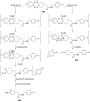
Scheme 178: The different ways of the cleavage of tetraoxane 643.

Scheme 179: The LC–MS analysis of interaction of tetraoxane 646 with iron(II)heme 647.

Scheme 180: The rearrangement of 3,6-epidioxy-1,10-bisaboladiene (EDBD, 649).

Scheme 181: Easily oxidized substrates.

Scheme 182: Biopathway of synthesis of prostaglandins.

Scheme 183: The reduction and rearrangements of isoprostanes.

Scheme 184: The partial mechanism for linoleate 658 oxidation.

Scheme 185: The transformation of lipid hydroperoxide.

Scheme 186: The acid-catalyzed cleavage of the product from free-radical oxidation of cholesterol (667).

Scheme 187: Two pathways of catechols oxidation.

Scheme 188: Criegee-like or Hock-like rearrangement of the intermediate hydroperoxide 675 in dioxygenase enzyme...

Scheme 189: Carotinoides 679 cleavage by carotenoid cleavage dioxygenases.
Multicomponent reactions: A simple and efficient route to heterocyclic phosphonates
- Mohammad Haji
Beilstein J. Org. Chem. 2016, 12, 1269–1301, doi:10.3762/bjoc.12.121
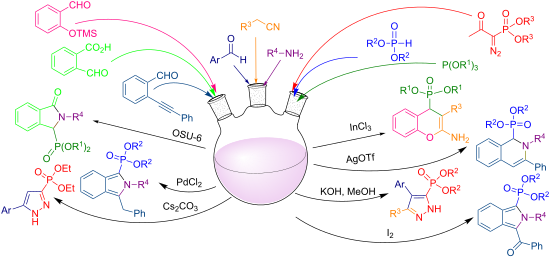
- substituted isatins 30 with aniline (32) and dimethyl- or diethyl phosphite under solvent-free conditions in the presence of magnetic Fe3O4 nanoparticle-supported phosphotungstic acid as a recyclable catalyst at 80 °C furnished α-aminophosphonates 33 in yields from 80% to 98% depending on the reaction time
- -methyl-3-formylchromone (75) with some 1,2-, 1,3- and 1,4-bi-nucleophiles and diethyl phosphonate under solvent-free conditions have been developed by E. Ali et al. [46]. The resulting α-aminophosphonate intermediates 77 and 80 were non-isolable and interconverted to the corresponding heterocyclic
- 1,2-dihydropyridine-3-phosphonate 259. Yavari et al. have described the phosphorylation of benzothiazole (263) and isoquinoline (246) through a one-pot three-component reaction with activated acetylenes 260 and diphenyl phosphonate (261) under solvent-free conditions at room temperature (Scheme 54

Graphical Abstract

Scheme 1: The Biginelli condensation.

Scheme 2: The Biginelli reaction of β-ketophosphonates catalyzed by ytterbium triflate.

Scheme 3: Trimethylchlorosilane-mediated Biginelli reaction of diethyl (3,3,3-trifluoropropyl-2-oxo)phosphona...

Scheme 4: Biginelli reaction of dialkyl (3,3,3-trifluoropropyl-2-oxo)phosphonate with trialkyl orthoformates ...

Scheme 5: p-Toluenesulfonic acid-promoted Biginelli reaction of β-ketophosphonates, aryl aldehydes and urea.

Scheme 6: General Kabachnik–Fields reaction for the synthesis of α-aminophosphonates.

Scheme 7: Phthalocyanine–AlCl catalyzed Kabachnik–Fields reaction of N-Boc-piperidin-4-one with diethyl phosp...

Scheme 8: Kabachnik–Fields reaction of isatin with diethyl phosphite and benzylamine.

Scheme 9: Magnetic Fe3O4 nanoparticle-supported phosphotungstic acid-catalyzed Kabachnik–Fields reaction of i...

Scheme 10: The Mg(ClO4)2-catalyzed Kabachnik–Fields reaction of 1-tosylpiperidine-4-one.

Scheme 11: An asymmetric version of the Kabachnik–Fields reaction for the synthesis of α-amino-3-piperidinylph...

Scheme 12: A classical Kabachnik–Fields reaction followed by an intramolecular ring-closing reaction for the s...

Scheme 13: Synthesis of (S)-piperidin-2-phosphonic acid through an asymmetric Kabachnik–Fields reaction.

Scheme 14: A modified diastereoselective Kabachnik–Fields reaction for the synthesis of isoindolin-1-one-3-pho...

Scheme 15: A microwave-assisted Kabachnik–Fields reaction toward isoindolin-1-ones.

Scheme 16: The synthesis of 3-arylmethyleneisoindolin-1-ones through a Horner–Wadsworth–Emmons reaction of Kab...

Scheme 17: An efficient one-pot method for the synthesis of ethyl (2-alkyl- and 2-aryl-3-oxoisoindolin-1-yl)ph...

Scheme 18: FeCl3 and PdCl2 co-catalyzed three-component reaction of 2-alkynylbenzaldehydes, anilines, and diet...

Scheme 19: Three-component reaction of 6-methyl-3-formylchromone (75) with hydrazine derivatives or hydroxylam...

Scheme 20: Three-component reaction of 6-methyl-3-formylchromone (75) with thiourea, guanidinium carbonate or ...

Scheme 21: Three-component reaction of 6-methyl-3-formylchromone (75) with 1,4-bi-nucleophiles in the presence...

Scheme 22: One-pot three-component reaction of 2-alkynylbenzaldehydes, amines, and diethyl phosphonate.

Scheme 23: Lewis acid–surfactant combined catalysts for the one-pot three-component reaction of 2-alkynylbenza...

Scheme 24: Lewis acid catalyzed cyclization of different Kabachnik–Fields adducts.

Scheme 25: Three-component synthesis of N-arylisoquinolone-1-phosphonates 119.

Scheme 26: CuI-catalyzed three-component tandem reaction of 2-(2-formylphenyl)ethanones with aromatic amines a...

Scheme 27: Synthesis of 1,5-benzodiazepin-2-ylphosphonates via ytterbium chloride-catalyzed three-component re...

Scheme 28: FeCl3-catalyzed four-component reaction for the synthesis of 1,5-benzodiazepin-2-ylphosphonates.

Scheme 29: Synthesis of indole bisphosphonates through a modified Kabachnik–Fields reaction.

Scheme 30: Synthesis of heterocyclic bisphosphonates via Kabachnik–Fields reaction of triethyl orthoformate.

Scheme 31: A domino Knoevenagel/phospha-Michael process for the synthesis of 2-oxoindolin-3-ylphosphonates.

Scheme 32: Intramolecular cyclization of phospha-Michael adducts to give dihydropyridinylphosphonates.

Scheme 33: Synthesis of fused phosphonylpyrans via intramolecular cyclization of phospha-Michael adducts.

Scheme 34: InCl3-catalyzed three-component synthesis of (2-amino-3-cyano-4H-chromen-4-yl)phosphonates.

Scheme 35: Synthesis of phosphonodihydropyrans via a domino Knoevenagel/hetero-Diels–Alder process.

Scheme 36: Multicomponent synthesis of phosphonodihydrothiopyrans via a domino Knoevenagel/hetero-Diels–Alder ...

Scheme 37: One-pot four-component synthesis of 1,2-dihydroisoquinolin-1-ylphosphonates under multicatalytic co...

Scheme 38: CuI-catalyzed four-component reactions of methyleneaziridines towards alkylphosphonates.

Scheme 39: Ruthenium–porphyrin complex-catalyzed three-component synthesis of aziridinylphosphonates and its p...

Scheme 40: Copper(I)-catalyzed three-component reaction towards 1,2,3-triazolyl-5-phosphonates.

Scheme 41: Three-component reaction of acylphosphonates, isocyanides and dialkyl acetylenedicarboxylate to aff...

Scheme 42: Synthesis of (4-imino-3,4-dihydroquinazolin-2-yl)phosphonates via an isocyanide-based three-compone...

Scheme 43: Silver-catalyzed three-component synthesis of (2-imidazolin-4-yl)phosphonates.

Scheme 44: Three-component synthesis of phosphonylpyrazoles.

Scheme 45: One-pot three-component synthesis of 3-carbo-5-phosphonylpyrazoles.

Scheme 46: A one-pot two-step method for the synthesis of phosphonylpyrazoles.

Scheme 47: A one-pot method for the synthesis of (5-vinylpyrazolyl)phosphonates.

Scheme 48: Synthesis of 1H-pyrrol-2-ylphosphonates via the [3 + 2] cycloaddition of phosphonate azomethine yli...

Scheme 49: Three-component synthesis of 1H-pyrrol-2-ylphosphonates.

Scheme 50: The classical Reissert reaction.

Scheme 51: One-pot three-component synthesis of N-phosphorylated isoquinolines.

Scheme 52: One-pot three-component synthesis of 1-acyl-1,2-dihydroquinoline-2-phosphonates and 2-acyl-1,2-dihy...

Scheme 53: Three-component reaction of pyridine derivatives with ethyl propiolate and dialkyl phosphonates.

Scheme 54: Three-component reactions for the phosphorylation of benzothiazole and isoquinoline.

Scheme 55: Three-component synthesis of diphenyl [2-(aminocarbonyl)- or [2-(aminothioxomethyl)-1,2-dihydroisoq...

Scheme 56: Three-component stereoselective synthesis of 1,2-dihydroquinolin-2-ylphosphonates and 1,2-dihydrois...

Scheme 57: Diphosphorylation of diazaheterocyclic compounds via a tandem 1,4–1,2 addition of dimethyl trimethy...

Scheme 58: Multicomponent reaction of alkanedials, acetamide and acetyl chloride in the presence of PCl3 and a...

Scheme 59: An oxidative domino three-component synthesis of polyfunctionalized pyridines.

Scheme 60: A sequential one-pot three-component synthesis of polysubstituted pyrroles.

Scheme 61: Three-component decarboxylative coupling of proline with aldehydes and dialkyl phosphites for the s...

Scheme 62: Three-component domino aza-Wittig/phospha-Mannich sequence for the phosphorylation of isatin deriva...

Scheme 63: Stereoselective synthesis of phosphorylated trans-1,5-benzodiazepines via a one-pot three-component...

Scheme 64: One-pot three-component synthesis of phosphorylated 2,6-dioxohexahydropyrimidines.
Supported bifunctional thioureas as recoverable and reusable catalysts for enantioselective nitro-Michael reactions
- José M. Andrés,
- Miriam Ceballos,
- Alicia Maestro,
- Isabel Sanz and
- Rafael Pedrosa
Beilstein J. Org. Chem. 2016, 12, 628–635, doi:10.3762/bjoc.12.61
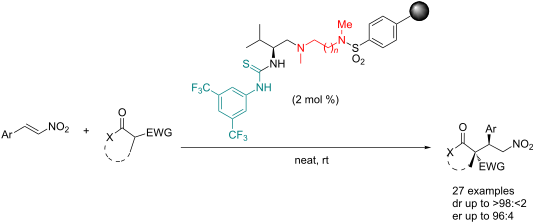
- (1a) under solvent-free conditions in a ball mill providing the addition product 7aa in excellent yield, total diastereoselectivity, and very good enantioselectitvity. Experimental General remarks 13C NMR (126 MHz) and 1H NMR (500 MHz) spectra were recorded in CDCl3 as the solvent. Chemical shifts for

Graphical Abstract

Figure 1: Parent and supported bifunctional thioureas used in this work.

Scheme 1: Reaction of nitrostyrene with diethyl malonate and 2-ethoxycarbonyl cyclopentanone.

Scheme 2: Reaction of nitrostyrenes with malonates and β-diketones.

Scheme 3: Reaction of nitrostyrenes with β-keto esters and β-dicarbonyl compounds.

Scheme 4: Reaction of nitrostyrenes with α-nitrocyclohexanone and ethyl α-nitropropionate.
(Thio)urea-mediated synthesis of functionalized six-membered rings with multiple chiral centers
- Giorgos Koutoulogenis,
- Nikolaos Kaplaneris and
- Christoforos G. Kokotos
Beilstein J. Org. Chem. 2016, 12, 462–495, doi:10.3762/bjoc.12.48
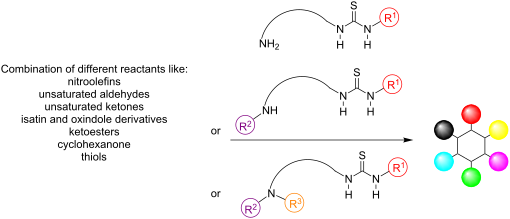
- screening of various catalysts, organocatalyst 43 and 4-methoxybenzoic acid as a cocatalyst, was identified as the optimum for the reaction of (E)-2-nitroallyl acetate 40 with cyclohexanone 41 to provide nitrobicyclo[3.3.1]nonan-9-one 42, in solvent-free conditions. This reaction provides products with

Graphical Abstract

Scheme 1: Activation of carbonyl compounds via enamine and iminium intermediates [2].

Scheme 2: Electronic and steric interactions present in enamine activation mode [2].

Scheme 3: Electrophilic activation of carbonyl compounds by a thiourea moiety.

Scheme 4: Asymmetric synthesis of dihydro-2H-pyran-6-carboxylate 3 using organocatalyst 4 [16].

Scheme 5: Possible hydrogen-bonding for the reaction of (E)-methyl 2-oxo-4-phenylbut-3-enoate [16].

Scheme 6: Asymmetric desymmetrization of 4,4-cyclohexadienones using the Michael addition reaction with malon...

Scheme 7: The enantioselective synthesis of α,α-disubstituted cycloalkanones using catalyst 11 [18].

Scheme 8: The enantioselective synthesis of indolo- and benzoquinolidine compounds through aza-Diels–Alder re...

Scheme 9: Enantioselective [5 + 2] cycloaddition [20].

Scheme 10: Asymmetric synthesis of oxazine derivatives 26 [21].

Scheme 11: Asymmetric synthesis of bicyclo[3.3.1]nonadienone, core 30 present in (−)-huperzine [22].

Scheme 12: Asymmetric inverse electron-demand Diels-Alder reaction catalyzed by amine-thiourea 34 [23].

Scheme 13: Asymmetric entry to morphan skeletons, catalyzed by amine-thiourea 37 [24].

Scheme 14: Asymmetric transformation of (E)-2-nitroallyl acetate [25].

Scheme 15: Proposed way of activation.

Scheme 16: Asymmetric synthesis of nitrobicyclo[3.2.1]octan-2-one derivatives [26].

Scheme 17: Asymmetric tandem Michael–Henry reaction catalyzed by 50 [27].

Scheme 18: Asymmetric Diels–Alder reactions of 3-vinylindoles 51 [29].

Scheme 19: Proposed transition state and activation mode of the asymmetric Diels–Alder reactions of 3-vinylind...

Scheme 20: Desymmetrization of meso-anhydrides by Chin, Song and co-workers [30].

Scheme 21: Desymmetrization of meso-anhydrides by Connon and co-workers [31].

Scheme 22: Asymmetric intramolecular Michael reaction [32].

Scheme 23: Asymmetric addition of malonate to 3-nitro-2H-chromenes 67 [33].

Scheme 24: Intramolecular desymmetrization through an intramolecular aza-Michael reaction [34].

Scheme 25: Enantioselective synthesis of (−)-mesembrine [34].

Scheme 26: A novel asymmetric Michael–Michael reaction [35].

Scheme 27: Asymmetric three-component reaction catalyzed by Takemoto’s catalyst 77 [46].

Scheme 28: Asymmetric domino Michael–Henry reaction [47].

Scheme 29: Asymmetric domino Michael–Henry reaction [48].

Scheme 30: Enantioselective synthesis of derivatives of 3,4-dihydro-2H-pyran 89 [49].

Scheme 31: Asymmetric addition of α,α-dicyano olefins 90 to 3-nitro-2H-chromenes 91 [50].

Scheme 32: Asymmetric three-component reaction producing 2,6-diazabicyclo[2.2.2]octanones 95 [51].

Scheme 33: Asymmetric double Michael reaction producing substituted chromans 99 [52].

Scheme 34: Enantioselective synthesis of multi-functionalized spiro oxindole dienes 106 [53].

Scheme 35: Organocatalyzed Michael aldol cyclization [54].

Scheme 36: Asymmetric synthesis of dihydrocoumarins [55].

Scheme 37: Asymmetric double Michael reaction en route to tetrasubstituted cyclohexenols [56].

Scheme 38: Asymmetric synthesis of α-trifluoromethyl-dihydropyrans 121 [58].

Scheme 39: Tyrosine-derived tertiary amino-thiourea 123 catalyzed Michael hemiaketalization reaction [59].

Scheme 40: Enantioselective entry to bicyclo[3.2.1]octane unit [60].

Scheme 41: Asymmetric synthesis of spiro[4-cyclohexanone-1,3’-oxindoline] 126 [61].

Scheme 42: Kinetic resolution of 3-nitro-2H-chromene 130 [62].

Scheme 43: Asymmetric synthesis of chromanes 136 [63].

Scheme 44: Wang’s utilization of β-unsaturated α-ketoesters 87 [64,65].

Scheme 45: Asymmetric entry to trifluoromethyl-substituted dihydropyrans 144 [66].

Scheme 46: Phenylalanine-derived thiourea-catalyzed domino Michael hemiaketalization reaction [67].

Scheme 47: Asymmetric synthesis of α-trichloromethyldihydropyrans 149 [68].

Scheme 48: Takemoto’s thiourea-catalyzed domino Michael hemiaketalization reaction [69].

Scheme 49: Asymmetric synthesis of densely substituted cyclohexanes [70].

Scheme 50: Enantioselective synthesis of polysubstituted chromeno [4,3-b]pyrrolidine derivatines 157 [71].

Scheme 51: Enantioselective synthesis of spiro-fused cyclohexanone/5-oxazolone scaffolds 162 [72].

Scheme 52: Utilizing 2-mercaptobenzaldehydes 163 in cascade processes [73,74].

Scheme 53: Proposed transition state of the initial sulfa-Michael step [74].

Scheme 54: Asymmetric thiochroman synthesis via dynamic kinetic resolution [75].

Scheme 55: Enantioselective synthesis of thiochromans [76].

Scheme 56: Enantioselective synthesis of chromans and thiochromans synthesis [77].

Scheme 57: Enantioselective sulfa-Michael aldol reaction en route to spiro compounds [78].

Scheme 58: Enantioselective synthesis of 4-aminobenzo(thio)pyrans 179 [79].

Scheme 59: Asymmetric synthesis of tetrahydroquinolines [80].

Scheme 60: Novel asymmetric Mannich–Michael sequence producing tetrahydroquinolines 186 [81].

Scheme 61: Enantioselective synthesis of biologically interesting chromanes 190 and 191 [82].

Scheme 62: Asymmetric tandem Henry–Michael reaction [83].

Scheme 63: An asymmetric synthesis of substituted cyclohexanes via a dynamic kinetic resolution [84].

Scheme 64: Three component-organocascade initiated by Knoevenagel reaction [85].

Scheme 65: Asymmetric Michael reaction catalyzed by catalysts 57 and 211 [86].

Scheme 66: Proposed mechanism for the asymmetric Michael reaction catalyzed by catalysts 57 and 211 [86].

Scheme 67: Asymmetric facile synthesis of hexasubstituted cyclohexanes [87].

Scheme 68: Dual activation catalytic mechanism [87].

Scheme 69: Asymmetric Michael–Michael/aldol reaction catalyzed by catalysts 57, 219 and 214 [88].

Scheme 70: Asymmetric synthesis of substituted cyclohexane derivatives, using catalysts 57 and 223 [89].

Scheme 71: Asymmetric synthesis of substituted piperidine derivatives, using catalysts 223 and 228 [90].

Scheme 72: Asymmetric synthesis of endo-exo spiro-dihydropyran-oxindole derivatives catalyzed by catalyst 232 [91]....

Scheme 73: Asymmetric synthesis of carbazole spiroxindole derivatives, using catalyst 236 [92].

Scheme 74: Enantioselective formal [2 + 2] cycloaddition of enal 209 with nitroalkene 210, using catalysts 23 ...

Scheme 75: Asymmetric synthesis of polycyclized hydroxylactams derivatives, using catalyst 242 [94].

Scheme 76: Asymmetric synthesis of product 243, using catalyst 246 [95].

Scheme 77: Formation of the α-stereoselective acetals 248 from the corresponding enol ether 247, using catalys...

Scheme 78: Selective glycosidation, catalyzed by Shreiner’s catalyst 23 [97].
Enantioselective additions of copper acetylides to cyclic iminium and oxocarbenium ions
- Jixin Liu,
- Srimoyee Dasgupta and
- Mary P. Watson
Beilstein J. Org. Chem. 2015, 11, 2696–2706, doi:10.3762/bjoc.11.290
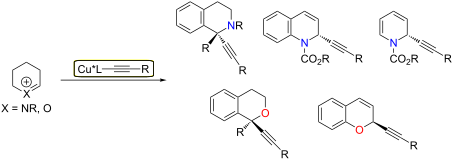
- report is the first and only example to date of alkynylation of an imine or iminium ion to form a chiral tetrasubstituted center with high ee. Enantioselective, copper-catalyzed alkynylations have also been accomplished under solvent-free conditions. In 2013, Su and co-workers established that the CDC

Graphical Abstract
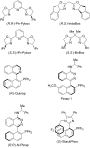
Figure 1: Chiral ligands utilized in copper-catalyzed alkynylations of cyclic iminium and oxocarbenium ions.

Scheme 1: Li’s alkynylation of acyclic N-arylimines.

Scheme 2: Knochel’s alkynylation of acyclic N-alkylenamines.

Scheme 3: Li’s CDC of tetrahydroisoquinolines and alkynes.

Scheme 4: Li’s alkynylation of N-aryldihydroisoquinolinium ions.

Scheme 5: Schreiber’s alkynylation of N-alkylisoquinolinium ions.

Scheme 6: Ma’s alkynylation of pyridium ions.

Scheme 7: Arndtsen’s alkynylation of cyclic iminium ions.

Scheme 8: Maruoka’s alkynylation of azomethine imines.

Scheme 9: Su’s CDC of tetrahydroisoquinolines and alkynes under ball milling conditions.

Scheme 10: Ma’s A3-coupling.

Scheme 11: Li’s CDC reaction using photoredox catalysis.
Scheme 12: Liu’s CDC reaction of N-carbamoyltetrahydroisoquinolines. T+BF4– = 2,2,6,6-tetramethylpiperidine N-...

Scheme 13: Aponick’s alkynylation of N-carbomoylquinolinium ions using StackPhos as ligand.

Scheme 14: Carreira’s enantioselective, catalytic alkynylation of aldehydes.

Scheme 15: Watson’s alkynylation of isochroman oxocarbenium ions.

Scheme 16: Watson’s alkynylation of chromene oxocarbenium ions.

Scheme 17: Watson’s alkynylation to set diaryl tetrasubstituted stereocenters.
Efficient synthetic protocols for the preparation of common N-heterocyclic carbene precursors
- Morgan Hans,
- Jan Lorkowski,
- Albert Demonceau and
- Lionel Delaude
Beilstein J. Org. Chem. 2015, 11, 2318–2325, doi:10.3762/bjoc.11.252
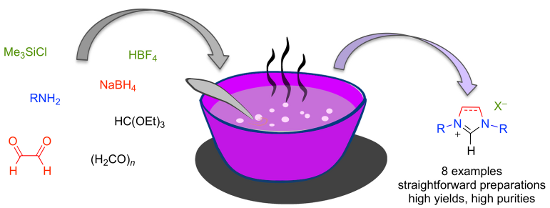
- and ZnCl2. This Friedel–Crafts alkylation was carried out under solvent-free conditions and afforded high yields of the bulky aniline needed to follow the Arduengo formylative cyclization path. It was originally performed in a sealed tube under autogeneous pressure at 160 °C. We checked that the

Graphical Abstract

Scheme 1: Various synthetic paths leading to the formation of NHCs.

Scheme 2: Retrosynthetic path for the preparation of symmetrical imidazolium and imidazolinium salts from sim...

Figure 1: Structures of the imidazolium and imidazolinium salts discussed in this study and their acronyms.

Scheme 3: Synthesis of 1,3-dicyclohexylimidazolium tetrafluoroborate (ICy·HBF4).

Scheme 4: Synthesis of 1,3-dibenzylimidazolium tetrafluoroborate (IBn·HBF4).

Scheme 5: Synthesis of 1,3-dimesitylimidazolium salts (IMes·HCl and IMes·HBF4).

Scheme 6: Synthesis of 1,3-dimesitylimidazolinium chloride (SIMes·HCl).

Scheme 7: Synthesis of 1,3-bis(2,6-diisopropylphenyl)imidazolium chloride (IDip·HCl).

Scheme 8: Synthesis of 1,3-bis(2,6-diisopropylphenyl)imidazolinium chloride (SIDip·HCl).

Scheme 9: Synthesis of 1,3-bis(2,6-bis(diphenylmethyl)-4-methylphenyl)imidazolium chloride (IDip*·HCl).
Olefin metathesis in air
- Lorenzo Piola,
- Fady Nahra and
- Steven P. Nolan
Beilstein J. Org. Chem. 2015, 11, 2038–2056, doi:10.3762/bjoc.11.221
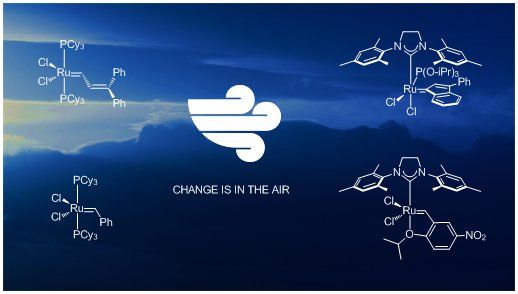
- % of Ru at 150 °C in air, under solvent-free conditions for several days, to afford 1,2-bis(silyl)ethenes in moderate to good yields [33]. Reactions without oxygen showed no conversion, highlighting the important role that the latter plays in the activation of the catalyst. In 1992, Grubbs and co
- 2nd generation catalyst (33) and a variation of the latter (66, Figure 8) in the RCM of diethyl diallylmalonate (29) [66]. Reactions were performed with very low catalyst loading (from 2.5 to 0.04 mol %), at 30 °C, under air in nondegassed DCM, nondegassed methyl decanoate and under solvent-free
- conditions in nondegassed substrates. Full conversions were achieved in the majority of cases, in both CM and RCM reactions, with all catalysts. In these reactions, catalyst 66 gave the highest performance. It should be noted that the results obtained by Meier with 33 were in contrast with the previous

Graphical Abstract

Scheme 1: Polymerization of 7-oxanorbornene in water.

Scheme 2: Synthesis of the first well-defined ruthenium carbene.

Scheme 3: Synthesis of Grubbs' 1st generation catalyst.

Figure 1: NHC-Ruthenium complexes and widely used NHC carbenes.

Scheme 4: Access to 21 from the Grubbs’ 1st generation catalyst and its one-pot synthesis.

Scheme 5: Synthesis of supported Hoveyda-type catalyst.

Figure 2: Scope of RCM reactions with supported Hoveyda-type catalyst. Reaction conditions: 24 (5 mol %), non...

Scheme 6: Synthesis of 33 by Hoveyda and Blechert.

Figure 3: Synthesis of chiral Hoveyda–Grubbs type catalyst and its use in RO/CM.

Scheme 7: Synthesis of 41.

Figure 4: RCM reactions in air using 41 as catalyst. Reaction conditions: 41 (5 mol %), MeOH (0.05 M), 22 °C,...

Figure 5: CM-type reactions in air using 41 as catalyst. Reaction conditions: 41 (5 mol %), 22 °C, 12 h, in a...

Figure 6: Grela's complex (54) and reaction scope in air. Reaction conditions: catalyst, substrate (0.25 mmol...
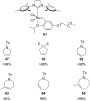
Figure 7: Abell's complex (61) and its RCM reaction scope in air. Reaction condition: 10 mol % of 61, refluxi...

Figure 8: Catalysts used by Meier in air.

Figure 9: Ammonium chloride-tagged complexes.

Figure 10: Scorpio-type complexes.

Scheme 8: Synthesis of Grubbs' 3rd generation catalyst.

Figure 11: Indenylidene complexes.

Figure 12: Commercially available complexes evaluated under air.

Figure 13: Grela's N,N-unsymmetrically substituted complexes.

Scheme 9: Synthesis of phosphite-based catalysts.

Figure 14: Catalysts used by the Cazin group.

Figure 15: RCM scope in air with catalysts 33, 85 and 98a. Reaction conditions: Catalyst, substrate (0.25 mmol...

Figure 16: Synthesis of Schiff base-ruthenium complexes.

Scheme 10: Schiff base–ruthenium complexes synthesized by Verpoort.

Scheme 11: Synthesis of mixed Schiff base–NHC complexes.

Figure 17: Veerport's indenylidene Schiff-base complexes.
Investigation on the reactivity of α-azidochalcones with carboxylic acids: Formation of α-amido-1,3-diketones and highly substituted 2-(trifluoromethyl)oxazoles
- Kandasamy Rajaguru,
- Arumugam Mariappan,
- Rajendran Suresh,
- Periasamy Manivannan and
- Shanmugam Muthusubramanian
Beilstein J. Org. Chem. 2015, 11, 2021–2028, doi:10.3762/bjoc.11.219

- temperature, it affords highly substituted 2-(trifluoromethyl)oxazoles. These flexible transformations proceed under solvent free conditions in good to excellent yields without any catalyst. Keywords: α-amido-1,3-diketones; α-azidochalcones; carboxylic acids; 2H-azirines; oxazoles; Introduction α

Graphical Abstract

Figure 1: Formation of substituted aziridine.

Figure 2: Various strategies for the formation of 2H-azirine.

Scheme 1: Attempted reaction for the synthesis of 3a.
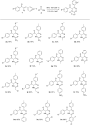
Figure 3: Synthesis of α-amido-1,3-diketone (3a–o). Reaction conditions: α-azidochalcone 1 (1.0 equiv) and ca...

Scheme 2: Plausible mechanism.

Scheme 3: Attempted reaction with acid derivatives.

Scheme 4: Oxazole formation from 3.

Figure 4: Possible isomers for 7.

Scheme 5: Oxazole formation.

Figure 5: Synthesis of highly substituted 2-(trifluoromethyl)oxazoles (8a–e). Reaction conditions: α-azidocha...

Scheme 6: Mechanism for the formation of 8.
Aerobic addition of secondary phosphine oxides to vinyl sulfides: a shortcut to 1-hydroxy-2-(organosulfanyl)ethyl(diorganyl)phosphine oxides
- Svetlana F. Malysheva,
- Alexander V. Artem’ev,
- Nina K. Gusarova,
- Nataliya A. Belogorlova,
- Alexander I. Albanov,
- C. W. Liu and
- Boris A. Trofimov
Beilstein J. Org. Chem. 2015, 11, 1985–1990, doi:10.3762/bjoc.11.214

- Chemistry, National Dong Hwa University, Hualien 97401, Taiwan 10.3762/bjoc.11.214 Abstract Secondary phosphine oxides react with vinyl sulfides (both alkyl- and aryl-substituted sulfides) under aerobic and solvent-free conditions (80 °C, air, 7–30 h) to afford 1-hydroxy-2-(organosulfanyl)ethyl(diorganyl
- addition of P–H species to the C=C bonds readily proceeds in the absence of any catalyst or initiator (Scheme 1). The reactions occur under mild solvent-free conditions (70–80 °C, inert atmosphere, 3–15 h) to chemo- and regioselectively furnish the anti-Markovnikov adducts in excellent yields (up to 99

Graphical Abstract

Scheme 1: Non-catalyzed addition of P–H species to alkenes.

Figure 1: ORTEP drawing (30% thermal ellipsoid) of phosphine oxide 3d. A CIF file with the crystallographic d...

Scheme 2: Addition of secondary phosphine sulfide to vinyl sulfide under aerobic catalyst-free conditions.
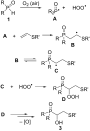
Scheme 3: Putative mechanism.
Robust bifunctional aluminium–salen catalysts for the preparation of cyclic carbonates from carbon dioxide and epoxides
- Yuri A. Rulev,
- Zalina Gugkaeva,
- Victor I. Maleev,
- Michael North and
- Yuri N. Belokon
Beilstein J. Org. Chem. 2015, 11, 1614–1623, doi:10.3762/bjoc.11.176
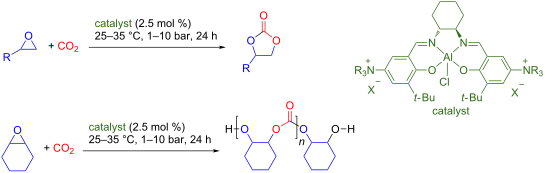
- free conditions. Catalyst recycling experiments are also reported and show the robustness of this system. Results and Discussion The preparation of salen ligands 8a and 8b was conducted according to Scheme 2, starting from tert-butylphenol, which was formylated and then nitrated to produce 5-nitro-3
- salts and increasing the steric hindrance around the ammonium salts. Herein, we report the synthesis of two aluminium–salen complexes incorporating quaternary ammonium salts directly attached to the salen ligand and their catalytic activities for the coupling of epoxides and carbon dioxide under solvent

Graphical Abstract

Scheme 1: Synthesis of cyclic and polycarbonates.

Figure 1: Bifunctional aluminium–salen complexes, including those studied in this work.

Scheme 2: Synthesis of salen ligands 8a and 8b.

Scheme 3: The preparation of aluminum complexes 1, 2 and 10.

Scheme 4: Possible formation of a dinuclear complex from 1 by treatment with H2O and Et3N.

Figure 2: MALDI–TOF spectrum of poly(hexene carbonate) prepared using catalyst 2. The peak at 565 Daltons cor...

Figure 3: GPC trace of poly(cyclohexene carbonate) prepared using catalyst 2. The chromatogram was obtained i...
Single-molecule conductance of a chemically modified, π-extended tetrathiafulvalene and its charge-transfer complex with F4TCNQ
- Raúl García,
- M. Ángeles Herranz,
- Edmund Leary,
- M. Teresa González,
- Gabino Rubio Bollinger,
- Marius Bürkle,
- Linda A. Zotti,
- Yoshihiro Asai,
- Fabian Pauly,
- Juan Carlos Cuevas,
- Nicolás Agraït and
- Nazario Martín
Beilstein J. Org. Chem. 2015, 11, 1068–1078, doi:10.3762/bjoc.11.120
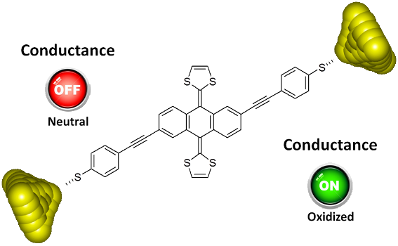
- -free conditions as recently reported [27]. Hence, as a starting point, we followed the same sample preparation conditions as previously with the OPE3-dithiol [27]. We prepared 0.1–1 mM solutions of compound 5 in both 1,2,4-trichlorobenzene (TCB) or mesitylene/tetrahydrofuran (Mes/THF 4:1), and exposed
- -dithiol compound (where 3 indicates the total number of phenyl rings), in which the central phenyl ring has been substituted by an exTTF unit. We could, therefore, expect compound 5 to form molecular junctions in a similar way to the OPE3-dithiol, which readily does so either in solution, or under solvent

Graphical Abstract

Figure 1: Depictions of 9,10-bis(1,3-dithiol-2-ylidene)-9,10-dihydroanthracene (exTTF) in the (a) neutral for...

Scheme 1: Synthetic route to the target exTTF-based molecular wire 5.

Figure 2: Cyclic voltammograms of compound 5 and pristine exTTF (at concentrations of approximately 0.2 mM) u...

Figure 3: 2D histograms resulting from break junction experiments on an unmodified gold sample (a), OPE3-dith...

Figure 4: 2D histograms corresponding to compound 5 after exposing a gold substrate to the solution of the co...

Figure 5: 2D histograms corresponding to compound 5 after exposing a gold substrate to a solution of the comp...

Figure 6: a) Examples of individual G(z) traces showing clear conductance plateaus. b–e) 2D histograms corres...
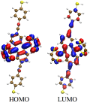
Figure 7: Frontier orbitals of compound 5 in the gas phase.

Figure 8: Top a) and hollow b) binding geometries of 5 to a gold cluster in metal–molecule–metal junctions.

Figure 9: Transmission as a function of energy for the top and hollow binding geometries.
On the strong difference in reactivity of acyclic and cyclic diazodiketones with thioketones: experimental results and quantum-chemical interpretation
- Andrey S. Mereshchenko,
- Alexey V. Ivanov,
- Viktor I. Baranovskii,
- Grzegorz Mloston,
- Ludmila L. Rodina and
- Valerij A. Nikolaev
Beilstein J. Org. Chem. 2015, 11, 504–513, doi:10.3762/bjoc.11.57

- diazo compounds 1a–f with cycloaliphatic thioketone 2b were calculated (Table 2). All calculations refer to the gas phase, since all reactions of DDC 1 with the thioxocyclobutanedione 2b were carried out under solvent-free conditions [20]. The driving force behind the DDC 1a–d reactions with

Graphical Abstract

Scheme 1: The key experimental results on the DDC 1 reactions with thioketones 2 [19-21].

Figure 1: Diazo compounds 1 and thioketones 2 used in the study.

Scheme 2: General scheme for reactions of DDC 1 with thiobenzophenone (2a).

Figure 2: Optimized structures of the lowest energy Z,E-conformers of diazo compounds 1a–d.

Scheme 3: Reactions of the intermediate thiocarbonyl ylide 7'd via competative 1,5-EC (a) or 1,3-EC (b) follo...
A green approach to the synthesis of novel phytosphingolipidyl β-cyclodextrin designed to interact with membranes
- Yong Miao,
- Florence Djedaïni-Pilard and
- Véronique Bonnet
Beilstein J. Org. Chem. 2014, 10, 2654–2657, doi:10.3762/bjoc.10.278
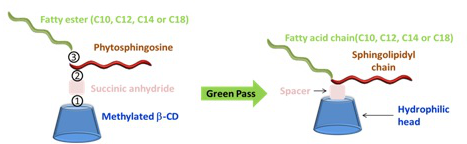
- medium. The mixture was left to react for 10 minutes. The use of TLC indicated the end of the reaction. After the purification, yields of above 70% were obtained. It was indeed observed that solvent-free conditions can be employed in this reaction. The reaction is much faster without solvent due to the

Graphical Abstract

Figure 1: Targeted modified cyclodextrins.

Scheme 1: Synthesis of bicatenar CDs 4, 5, 6 and 7; a) succinic anhydride, 135 °C, 10 min, 70%; b) phytosphin...
Regio- and stereoselective synthesis of new diaminocyclopentanols
- Evgeni A. Larin,
- Valeri S. Kochubei and
- Yuri M. Atroshchenko
Beilstein J. Org. Chem. 2014, 10, 2513–2520, doi:10.3762/bjoc.10.262

- experiments was performed under solvent-free conditions at 100 °C. In case of morpholine (7a), the best catalytic effect was observed with LiClO4 [36] and Zn(ClO4)2·6H2O [37] affording 56 and 76% yield of 8a after isolation and purification, therefore the absence of the solvent seems crucial for the reaction
- nucleophilicity. Moreover, there was not much effect on the outcome of the reactions conducted either under solvent-free conditions or using DMSO as a solvent. The regioisomers 9a–d and 10a–d were isolated through column chromatographic separation and fully characterized in order to avoid ambiguity. The
- diaminocyclopentanols in good yields. It has been shown that using Zn(ClO4)2·6H2O under solvent-free conditions and Cs2CO3 in DMSO is preferable to the ring opening of di-N-protected cyclopentanamine epoxides. We have highlighted the influence of the nature of the N,N-disubstituted amino moiety and the orientation of

Graphical Abstract

Scheme 1: Preparation of the starting materials.

Figure 1: Amine-based nucleophiles used in the epoxide ring opening reaction.

Scheme 2: Postulated mechanism for the formation of 14a,b.
Multicomponent reactions in nucleoside chemistry
- Mariola Koszytkowska-Stawińska and
- Włodzimierz Buchowicz
Beilstein J. Org. Chem. 2014, 10, 1706–1732, doi:10.3762/bjoc.10.179
- phosphite were carried out under solvent-free conditions at 60 °C (for 14) or at 80 °C (for 27). Products 28 and 29 were obtained in good to excellent yields as 1:1 diastereoisomeric mixtures arising from the generation of a stereogenic center at the aminophosphonate chain. The mixtures were not separated
- , microwave irradiation (600 W), 6–10 min (solvent-free conditions). Reagents and reaction conditions: i. Montmorillonite K-10 clay, microwave irradiation (560 W), 6–10 min (solvent-free conditions). Reagents and reaction conditions: i. CeCl3·7H2O (20 mol %), NaI (20 mol %), microwave irradiation (90 °C), 6–8

Graphical Abstract

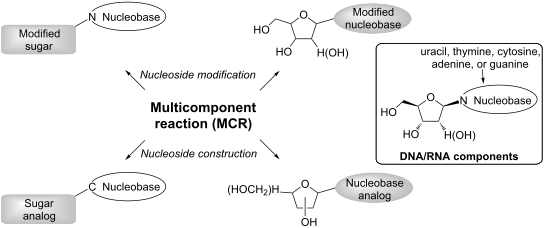
Figure 1: Selected chemical modifications of natural ribose or 2'-deoxyribose nucleosides leading to the deve...

Scheme 1: (a) Classical Mannich reaction; (b) general structures of selected hydrogen active components and s...

Scheme 2: Reagents and reaction conditions: i. H2O or H2O/EtOH, 60–100 °C, 7 h–10 d; ii. H2, Pd/C or PtO2; ii...

Scheme 3: Reagents and reaction conditions: i. H2O, 90 °C, overnight.

Scheme 4: Reagents and reaction conditions: i. AcOH, H2O, 60 °C, 12 h-5 d; ii. AcOH, H2O, 60 °C, 8 h.

Scheme 5: Reagents and reaction conditions: i. CuBr, THF, reflux, 0.5 h; ii. n-Bu4NF·3H2O, THF, rt, 2 h.

Scheme 6: Reagents and reaction conditions: i. [bmim][PF6], 80 °C, 5–8 h.

Scheme 7: Reagents and reaction conditions: i. EtOH, reflux, 24 h.

Scheme 8: Reagents and reaction conditions: i. NaOAc, H2O, 95 °C, 1–16 h; ii. NaOAc, H2O, 95 °C, 1 h.

Scheme 9: Reagents and reaction conditions: i. a. 37% aq HCl, MeOH; b. NaOAc, 1,4-dioxane, H2O, 100 °C, overn...

Scheme 10: Reagents and reaction conditions: i. DMAP, DCC, MeOH, rt, 1 h.

Scheme 11: The Kabachnik–Fields reaction.

Scheme 12: Reagents and reaction conditions: i. 60 °C, 3 h; ii. 80 °C, 2 h.

Scheme 13: The four-component Ugi reaction.

Scheme 14: Reagents and reaction conditions: i. MeOH, rt, 2–3 d, yields not given.

Scheme 15: Reagents and reaction conditions: i. MeOH/CH2Cl2 (1:1), rt, 24 h, yield not given; ii. 6 N aq HCl, ...

Scheme 16: Reagents and reaction conditions: i. MeOH/H2O, rt, 26 h; ii. aq AcOH, reflux, 50%; iii. reversed ph...

Scheme 17: Reagents and reaction conditions: i. MeOH, rt, 24 h; ii. HCl, MeOH, 0 °C to rt, 6 h, then H2O, rt, ...

Scheme 18: Reagents and reaction conditions: i. DMF/Py/MeOH (1:1:1), rt, 48 h; ii. 10% HCl/MeOH, rt, 30 min.

Scheme 19: Reagents and reaction conditions (R = CH3 or H): i. CH2Cl2/MeOH (2:1), 35–40 °C, 2 d; ii. HF/pyridi...

Scheme 20: Reagents and reaction conditions: i. MeOH, 76%; ii. 80% aq TFA, 100%.

Scheme 21: Reagents and reaction conditions: i. EtOH, rt, 72 h; ii. Zn, aq NaH2PO4, THF, rt, 1 week; then 80% ...

Scheme 22: Reagents and reaction conditions: i. EtOH, rt, 48 h, then silica gel chromatography, 33% for 57 (30...

Scheme 23: Reagents and reaction conditions: i. [bmim]BF4, 80 °C, 4 h; ii. [bmim]BF4, 80 °C, 3 h; iii. [bmim]BF...

Scheme 24: Reagents and reaction conditions: i. [bmim]BF4, 80 °C.

Scheme 25: Reagents and reaction conditions: i. H3PW12O40 (2 mol %), EtOH, 50 °C, 2–15 h; ii. H3PW12O40 (2 mol...

Scheme 26: General scheme of the Biginelli reaction.

Scheme 27: Reagents and reaction conditions: i. EtOH, reflux.

Scheme 28: Reagents and reaction conditions: i. Bu4N+HSO4−, diethylene glycol, 120 °C, 1.5–3 h.

Scheme 29: Reagents and reaction conditions: i. BF3·Et2O, CuCl, AcOH, THF, 65 °C, 24 h; ii. Yb(OTf)3, THF, ref...

Scheme 30: Reagents and reaction conditions: TCT (10 mol %), rt: i. 100 min; ii. 150 min; iii. 140 min.

Scheme 31: Reagents and reaction conditions: i. EtOH, microwave irradiation (300 W), 10 min; ii. EtOH, 75 °C, ...

Scheme 32: The Hantzsch reaction.

Scheme 33: Reagents and reaction conditions: TCT (10 mol %), rt, 80–150 min.

Scheme 34: Reagents and reaction conditions: i. Yb(OTf)3, THF, 90 °C, 12 h; ii. 4 Å molecular sieves, EtOH, 90...

Scheme 35: Reagents and reaction conditions: i. MeOH, 50 °C, 48 h.

Scheme 36: Reagents and reaction conditions: i. MeOH, 25 °C, 5 d.

Scheme 37: Bu4N+HSO4−, diethylene glycol, 80 °C, 1–2 h.

Scheme 38: The three-component carbopalladation of dienes on the example of buta-1,3-diene.

Scheme 39: Reagents and reaction conditions: i. 5 mol % Pd(dba)2, Bu4NCl, ZnCl2, acetonitrile or DMSO, 80 °C o...

Scheme 40: Reagents and reaction conditions: i. 2.5 mol % Pd2(dba)3, tris(2-furyl)phosphine, K2CO3, MeCN or DM...

Scheme 41: Reagents and reaction conditions: i. 2.5 mol % Pd2(dba)3, tris(2-furyl)phosphine, K2CO3, MeCN or DM...

Scheme 42: The three-component Bucherer–Bergs reaction.

Scheme 43: Reagents and reaction conditions: i. MeOH, H2O, 70 °C, 4.5 h; ii. (1) H2, 5% Pd/C, MeOH, 55 °C, 5 h...

Scheme 44: Reagents and reaction conditions: i. pyridine, MgSO4, 100 °C, 28 h, N2; ii. DMF, 70–90 °C, 22–30 h,...

Scheme 45: Reagents and reaction conditions: i. Montmorillonite K-10 clay, microwave irradiation (600 W), 6–10...

Scheme 46: Reagents and reaction conditions: i. Montmorillonite K-10 clay, microwave irradiation (560 W), 6–10...

Scheme 47: Reagents and reaction conditions: i. CeCl3·7H2O (20 mol %), NaI (20 mol %), microwave irradiation (...

Scheme 48: Reagents and reaction conditions: i. PhI(OAc)2 (3 mol %), microwave irradiation (45 °C), 6–9 min.

Scheme 49: Reagents and reaction conditions: i. 117, ethyl pyruvate, TiCl4, dichloromethane, −78 °C, 1 h; then ...
Preparation of phosphines through C–P bond formation
- Iris Wauters,
- Wouter Debrouwer and
- Christian V. Stevens
Beilstein J. Org. Chem. 2014, 10, 1064–1096, doi:10.3762/bjoc.10.106
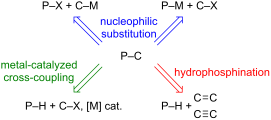
- also been shown to take place at room temperature in the absence of a catalyst [86][87] and even under solvent-free conditions [88]. More recently also metal complex-assisted or organocatalyzed hydrophosphinations have been reported. Several reviews focusing on hydrophosphination have been pusblished
- corresponding triflate under similar conditions [196][197]. The reaction also proceeded under solvent-free conditions with slightly higher yields [198]. A heterogeneous Pd/C catalyst has been applied as well [199][200]. The group of Glueck has reported the first asymmetric palladium-catalyzed C–P bond formation

Graphical Abstract

Scheme 1: Synthesis of P-stereogenic phosphines 5 using menthylphosphinite borane diastereomers 2.

Scheme 2: Enantioselective synthesis of chiral phosphines 10 with ephedrine as a chiral auxiliary.

Scheme 3: Chlorophosphine boranes 11a as P-chirogenic electrophilic building blocks.

Scheme 4: Monoalkylation of phenylphosphine borane 15 with methyl iodide in the presence of Cinchona alkaloid...

Scheme 5: Preparation of tetraphosphine borane 19.

Scheme 6: Using chiral chlorophosphine-boranes 11b as phosphide borane 20 precursors.

Scheme 7: Nickel-catalyzed cross-coupling (dppe = 1,2-bis(diphenylphosphino)ethane).

Scheme 8: Pd-catalyzed cross-coupling reaction with organophosphorus stannanes 30.

Scheme 9: Copper iodide catalyzed carbon–phosphorus bond formation.

Scheme 10: Thermodynamic kinetic resolution as the origin of enantioselectivity in metal-catalyzed asymmetric ...

Scheme 11: Ru-catalyzed asymmetric phosphination of benzyl and alkyl chlorides 35 with HPPhMe (36a, PHOX = pho...

Scheme 12: Pt-catalyzed asymmetric alkylation of secondary phosphines 36b.

Scheme 13: Different adducts 43 can result from hydrophosphination.

Scheme 14: Pt-catalyzed asymmetric hydrophosphination.

Scheme 15: Intramolecular hydrophosphination of phosphinoalkene 47.

Scheme 16: Organocatalytic asymmetric hydrophosphination of α,β-unsaturated aldehydes 59.

Scheme 17: Preparation of phosphines using zinc organometallics.

Scheme 18: Preparation of alkenylphosphines 71a from alkenylzirconocenes 69 (dtc = N,N-diethyldithiocarbamate,...

Scheme 19: SNAr with P-chiral alkylmethylphosphine boranes 13c.

Scheme 20: Synthesis of QuinoxP 74 (TMEDA = tetramethylethylenediamine).

Scheme 21: Pd-Mediated couplings of a vinyl triflate 76 with diphenylphosphine borane 13e.

Figure 1: Menthone (83) and camphor (84) derived chiral phosphines.

Scheme 22: Palladium-catalyzed cross-coupling reaction of vinyl tosylates 85 and 87 with diphenylphosphine bor...

Scheme 23: Attempt for the enantioselective palladium-catalyzed C–P cross-coupling reaction between an alkenyl...

Scheme 24: Enol phosphates 88 as vinylic coupling partners in the palladium-catalyzed C–P cross-coupling react...

Scheme 25: Nickel-catalyzed cross-coupling in the presence of zinc (dppe = 1,2-bis(diphenylphosphino)ethane).

Scheme 26: Copper-catalyzed coupling of secondary phosphines with vinyl halide 94.

Scheme 27: Palladium-catalyzed cross-coupling of aryl iodides 97 with organoheteroatom stannanes 30.

Scheme 28: Synthesis of optically active phosphine boranes 100 by cross-coupling with a chiral phosphine boran...

Scheme 29: Palladium-catalyzed P–C cross-coupling reactions between primary or secondary phosphines and functi...

Scheme 30: Enantioselective synthesis of a P-chirogenic phosphine 108.

Scheme 31: Enantioselective arylation of silylphosphine 110 ((R,R)-Et-FerroTANE = 1,1'-bis((2R,4R)-2,4-diethyl...

Scheme 32: Nickel-catalyzed arylation of diphenylphosphine 25d.

Scheme 33: Nickel-catalyzed synthesis of (R)-BINAP 116 (dppe = 1,2-bis(diphenylphosphino)ethane, DABCO = 1,4-d...

Scheme 34: Nickel-catalyzed cross-coupling between aryl bromides 119 and diphenylphosphine (25d) (dppp = 1,3-b...

Scheme 35: Stereocontrolled Pd(0)−Cu(I) cocatalyzed aromatic phosphorylation.

Scheme 36: Preparation of alkenylphosphines by hydrophosphination of alkynes.

Scheme 37: Palladium and nickel-catalyzed addition of P–H to alkynes 125a.

Scheme 38: Palladium-catalyzed asymmetric hydrophosphination of an alkyne 128.

Scheme 39: Ruthenium catalyzed hydrophosphination of propargyl alcohols 132 (cod = 1,5-cyclooctadiene).

Scheme 40: Cobalt-catalyzed hydrophosphination of alkynes 134a (acac = acetylacetone).

Scheme 41: Tandem phosphorus–carbon bond formation–oxyfunctionalization of substituted phenylacetylenes 125c (...

Scheme 42: Organolanthanide-catalyzed intramolecular hydrophosphination/cyclization of phosphinoalkynes 143.

Scheme 43: Hydrophosphination of alkynes 134c catalyzed by ytterbium-imine complexes 145 (hmpa = hexamethylpho...

Scheme 44: Calcium-mediated hydrophosphanylation of alkyne 134d.

Scheme 45: Formation and substitution of bromophosphine borane 151.

Scheme 46: General scheme for a nickel or copper catalyzed cross-coupling reaction.

Scheme 47: Copper-catalyzed synthesis of alkynylphosphines 156.
Silver and gold-catalyzed multicomponent reactions
- Giorgio Abbiati and
- Elisabetta Rossi
Beilstein J. Org. Chem. 2014, 10, 481–513, doi:10.3762/bjoc.10.46
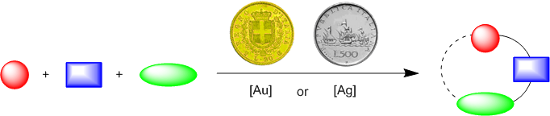
- recently, silver–NHC complexes were found to be valuable catalysts for this MCR. Their first application was reported by Wang and co-workers in 2008 [12], who developed a polystyrene-supported NHC–Ag(I) complex as an efficient catalyst for the A3-coupling under solvent-free conditions, at room temperature

Graphical Abstract

Scheme 1: General reaction mechanism for Ag(I)-catalyzed A3-coupling reactions.

Scheme 2: A3-coupling reaction catalyzed by polystyrene-supported NHC–silver halides.

Figure 1: Various NHC–Ag(I) complexes used as catalysts for A3-coupling.

Scheme 3: Proposed reaction mechanism for NHC–AgCl catalyzed A3-coupling reactions.

Scheme 4: Liu’s synthesis of pyrrole-2-carboxaldehydes 4.

Scheme 5: Proposed reaction mechanism for Liu’s synthesis of pyrrole-2-carboxaldehydes 4.

Scheme 6: Gold-catalyzed synthesis of propargylamines 1.

Scheme 7: A3-coupling catalyzed by phosphinamidic Au(III) metallacycle 6.

Scheme 8: Gold-catalyzed KA2-coupling.

Scheme 9: A3-coupling applied to aldehyde-containing oligosaccharides 8.

Scheme 10: A3-MCR for the preparation of propargylamine-substituted indoles 9.

Scheme 11: A3-coupling interceded synthesis of furans 12.

Scheme 12: A3/KA2-coupling mediated synthesis of functionalized dihydropyrazoles 13 and polycyclic dihydropyra...

Scheme 13: Au(I)-catalyzed entry to cyclic carbamimidates 17 via an A3-coupling-type approach.

Scheme 14: Proposed reaction mechanism for the Au(I)-catalyzed synthesis of cyclic carbamimidates 17.

Figure 2: Chiral trans-1-diphenylphosphino-2-aminocyclohexane–Au(I) complex 20.

Scheme 15: A3-coupling-type synthesis of oxazoles 21 catalyzed by Au(III)–salen complex.

Scheme 16: Proposed reaction mechanism for the synthesis of oxazoles 21.

Scheme 17: Synthesis of propargyl ethyl ethers 24 by an A3-coupling-type reaction.

Scheme 18: General mechanism of Ag(I)-catalyzed MCRs of 2-alkynylbenzaldehydes, amines and nucleophiles.

Scheme 19: General synthetic pathway to 1,3-disubstituted-1,2-dihydroisoquinolines.

Scheme 20: Synthesis of 1,3-disubstituted-1,2-dihydroisoquinolines 29.

Scheme 21: Synthesis of 1,3-disubstituted-1,2-dihydroisoquinolines 35 and 36.

Scheme 22: Rh(II)/Ag(I) co-catalyzed synthesis of 1,3-disubstituted-1,2-dihydroisoquinolines 40.

Scheme 23: General synthetic pathway to 2-amino-1,2-dihydroquinolines.

Scheme 24: Synthesis of 2-amino-1,2-dihydroquinolines 47.

Scheme 25: Synthesis of tricyclic H-pyrazolo[5,1-a]isoquinoline 48.

Scheme 26: Synthesis of tricyclic H-pyrazolo[5,1-a]isoquinolines 48.

Scheme 27: Cu(II)/Ag(I) catalyzed synthesis of H-pyrazolo[5,1-a]isoquinolines 48.

Scheme 28: Synthesis of 2-aminopyrazolo[5,1-a]isoquinolines 53.

Scheme 29: Synthesis of 1-(isoquinolin-1-yl)guanidines 55.

Scheme 30: Ag(I)/Cu(I) catalyzed synthesis of 2-amino-H-pyrazolo[5,1-a]isoquinolines 58.

Scheme 31: Ag(I)/Ni(II) co-catalyzed synthesis of 3,4-dihydro-1H-pyridazino[6,1-a]isoquinoline-1,1-dicarboxyla...

Scheme 32: Ag(I) promoted activation of the α-carbon atom of the isocyanide group.

Scheme 33: Synthesis of dihydroimidazoles 65.

Scheme 34: Synthesis of oxazoles 68.

Scheme 35: Stereoselective synthesis of chiral butenolides 71.

Scheme 36: Proposed reaction mechanism for the synthesis of butenolides 71.

Scheme 37: Stereoselective three-component approach to pirrolidines 77 by means of a chiral auxiliary.

Scheme 38: Stereoselective three-component approach to pyrrolidines 81 and 82 by means of a chiral catalyst.

Scheme 39: Synthesis of substituted five-membered carbocyles 86.

Scheme 40: Synthesis of regioisomeric arylnaphthalene lactones.

Scheme 41: Enantioselective synthesis of spiroacetals 96 by Fañanás and Rodríguez [105].

Scheme 42: Enantioselective synthesis of spiroacetals 101 by Gong [106].

Scheme 43: Synthesis of polyfunctionalized fused bicyclic ketals 103 and bridged tricyclic ketals 104.

Scheme 44: Proposed reaction mechanism for the synthesis of ketals 103 and 104.

Scheme 45: Synthesis of β-alkoxyketones 108.

Scheme 46: Synthesis of N-methyl-1,4-dihydropyridines 112.

Scheme 47: Synthesis of tetrahydrocarbazoles 115–117.

Scheme 48: Plausible reaction mechanism for the synthesis of tetrahydrocarbazoles 115–117.

Scheme 49: Carboamination, carboalkoxylation and carbolactonization of terminal alkenes.

Scheme 50: Oxyarylation of alkenes with arylboronic acids and Selectfluor as reoxidant.

Scheme 51: Proposed reaction mechanism for oxyarylation of alkenes.

Scheme 52: Oxyarylation of alkenes with arylsilanes and Selectfluor as reoxidant.

Scheme 53: Oxyarylation of alkenes with arylsilanes and IBA as reoxidant.
Simple two-step synthesis of 2,4-disubstituted pyrroles and 3,5-disubstituted pyrrole-2-carbonitriles from enones
- Murat Kucukdisli,
- Dorota Ferenc,
- Marcel Heinz,
- Christine Wiebe and
- Till Opatz
Beilstein J. Org. Chem. 2014, 10, 466–470, doi:10.3762/bjoc.10.44
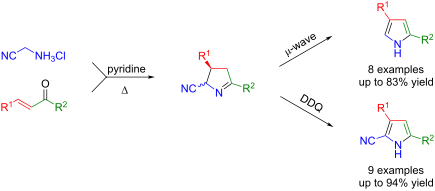
- . Gratifyingly, yield and purity of pyrrole 7a increased when 6a was heated with microwaves to 250 °C under air cooling of the reaction vessel without any additive under solvent-free conditions. The results of the application of these conditions to cyanopyrrolines 6a–j are summarized in Table 1. This compound

Graphical Abstract

Scheme 1: Synthesis and conversion of 3,4-dihydro-2H-pyrrole-2-carbonitriles 6.
Practical synthesis of aryl-2-methyl-3-butyn-2-ols from aryl bromides via conventional and decarboxylative copper-free Sonogashira coupling reactions
- Andrea Caporale,
- Stefano Tartaggia,
- Andrea Castellin and
- Ottorino De Lucchi
Beilstein J. Org. Chem. 2014, 10, 384–393, doi:10.3762/bjoc.10.36

- variants have been introduced to perform efficiently this reaction with regard to synthetic and industrial aspects, including protocols in aqueous media [14][15][16][17], amine-free [18] or solvent-free conditions [19]. Moreover efficient reusable Pd catalysts [20][21][22][23][24] and even palladium-free

Graphical Abstract

Scheme 1: Conventional (from the left) and decarboxylative (from the right) Pd-catalyzed Sonogashira coupling...

Scheme 2: Protection of propiolic acid with acetone.



