


Search results
Search for "Wittig reaction" in Full Text gives 133 result(s) in Beilstein Journal of Organic Chemistry.
Reversible intramolecular photocycloaddition of a bis(9-anthrylbutadienyl)paracyclophane – an inverse photochromic system. (Photoactive cyclophanes 5)
Beilstein J. Org. Chem. 2009, 5, No. 20, doi:10.3762/bjoc.5.20
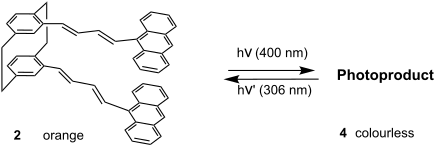
- structure and photochromic properties of 2 are reported in this paper. Results and Discussion 1 Synthesis Compound 2 was prepared from dialdehyde 3 using the Wittig reaction, as outlined in Scheme 1, in 48% yield. Dialdehyde 3 wasobtained in five steps from [2.2]paracylophane, a commercial product, in 72
- % overall yield as described previously [19]. Therefore, the overall yield of 2 from the parent cyclophane was found tobe 35% on the gram scale. The Wittig reaction provides a mixture of cis and trans isomers, but the pure all-trans isomer was isolated by crystallization as orange crystals (see Experimental
- structure of 4 (1,4 : 2′,3′-cycloadduct). Preparation of 2 (last step), using the Wittig reaction. The preparation of 3 has been described in ref [19]. Angles between various partial planes in molecule 2 in the crystal. Supporting Information Supporting Information File 40: Thermal dissociation of


Convenient methods for preparing π-conjugated linkers as building blocks for modular chemistry
Beilstein J. Org. Chem. 2009, 5, No. 11, doi:10.3762/bjoc.5.11
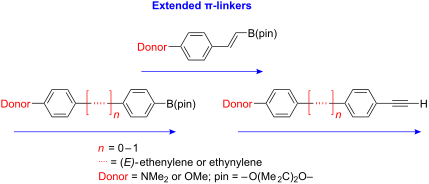
- and 4-bromobenzyl(triphenyl)phosphonium bromide [37] by the Wittig reaction [37][38] in 37 and 54% yields, respectively. In contrast to the Horner–Wadsworth–Emmons reaction, this procedure afforded both (E)- and (Z)-stilbenes that were isomerized by heating with traces of iodine in toluene to afford


Catalytic synthesis of (E)-α,β-unsaturated esters from aldehydes and 1,1-diethoxyethylene
Beilstein J. Org. Chem. 2009, 5, No. 3, doi:10.3762/bjoc.5.3
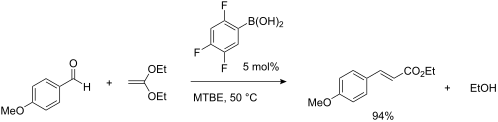
- high yielding synthesis of α,β-unsaturated esters from aldehydes and 1,1-diethoxyethylene was developed. Keywords: 1,1-diethoxyethylene; α,β-unsaturated esters; Introduction A number of reactions transforming aldehydes into α,β-unsaturated esters have been developed and especially Wittig reaction


A facile synthesis and fungicidal activities of 2-(alkylamino)-5,6-dimethylthieno[2,3-d]pyrimidin- 4(3H)-ones
Beilstein J. Org. Chem. 2008, 4, No. 49, doi:10.3762/bjoc.4.49

- activities against six kinds of fungi. Keywords: 2-(alkylamino)-5,6-dimethylthieno[2,3-d]pyrimidin-4(3H)-one; aza-Wittig reaction; fungicidal activity; synthesis; Introduction Over the past ten years, aza-Wittig reactions of functionalized iminophosphoranes with isocyanates have been applied to produce
- interested in the synthesis of a series of new heterocyclic compounds via aza-Wittig reaction of α- or β-(ethoxycarbonyl)-substituted iminophosphoranes with aromatic isocyanates and subsequent reaction with various nucleophiles under mild conditions [11][12][13][14]. Herein we wish to report an efficient


Recent progress on the total synthesis of acetogenins from Annonaceae
Beilstein J. Org. Chem. 2008, 4, No. 48, doi:10.3762/bjoc.4.48
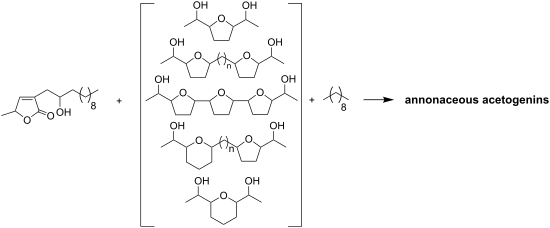
- utilizing Wu’s own methodology. Wittig reaction of the aldehyde 37 and the Wittig reagent 38 furnished the butenolide unit 39. The tetrahydrofuran part of 22 was constructed from D-glucose via epoxide 40. The entire carbon skeleton of 41 was constructed by Pd(0)-catalyzed cross-coupling reaction between 39
- building block 45 by means of the Sharpless AD reaction and cyclization catalyzed by Co(modp)2 (the Mukaiyama epoxidation method) under mild reaction conditions. The connection of the THF unit 46 with the γ-lactone segment 47 was carried out by means of a Wittig reaction. The target compound 42 had
- conditions resulted in a smooth conversion of the starting material into THF 89. Triol (+)-90 was obtained with lipase Amano AK desymmetrization. For the appropriate side chain attachment, the termini were differentiated to give lactone (−)-91. Reduction of (−)-91 followed by a Wittig reaction yielded fully


End game strategies towards the total synthesis of vibsanin E, 3-hydroxyvibsanin E, furanovibsanin A, and 3-O-methylfuranovibsanin A
Beilstein J. Org. Chem. 2008, 4, No. 34, doi:10.3762/bjoc.4.34

- lithium aluminium hydride proceded smoothly, however, global oxidation caused significant problems yielding only very low amounts of aldehyde 52, which was not enough to attempt the Wittig reaction with 45 (Scheme 8). In the view of the diasppointing results obtained above (Scheme 8) all attention was


Flexible synthesis of poison- frog alkaloids of the 5,8-disubstituted indolizidine- class. II: Synthesis of (-)-209B, (-)-231C, (-)-233D, (-)-235B", (-)-221I, and an epimer of 193E and pharmacological effects at neuronal nicotinic acetylcholine receptors
Beilstein J. Org. Chem. 2007, 3, No. 30, doi:10.1186/1860-5397-3-30
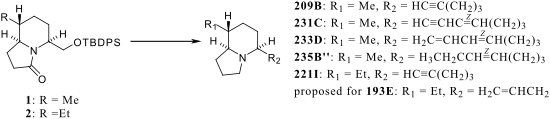
- (-)-231C, (-)-221I and (-)-epi-193E on α4β2 and α7 nicotinic receptors, the most abundant subtypes in the mammalian brain. [4] Results and Discussion Reduction of the lactam 1 [1] with LiAlH4 followed by Swern oxidation of the resulting alcohol and Wittig reaction gave the olefin 3 in 78% overall yield
- (Scheme 1). Hydrogenation of the double bond in 3 with 10% Pd/C provided (-)-209B, whose spectral data were identical with reported values. [7] The lactam 1 was also converted to the alcohol 4, [1] which was transformed into (-)-235B" by Swern oxidation followed by Wittig reaction under high dilution and
- 'salt free' conditions (Scheme 1). The spectral data of synthetic (-)-235B" were identical with reported values. [8][9] Indolizidines (-)-231C [10] and (-)-233D [10] were synthesized from common intermediate 5 prepared from the alcohol 4. Thus, the Swern oxidation of 4 and then the Wittig reaction of


Flexible synthetic routes to poison- frog alkaloids of the 5,8-disubstituted indolizidine- class I: synthesis of common lactam chiral building blocks and application to the synthesis of (-)-203A, (-)-205A, and (-)-219F
Beilstein J. Org. Chem. 2007, 3, No. 29, doi:10.1186/1860-5397-3-29
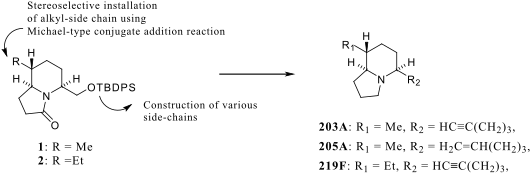
- , CHCl3)) suggest that the absolute stereochemistry of natural 203A is 5S, 8R, 9S. We achieved the total synthesis of (-)-205A starting from 1 via 13 (Scheme 3). Lithium aluminum hydride reduction of 13 followed by Swern oxidation and Wittig reaction of the resulting aldehyde gave the olefin 17
- , followed by an Arndt-Eistert sequence of the resulting carboxylic acid. Reduction of both carbonyl groups in 14 with lithium aluminum hydride provided the alcohol, which was directly used for formation of Z-iodoolefin 15. Thus, the Dess-Martin periodinane oxidation [24] of the alcohol, followed by Wittig
- reaction of the resulting aldehyde under Stork's reaction conditions, [25] gave the olefin. Purification by silica gel column chromatography afforded pure 15 in 60% isolated yield. The coupling reaction of 15 with TMS-acetylene under Sonogashira's conditions [26] gave rise to the product 16. Finally



Other Beilstein-Institut Open Science Activities



