Search results
Search for "cyclisation" in Full Text gives 189 result(s) in Beilstein Journal of Organic Chemistry.
Isocyanide-based multicomponent reactions towards cyclic constrained peptidomimetics
Beilstein J. Org. Chem. 2014, 10, 544–598, doi:10.3762/bjoc.10.50

- combination of deprotection and activation is also possible and is found in the literature as an Ugi Deprotection/Activation–Cyclisation (UDAC). In addition, other MCR-post-condensation reactions, especially for macrocycles, include intramolecular aryl couplings, amidations, SnAr reactions, nucleophilic


Concise, stereodivergent and highly stereoselective synthesis of cis- and trans-2-substituted 3-hydroxypiperidines – development of a phosphite-driven cyclodehydration
Beilstein J. Org. Chem. 2014, 10, 369–383, doi:10.3762/bjoc.10.35
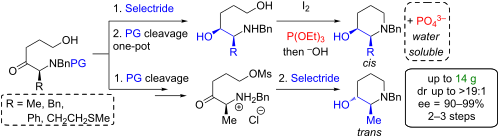
- , initial deprotection of D (to liberate the Lewis-basic –NHBn moiety) and subsequent reduction passing through a Cram-chelate transition state [54] should deliver the anti-amino alcohol C. After subsequent cyclisation trans-B would result. Noteworthy, this strategy would completely circumvent
- significant amounts in the cyclisation of amino diol 9c. This is explained by steric shielding of the amino function (→ decreased nucleophilicity) through the bulky phenyl group in α-position (compared to the less demanding Me and Bn side chains R of substrates 9a and 9c). As the R-substituent is in the β
- Et3N/CH2Cl2 can be attributed to the lower solubility of iodine in Et3N (which leads to a slower and thus more selective reaction) and general base catalysis: Simultaneous deprotonation (through Et3N) in the cyclisation step strongly favours the desired reaction pathway to piperidines 11. Due to this


Intermediates in monensin biosynthesis: A late step in biosynthesis of the polyether ionophore monensin is crucial for the integrity of cation binding
Beilstein J. Org. Chem. 2014, 10, 361–368, doi:10.3762/bjoc.10.34
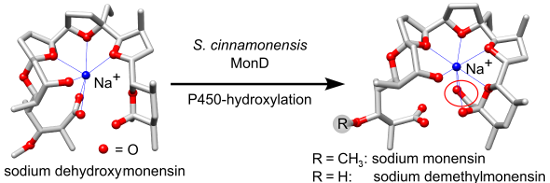
- initially-formed (E,E,E)-triene undergoes stereospecific epoxidation to a tri-epoxide and subsequent ring-opening and cyclisation to generate the polyether rings. This model has been confirmed and extended (Scheme 1) by the results of more recent work in which specific genes have been disrupted or deleted
- cyclisation is not initiated before the full-length chain is produced, and that the initial product of the PKS is a linear enzyme-bound (E,E,E)-triene, “premonensin” (2) [19]. The monensin PKS does not have a conventional C-terminal thioesterase domain that would catalyse polyketide chain release, and instead
- MonACPX, catalysed by the unusual thioesterase MonCII [20]. The evidently tight coupling between PKS-mediated chain assembly and oxidative cyclisation has hampered efforts to unravel the exact sequence and mechanism of events in the late stages of the biosynthesis. Indirect but suggestive evidence for the



Efficient synthesis of dihydropyrimidinones via a three-component Biginelli-type reaction of urea, alkylaldehyde and arylaldehyde
Beilstein J. Org. Chem. 2013, 9, 2846–2851, doi:10.3762/bjoc.9.320
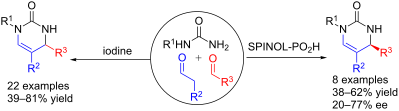
- condensation of imine 5 with substituted acetaldehyde 2. This could then undergo an iodine-catalytic intramolecular cyclisation to afford the final dihydropyrimidinone 4. Based on the observations above, a preliminary investigation on the catalytic asymmetric version was performed. Recently, our group has


[2H26]-1-epi-Cubenol, a completely deuterated natural product from Streptomyces griseus
Beilstein J. Org. Chem. 2013, 9, 2841–2845, doi:10.3762/bjoc.9.319
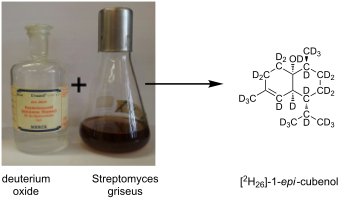
- the homomonoterpene 1 proceeds by S-adenosylmethionine-dependent methylation of GPP followed by a cyclisation reaction [3][4][5]. For biosynthetic studies on secondary metabolites isotopically labelled precursors are frequently used. Historically, the usage of radiolabelled compounds was most



Modulating NHC catalysis with fluorine
Beilstein J. Org. Chem. 2013, 9, 2812–2820, doi:10.3762/bjoc.9.316
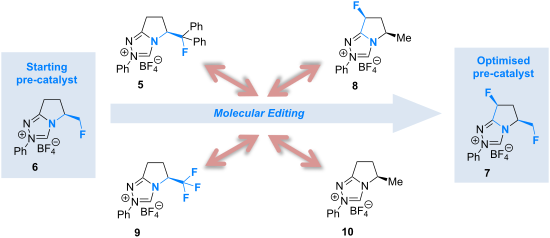
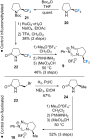
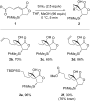
- the corresponding lactam 13 using a Ru(III)/NaIO4 system proceeded smoothly, followed by TFA-mediated Boc deprotection to yield 14 (75%, 2 steps). Reduction of the methyl ester to the primary alcohol (15, 18%), and subsequent protection as the TBDMS ether delivered the cyclisation substrate 16 in good
- yield (92%). A three step, one pot sequence consisting of methylation, treatment with phenylhydrazine and subsequent cyclisation furnished the triazolium salt 17 in 76% yield (3 steps). Finally, DAST-mediated TBDMS deprotection/deoxyfluorination completed the synthetic sequence to give 7 in 45% yield
- lactam 19 (21% over 2 steps) in preparation for the cyclisation sequence. As previously described, successive treatment with the Meerwein salt, phenylhydrazine and methyl orthoformate yielded the target triazolium salt 8 in 61% over 3 steps. The pre-catalysts 9 and 10 required for control experiments




Stereoselectively fluorinated N-heterocycles: a brief survey
Beilstein J. Org. Chem. 2013, 9, 2696–2708, doi:10.3762/bjoc.9.306
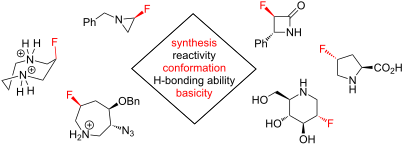
- the cyclisation event. 6.4 Enantioselective fluorocyclisation The lack of diastereoselectivity seen in Scheme 7 is attributable to the fluorination event preceding the cyclisation event, and this is a significant issue which inhibits the further development of diastereoselective processes. However
- synthesis this reagent fulfils both functions at different stages: thus, the target 78 is achieved from N-(tert-butylsulfinyl)imine 75 through a nucleophilic addition/radical cyclisation sequence. The selectivity during the radical cyclisation (77→78) can be explained by the Beckwith–Houk transition-state
- illustrates a strategy for achieving stereoselectivity in C–F bond formation. The racemic β-lactam 4b was synthesised as a single diastereoisomer from the Schiff base 79 (Scheme 11), by a Reformatsky addition followed by spontaneous cyclisation; removal of the amine protecting group under oxidative conditions


IBD-mediated oxidative cyclization of pyrimidinylhydrazones and concurrent Dimroth rearrangement: Synthesis of [1,2,4]triazolo[1,5-c]pyrimidine derivatives
Beilstein J. Org. Chem. 2013, 9, 2629–2634, doi:10.3762/bjoc.9.298

- ]pyrimidines by the oxidative cyclisation of benzothieno[2,3-d]pyrimidine hydrazones. The investigation has also suggested the important ability as inhibitors of Shiga toxin trafficking for protecting HeLa cells [9]. The wide range of biological activities shown by various triazolopyrimidines encouraged
- an efficient synthesis of new [1,2,4]triazolo[1,5-c]pyrimidine derivatives from hypervalent iodine (IBD)-mediated oxidative cyclisation of aldehyde pyrimidinylhydrazones and consecutive Dimroth rearrangement in relatively good yields under very mild conditions. Results and Discussion The
- feasible oxidative cyclisation to afford novel triazolopyrimidines. We initiated our investigation by examining the oxidative cyclization of 4a with iodobenzenediacetate (IBD) as an oxidant (Table 2). Thus, 4a was treated with one equivalent of freshly prepared IBD in dichloromethane at room temperature


An overview of the synthetic routes to the best selling drugs containing 6-membered heterocycles
Beilstein J. Org. Chem. 2013, 9, 2265–2319, doi:10.3762/bjoc.9.265
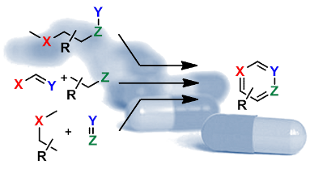
- -methylpiperidine (1.21) using zeolites and easily aromatised by catalytic dehydrogenation to 3-picoline in 78% overall yield (Scheme 4) [26]. The overall processing sequence is highly energy-efficient (coupling of the endothermic cyclisation with the exothermic dehydration gives a reasonable energy balance). In
- addition the ammonia liberated during the cyclisation step is later consumed in the ammoxidation of the 3-picoline to the corresponding 3-cyanopyridine (Scheme 3). The value of substituted 3-picoline precursors is illustrated in the synthesis of clarinex (1.22, Desloratadine, Scheme 5), a dual antagonist
- the pyridine ring therefore yielding the corresponding piperidine 2.63. A base-mediated Dieckmann cyclisation and Krapcho decarboxylation [77] then furnishes 2.60. Traditionally, the reduction of 2.60 to prepare 2.59 can be carried out under fairly mild hydrogenation conditions that ultimately produce


Synthesis and characterization of novel bioactive 1,2,4-oxadiazole natural product analogs bearing the N-phenylmaleimide and N-phenylsuccinimide moieties
Beilstein J. Org. Chem. 2013, 9, 2202–2215, doi:10.3762/bjoc.9.259
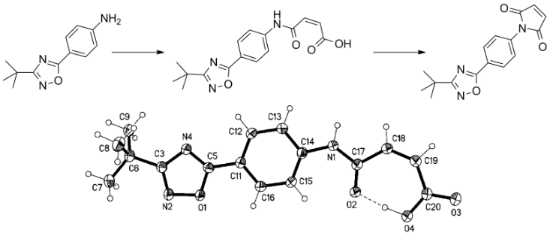
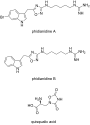
- ′-carbonyldiimidazole (CDI). In the first step the amidoxime is O-acylated with the activated derivative in a condensation reaction. The O-acylated amidoxime can be isolated or it can immediately undergo the cyclisation to the heterocyclic oxadiazole ring. This cyclodehydration reaction takes place by heating to



Synthesis and antibacterial activity of monocyclic 3-carboxamide tetramic acids
Beilstein J. Org. Chem. 2013, 9, 1899–1906, doi:10.3762/bjoc.9.224

- ) carboxamides. Results and Discussion Synthesis The synthesis of the required tetramic acid systems 2a–g (Scheme 1), 2h (Scheme 2) and 3a–f (Scheme 3) was achieved by Dieckmann cyclisation of the required N-alkyl-N-malonyl glycine (readily prepared from glycine). A similar strategy for the base-mediated
- cyclisation of N-acetoacetylamino acid esters leading to 3-acetyltetramates has been reported, which give N–H rather than N-alkyl systems [15][16][17]. Tetramate 7 was obtained from amino acid 6, except that the key intermediate 5 was obtained by reductive amination (Scheme 2) of (R)-citronellal (4), which
- generality [20][21]. We found that an approach based upon direct acylation of methyl thioethers 8a,b (these were readily obtained from the required N-acylmethionine by DCC/DMAP coupling with Meldrum’s acid and cyclisation under reflux) was possible, which made use of the high acidity of the tetramate system


Gold(I)-catalysed one-pot synthesis of chromans using allylic alcohols and phenols
Beilstein J. Org. Chem. 2013, 9, 1797–1806, doi:10.3762/bjoc.9.209
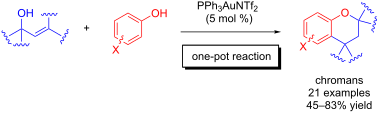
- structural motifs found in a variety of important biologically active natural products such as vitamin E and flavanoids [1][2][3][4][5]. One approach towards chromans [6][7][8][9][10][11][12], which is biosynthetically inspired, is the Friedel–Crafts allylation [13] of phenols followed by cyclisation of the
- necessary to force the in situ cyclisation of 9 to 8. Next, lower equivalents of phenol 5 were investigated. Unfortunately, dropping the equivalents of phenol also appears to be detrimental to chroman formation: only Friedel–Crafts products 9 and 10 are observed with 2 or 1 equivalents of phenol (Table 1
- (Table 3, entries 7 and 8). Substitution at the β-position, however, is not tolerated: the reaction stops at the Friedel–Crafts stage (9t), and is reluctant to undergo further cyclisation to the desired chroman (Table 3, entry 9). Having investigated a series of tertiary allylic alcohols in entries 1–9


Computational study of the rate constants and free energies of intramolecular radical addition to substituted anilines
Beilstein J. Org. Chem. 2013, 9, 1620–1629, doi:10.3762/bjoc.9.185

- −1) and the B3LYP geometries (10.67 kcal mol−1). The total influence of the geometries and vibrations on ΔG‡ is therefore small (0.1–0.2 kcal mol−1 at most) and this technical detail cannot explain the discrepancy of the CCSD(T) barrier and the experimental value. The 5-exo cyclisation of 5-hexenyl


Development of an additive-controlled, SmI2-mediated stereoselective sequence: Telescoped spirocyclisation, lactone reduction and Peterson elimination
Beilstein J. Org. Chem. 2013, 9, 1443–1447, doi:10.3762/bjoc.9.163

- to “switch on” individual steps mediated by the electron transfer reagent. The sequence involves the use of two activated SmI2 reagent systems and a silicon stereocontrol element that exerts complete diastereocontrol over the cyclisation and is removed during the final stage of the sequence by
- Peterson elimination. The approach allows functionalised cyclopentanols containing two vicinal quaternary stereocentres to be conveniently prepared from simple starting materials. Keywords: cyclisation; free radical; Peterson elimination; reduction; samarium; telescoped process; Introduction Samarium
- manuscript, we report studies on SmI2-mediated cyclisation and lactone reduction that culminate in a “telescoped” sequence, i.e., a sequence of steps carried out on a single reaction mixture by the sequential addition of various reagents. In the sequence, additives are used with SmI2 to “switch on




Anionic cascade reactions. One-pot assembly of (Z)-chloro-exo-methylenetetrahydrofurans from β-hydroxyketones
Beilstein J. Org. Chem. 2013, 9, 1319–1325, doi:10.3762/bjoc.9.148

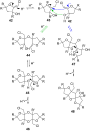
- addition of 9 then affords the intermediate 10, which undergoes a 5-exo-dig cyclisation, ultimately yielding the observed (Z)-chloro-exo-methylenetetrahydrofuran 6. This structural motif constitutes the core of several biologically active compounds, including antimicrobial agents, fungicides and





Interplay of ortho- with spiro-cyclisation during iminyl radical closures onto arenes and heteroarenes
Beilstein J. Org. Chem. 2013, 9, 1083–1092, doi:10.3762/bjoc.9.120
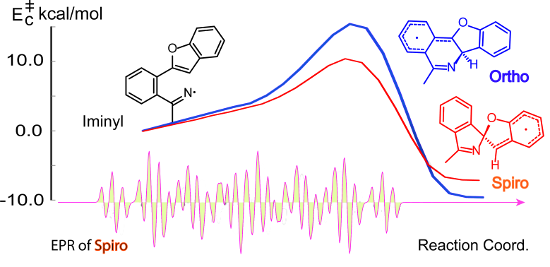
- spectroscopy. Iminyls with suitably placed arene or heteroarene acceptors underwent cyclisations yielding phenanthridine-type products from ortho-additions. For benzofuran and benzothiophene acceptors, spiro-cyclisation predominated at low temperatures, but thermodynamic control ensured ortho-products
- , benzofuro- or benzothieno-isoquinolines, formed at higher temperatures. Estimates by steady-state kinetic EPR established that iminyl radical cyclisations onto aromatics took place about an order of magnitude more slowly than prototypical C-centred radicals. The cyclisation energetics were investigated by
- DFT computations, which gave insights into factors influencing the two cyclisation modes. Keywords: cyclisation; EPR spectroscopy; free radicals; heterocycles; oxime carbonates; Introduction Radical cyclisations onto aromatic acceptors take place readily, even though disruption of the 6π-electron




Some aspects of radical chemistry in the assembly of complex molecular architectures
Beilstein J. Org. Chem. 2013, 9, 557–576, doi:10.3762/bjoc.9.61

- illustration is provided by the central transformation in the total synthesis of (–)-dendrobine (4), where the carbamyl radical cyclisation is followed by rupture of the cyclobutane ring [8][9]. This operation, displayed in Scheme 1, starts with benzoate 1 and results in the formation of the carbon–nitrogen
- quaternary centres. The chlorine atom in 8 is deliberately introduced in order to direct the second cyclisation towards the 6-endo mode. The chloride in intermediate 9 is now aliphatic and not vinylic as in precursor 8; it is therefore more susceptible to attack by stannyl radicals and the addition of an
- extra equivalent of tributylstannane ensures its in situ reductive removal. This domino radical cyclisation represents, in fact, a general strategy for the construction of indolizidines and pyrrolizidines, which constitute the core structure of numerous alkaloids. For pyrrolizidines, one needs simply to













Efficient synthesis of β’-amino-α,β-unsaturated ketones
Beilstein J. Org. Chem. 2013, 9, 486–495, doi:10.3762/bjoc.9.52

- reaction of chiral imines with enolates derived from Weinreb amides [13][14]. In previous work on the asymmetric synthesis of 2,6-disubstituted piperidines by C–N bond formation, we demonstrated that intramolecular aza-Michael ”type” cyclisation [15] using a β'-carbamate-α,β-unsaturated ketone


Alkyne hydroarylation with Au N-heterocyclic carbene catalysts
Beilstein J. Org. Chem. 2013, 9, 246–253, doi:10.3762/bjoc.9.29

- selectivity compared to the previously published complex AuCl(PPh3). Preliminary results on intramolecular hydroarylations using this catalytic system indicate, however, that alkyne hydration by traces of water may become a serious competing reaction. Keywords: alkyne; C–H functionalization; cyclisation
- ]. In such reactions, often simply termed cyclisation reactions, the arene and the alkyne are linked through a tether, the nature of which can range from simple alkyl groups to ether, amino, ester or amido groups; depending on the nature and length of the tether, different kinds of unsaturated poly
- the use of gold species as catalysts for alkyne hydroarylation is still quite limited. A substantial number of reports on the intramolecular cyclisation of arenes with tethered alkyne moieties using gold(I) or, to a lesser extent, gold(III) catalysts can be found in the literature [35][36][37][38][39


Radical zinc-atom-transfer-based carbozincation of haloalkynes with dialkylzincs
Beilstein J. Org. Chem. 2013, 9, 236–245, doi:10.3762/bjoc.9.28
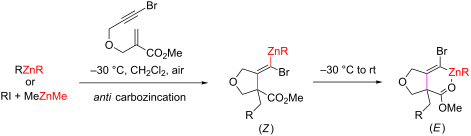
- consistent with our anticipated zinc atom radical transfer mechanism (Scheme 1) and can be rationalized according to the following scenario (Scheme 5). The process involves the initial 1,4-addition of radical R to the starting enoate and the subsequent 5-exo-dig cyclisation of enoxy radical 14 to provide α


Reactions of salicylaldehyde and enolates or their equivalents: versatile synthetic routes to chromane derivatives
Beilstein J. Org. Chem. 2012, 8, 2166–2175, doi:10.3762/bjoc.8.244

- temperature to give chalcone 14. To set the stage for the cyclisation reaction, the trans carbon–carbon double bond must either be isomerized to the cis form or completely reduced. In this case, chalcone 14 was treated with H2 in the presence of a catalytic amount of Pd to give intermediate 15 in 99% yield


Flow photochemistry: Old light through new windows
Beilstein J. Org. Chem. 2012, 8, 2025–2052, doi:10.3762/bjoc.8.229


Hybrid super electron donors – preparation and reactivity
Beilstein J. Org. Chem. 2012, 8, 994–1002, doi:10.3762/bjoc.8.112
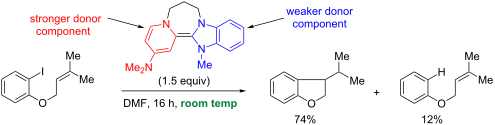
- to an iodoarene; single electron transfer would afford an aryl radical that would undergo cyclisation efficiently [17], while two-electron transfer to afford an aryl anion would afford an aryl anion that would not cyclise in DMF as solvent [18]. The reaction with 30 was conducted under slightly







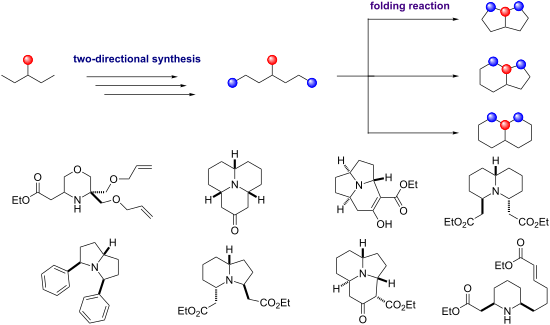
Two-directional synthesis as a tool for diversity-oriented synthesis: Synthesis of alkaloid scaffolds
Beilstein J. Org. Chem. 2012, 8, 850–860, doi:10.3762/bjoc.8.95
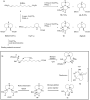
- reactivity of four N-Boc-aminoalkenes containing α,β-unsaturated ester groups (1–4, Scheme 1), as substrates for intramolecular pairing reactions. The N-Boc protecting group was chosen to give the potential for deprotection to be carried out in tandem with the Lewis acid catalysed cyclisation reactions by
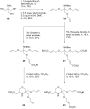
- chloroacetamide with thiourea gave the free amine [21], which was then protected with Boc anhydride. Finally, cross metathesis with ethyl acrylate furnished the desired compound 4 in 24% overall yield. Cyclisation reactions The first attempts at the tandem Boc-deprotection/bicyclisation of these substrates were
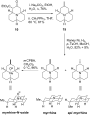
- mixture of diastereomers. The cyclisation of 1 gave pyrrolizidine 5 as a mixture of 4,10-trans-7,10-trans (trans-5) (42%) and 4,10-cis-7,10-trans (cis-5) (28%) isomers, which proved to be separable by flash chromatography. The stereochemistry of cis-5 was confirmed by analogy to known 1H and 13C NMR




Carbohydrate-auxiliary assisted preparation of enantiopure 1,2-oxazine derivatives and aminopolyols
Beilstein J. Org. Chem. 2012, 8, 662–674, doi:10.3762/bjoc.8.74
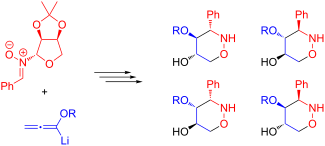
- hydroxylated 2H-1,2-oxazine derivatives is presented utilizing the [3 + 3] cyclisation of lithiated alkoxyallenes and an L-erythrose-derived N-glycosyl nitrone as precursors. This key step proceeded only with moderate diastereoselectivity, but allowed entry into both enantiomeric series of the resulting 3,6
- ][8], these nitrones very often furnish the corresponding products in a highly selective manner. In this context, reactions of lithiated alkoxyallenes with enantiopure nitrones are particularly of interest since they lead by a [3 + 3] cyclisation process to 1,2-oxazine derivatives with excellent
- were not isolated, but (in the presence of a drying agent) they underwent slow cyclisation in Et2O solution at room temperature to furnish the desired 1,2-oxazine derivative as a mixture of separable diastereomers (3S)-3a and (3R)-3a in 25% and 8% yield, respectively (Table 1, entry 3). The 1,2