Search results
Search for "cysteine" in Full Text gives 136 result(s) in Beilstein Journal of Organic Chemistry.
Synthetic glycopeptides and glycoproteins with applications in biological research
Beilstein J. Org. Chem. 2012, 8, 804–818, doi:10.3762/bjoc.8.90
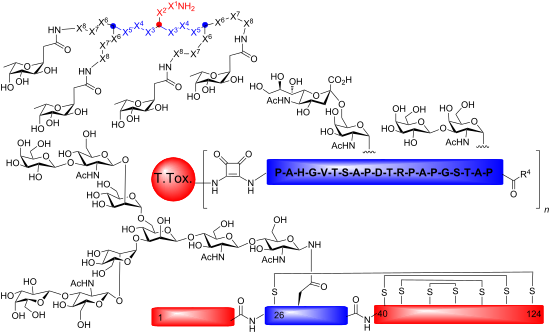
- cysteine, followed by a S→N acyl shift. The development of a variant of NCL, namely expressed protein ligation (EPL), has further made it possible to efficiently prepare large proteins without the size limitations set by ordinary peptide synthesis [45]. Bertozzi and co-workers introduced the NCL and EPL
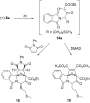
- Fmoc-SPPS followed by sequential NCL [51]. The N-glycopeptide fragment RNase 26–39 (17) was prepared with a thioester in the C-terminal and a thiazolidine protected cysteine at the N-terminus. The chemical ligation was performed by coupling of the N-glycopeptide thioester RNase 26–39 (17) and the
- expressed protein fragment 40–124 (18) containing a N-terminal cysteine, employing thiophenol and tris(2-carboxyethyl)phosphine (TCEP). The obtained RNase fragment 26–124 (19) was then treated with N-methoxyamine (0.2 M, pH 3–4, 4 h) to remove the protecting group on the N-terminal cysteine. Ligation of the


Mutational analysis of a phenazine biosynthetic gene cluster in Streptomyces anulatus 9663
Beilstein J. Org. Chem. 2012, 8, 501–513, doi:10.3762/bjoc.8.57
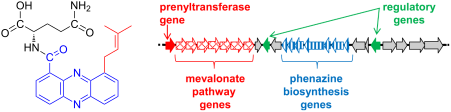
- as = +16.8 (c = 0.33, MeOH). Endophenazine E is a new natural product. The conjugation of a phenazine to N-acetylcysteine has been described previously [17]. In that case, conjugation occurred through the thiol group of cysteine and led to the loss of the antibacterial activity of the phenazine. A


Intramolecular carbenoid ylide forming reactions of 2-diazo-3-keto-4-phthalimidocarboxylic esters derived from methionine and cysteine
Beilstein J. Org. Chem. 2012, 8, 433–440, doi:10.3762/bjoc.8.49
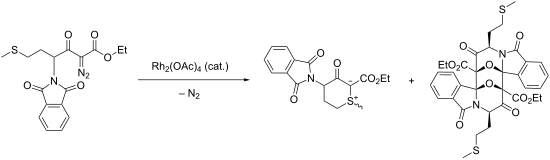
- Synthesis of diazoesters The 2-diazo-3-oxo-4-phthalimidocarboxylic esters 8a–c were prepared from L-methionine (5a), S-benzyl-L-cysteine (5b) and S-allyl-L-cysteine (5c), respectively, in a three-step sequence (Scheme 3) applied by us previously for other α-aminoacids [18]. Acids 5a–c were converted into
- rotation value for N,N-phthaloyl-L-methionine (6a), but racemisation occurred to a significant extent in the case of S-benzyl-N,N-phthaloyl-L-cysteine (6b) (Supporting Information File 1). Practically complete racemisation took place during conversion of N-protected aminoacids 6a–c to the β-ketoesters 7a–c
- ] cycloaddition with the dipolarophiles NPI and DMAD (notice that carbonyl ylide dimer 13a also results from an intermolecular cycloaddition reaction). With the cysteine-derived diazoesters 8b and c, on the other hand, it appears that the formation of the five-membered cyclic sulfonium ylides 12b and c and of the



Imidazole as a parent π-conjugated backbone in charge-transfer chromophores
Beilstein J. Org. Chem. 2012, 8, 25–49, doi:10.3762/bjoc.8.4
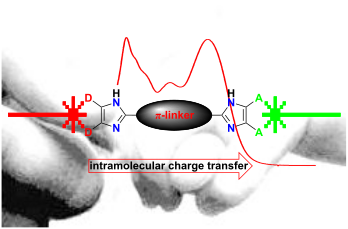
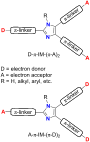
- (Figure 5, Table 3). Imidazoles 12 (DIYSP, δ = 41 GM, [38][39]) and 13 (FD3, δ = 1556 GM, [40]) were developed as two-photon absorbing and fluorescent A-π-A’ chromophores, which undergo photopolymerization or can be applied as fluorescent sensors for (homo)cysteine. Donor 4,5-disubstituted imidazole




Natural product biosyntheses in cyanobacteria: A treasure trove of unique enzymes
Beilstein J. Org. Chem. 2011, 7, 1622–1635, doi:10.3762/bjoc.7.191
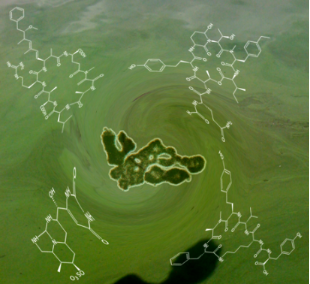
- -type monooxygenases encoded by the cluster, HctG or HctH, to 2,3-dihydroxyisovaleric acid. Two other NRPS modules contain all the required domains for adenylation and heterocyclization of cysteine, and an FMN-dependent oxidase domain, which is likely involved in thiazole ring formation. The cluster
- multidrug resistance [59]. The patellamide gene cluster consists of seven genes, expression of which in E. coli leads to the production of the peptides [59]. Heterocyclization of serine, cysteine and threonine, respectively is catalyzed by the heterocyclase PatD [60]. In contrast to other heterocyclases
- of bacteria. The characteristic feature of the group is lanthionine bridges, which are formed by dehydration of serine or threonine followed by intramolecular addition of cysteine thiols to the resulting dehydro amino acids. Lantipeptides exhibit a variety of bioactivities, in particular


Ratiometric fluorescent probe for enantioselective detection of D-cysteine in aqueous solution
Beilstein J. Org. Chem. 2011, 7, 1508–1515, doi:10.3762/bjoc.7.176

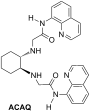
- enantioselective detection of cysteine in 99:1 buffered HEPES:ACN solutions. Under the measuring conditions, the sensor demonstrates high selectivity toward Cys against Hcy and GSH, and an enantioselectivity of 3.35 can be achieved for antipodal forms of Cys. Keywords: chemosensor; D-cysteine; enantioselectivity
- ; fluorescence; ratiometric; Introduction The rapid, sensitive, and selective sensing of biologically relevant thiols including cysteine (Cys), homocysteine (Hcy) and glutathione (GSH) has attracted significant interest in the sensor community (Figure 1) [1]. All three of these thiols are present in living
- ratiometric fluorescent chemosensors for the detection of thiols have been constructed [29][30][31]. Recently, on the basis of a native chemical-ligation reaction, Lin and coworkers reported a FRET-based probe suitable for ratiometric imaging of cysteine in living cells [31]. Therefore, it is a challenging




A novel high-yield synthesis of aminoacyl p-nitroanilines and aminoacyl 7-amino-4-methylcoumarins: Important synthons for the synthesis of chromogenic/fluorogenic protease substrates
Beilstein J. Org. Chem. 2011, 7, 1030–1035, doi:10.3762/bjoc.7.117

- removal of the Boc protecting group and oxidation of the free amino group to the nitro group [13]. This method, however, is not applicable to methionine, tyrosine, tryptophan and cysteine, all of which are sensitive to the oxidation conditions used. As an alternative, Nα-protected amino acids were used to
- -phthalaldehyde/Nα-tert-butyloxycarbonyl-L-cysteine and HPLC analysis, and we concluded that the obtained amide product contained a small amount (1.7%) of the D-isomer resulting from the first step of carboxylate activation rather than the last two steps of selenocarboxylate generation and amidation [20]. In

Photoinduced electron-transfer chemistry of the bielectrophoric N-phthaloyl derivatives of the amino acids tyrosine, histidine and tryptophan
Beilstein J. Org. Chem. 2011, 7, 518–524, doi:10.3762/bjoc.7.60
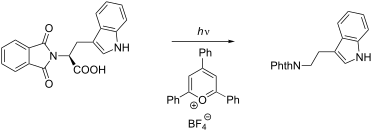
- cysteine and S-methyl cysteine derivatives [8]. Other proteinogenic amino acids that, in principle, should also be able to show bielectrophoric behavior with aromatic side chains similar to phenylalanine are tyrosine, histidine and tryptophan. The photochemistry of the phthalimide derivatives of these


pH-Responsive chromogenic-sensing molecule based on bis(indolyl)methene for the highly selective recognition of aspartate and glutamate
Beilstein J. Org. Chem. 2011, 7, 218–221, doi:10.3762/bjoc.7.29
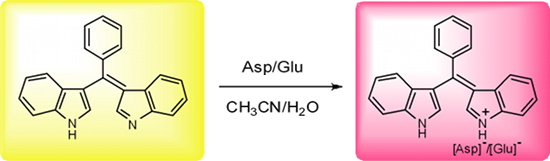
- observed upon addition of cysteine. On the other hand, no noticeable changes in color and absorption spectra were observed in the presence of various neutral amino acids and basic amino acids under the same conditions (even at much higher amino acids concentrations), which means that the receptor 1
- the protonated receptor [H2L]+. For cysteine, due to its slight acidity compared to neutral and basic amino acids, it may also partly protonate 1, however, the spectral change observed does not achieve the same level as the acidic amino acids even in the presence of 100 equiv of cysteine. On the other


The allylic chalcogen effect in olefin metathesis
Beilstein J. Org. Chem. 2010, 6, 1219–1228, doi:10.3762/bjoc.6.140
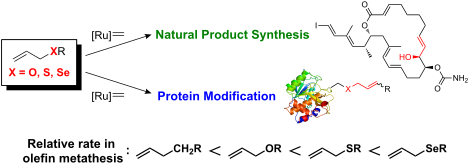
- and S-pentenyl cysteine (21b and 21c, respectively), failed to work under identical conditions in aqueous media (Scheme 7a) [17]. In order to compare the relative CM reactivity between other allylic heteroatom derivatives, further studies were carried out on the CM of allyl benzyl ether (23) and allyl


Molecular recognition of organic ammonium ions in solution using synthetic receptors
Beilstein J. Org. Chem. 2010, 6, No. 32, doi:10.3762/bjoc.6.32