


Search results
Search for "desilylation" in Full Text gives 134 result(s) in Beilstein Journal of Organic Chemistry.
Synthesis of glycoconjugate fragments of mycobacterial phosphatidylinositol mannosides and lipomannan
Beilstein J. Org. Chem. 2011, 7, 369–377, doi:10.3762/bjoc.7.47

- remaining hydroxyl groups afforded the glycoside 13, which was desilylated with HF·pyridine complex to yield 14. This chemoselective transformation uses conditions that are similar to those reported by Tam et al. [23], and result in desilylation in a significantly shorter period than that previously


Synthesis of 6-PEtN-α-D-GalpNAc-(1–>6)-β-D-Galp-(1–>4)-β-D-GlcpNAc-(1–>3)-β-D-Galp-(1–>4)-β-D-Glcp, a Haemophilus influenzae lipopolysacharide structure, and biotin and protein conjugates thereof
Beilstein J. Org. Chem. 2010, 6, 704–708, doi:10.3762/bjoc.6.80
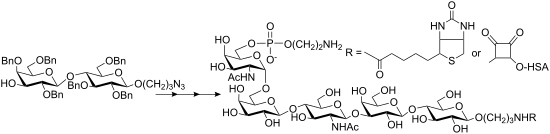
- thioglycoside 4 [14] yielded the 6-O-silylated compound 5 (92%), benzylation of which gave donor 6 (85%). A benzyl group in the 4-position was preferred to an ester group to avoid the risk of acyl migration during subsequent reactions; desilylation, glycosidation and phosphorylation. 3II,4II-Diols of lactose


Polar tagging in the synthesis of monodisperse oligo(p-phenyleneethynylene)s and an update on the synthesis of oligoPPEs
Beilstein J. Org. Chem. 2010, 6, No. 57, doi:10.3762/bjoc.6.57
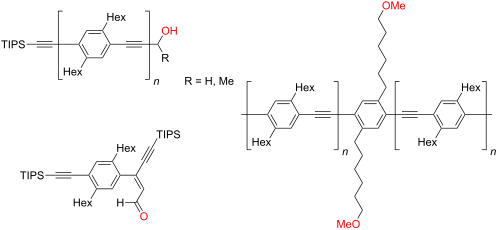
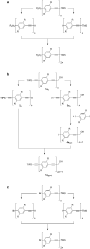
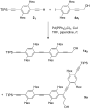
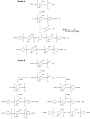
- synthetic routes have emerged: The repeating unit by repeating unit approach (Scheme 1a) with desilylation and coupling of the (functionalized) arylethyne with 1-iodo-4-(2-trimethylsilylethynyl)benzene as the two repeating steps [6][9][20][21][22][23][24]. The oligomer grows slowly repeating unit by
- -trimethylsilylethynyl)benzene is the parent compound. Desilylation and exchange of the triazenyl substituent for an iodo substituent are the two divergent steps followed by the alkynyl–aryl coupling, the convergent step. The dialkyltriazenyl group decomposes during chromatography on silica gel [28]. The divergent




Recent progress on the total synthesis of acetogenins from Annonaceae
Beilstein J. Org. Chem. 2008, 4, No. 48, doi:10.3762/bjoc.4.48
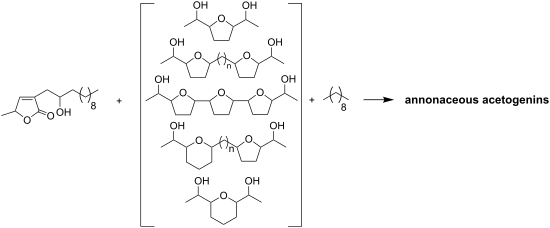
- hydrogenation, desilylation and removal of the butane diacetal group finished the total synthesis of 134. The spectroscopic data for synthetic 134 (1H NMR, 13C NMR, IR, MS, mp and specific rotation) were in excellent agreement with those reported for naturally occurring muricatetrocin C (134). In 2002, the full
- . Oxidative release of 160 followed by Swern oxidation and Takai reaction provided the terminal vinyl iodide 161. Final Pd0-catalyzed coupling of alkyne 157 with vinyl iodide 161 gave the enediyne 162, which underwent selective hydrogenation and desilylation to give (+)-parviflorin (153). In 1997, Trost’s


Synthesis of chiral cyclohexanes and carbasugars by 6-exo-dig radical cyclisation reactions
Beilstein J. Org. Chem. 2008, 4, No. 43, doi:10.3762/bjoc.4.43

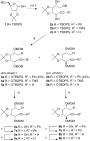
- juncture we were able to separate the diastereoisomers, 3a (anti) and 3b (syn), by flash column chromatography on silica gel. Alternatively the syn isomer 3b could be prepared almost exclusively using D-ribonolactone as the starting material [23]. Desilylation of 3a was effective with TBAF in THF and
- 96% and 91% yields, respectively. These compounds were identical to those obtained from 2c after the diastereoisomers had been subjected to protection as MOM ethers on treatment with MOM chloride to give 5a and 5b followed by desilylation, the anti:syn ratio being 2.3:1. The syn-product was





Analogues of amphibian alkaloids: total synthesis of (5R,8S,8aS)-(−)-8-methyl- 5-pentyloctahydroindolizine (8-epi-indolizidine 209B) and [(1S,4R,9aS)-(−)-4-pentyloctahydro- 2H-quinolizin- 1-yl]methanol
Beilstein J. Org. Chem. 2008, 4, No. 5, doi:10.1186/1860-5397-4-5
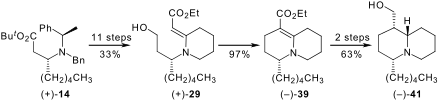
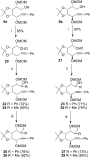
- unsuccessful, apparently because the silyl ether failed to survive the reaction conditions. Inelegant though it was, we were forced at this stage to change protecting groups on the alcohol. Fortunately, the drop in yield was not too serious when desilylation of 34 with aqueous hydrofluoric acid to give the


Investigation of acetyl migrations in furanosides
Beilstein J. Org. Chem. 2006, 2, No. 14, doi:10.1186/1860-5397-2-14
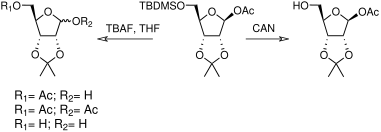
- O. P. Chevallier M. E. Migaud School of Chemistry and Chemical Engineering, Queen's University, David Keir Building, Stranmillis Road, Belfast, BT9 5AG, Northern Ireland, UK 10.1186/1860-5397-2-14 Abstract Standard reaction conditions for the desilylation of acetylated furanoside (riboside
- ribosides, acyl migration could be prevented when desilylation was catalysed by cerium ammonium nitrate. Introduction Over the years, a number of methods aimed at achieving chemoselective acylation of carbohydrates have been developed.[1][2][3] In addition to the challenges encountered in the selective
- experiments were sufficiently clear to allow accurate compound identification. No isomerisation was detected for any of the isolated compounds when stored in an organic solvent such as hexane, ethyl acetate or CDCl3 for up to 12 hrs. The chemical shifts of the 1H- and 13C-NMR of the desilylation products for


The oxanorbornene approach to 3-hydroxy, 3,4-dihydroxy and 3,4,5-trihydroxy derivatives of 2-aminocyclohexanecarboxylic acid
Beilstein J. Org. Chem. 2006, 2, No. 9, doi:10.1186/1860-5397-2-9

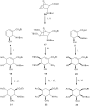
- failed. Fortunately, use of LiHMDS was successful albeit accompanied by the unexpected loss of Boc group. Similar strategies using either the free diol or the corresponding acetonide were not successful leading to extensive decomposition. Following TBAF promoted desilylation, peracylation and reduction




Synthesis of highly substituted allenylsilanes by alkylidenation of silylketenes
Beilstein J. Org. Chem. 2005, 1, No. 5, doi:10.1186/1860-5397-1-5
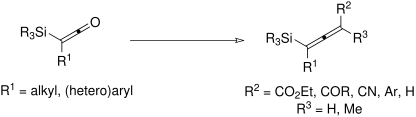
- silylketenes with reactive ylides involves deprotonation by the basic reagent to generate ynolate anions. Clearly, since such a pathway cannot operate with the substituted ketenes used here other mechanisms are at play, which may include nucleophilic desilylation or ketene oligomerisation initiated by


Other Beilstein-Institut Open Science Activities



