Search results
Search for "hydration" in Full Text gives 141 result(s) in Beilstein Journal of Organic Chemistry.
Synthesis of a novel chemotype via sequential metal-catalyzed cycloisomerizations
Beilstein J. Org. Chem. 2012, 8, 1338–1343, doi:10.3762/bjoc.8.153

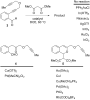
- , evaluating a number of metal catalysts in the presence of diethyl malonate. From this focused reaction screen we identified three types of reactivity: (1) no reaction; (2) alkyne hydration (4); and (3) cycloisomerization leading to isochromene (5) (Figure 1). Many catalysts resulted in no reaction, including
- ones that might have been expected to catalyze cycloisomerization, such as AgOTf. Two catalysts, Cu(OTf)2 and Pd(MeCN)2Cl2, afforded only hydration of the alkyne. Interestingly, hydration was regioselective, which is possibly due to direction from the ether oxygen. We were most interested in metal




Continuous-flow hydration–condensation reaction: Synthesis of α,β-unsaturated ketones from alkynes and aldehydes by using a heterogeneous solid acid catalyst
Beilstein J. Org. Chem. 2011, 7, 1680–1687, doi:10.3762/bjoc.7.198
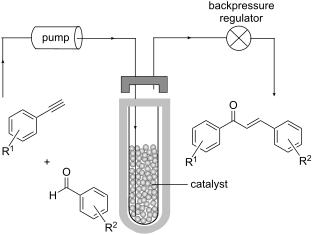
- Magnus Rueping Teerawut Bootwicha Hannah Baars Erli Sugiono Institute of Organic Chemistry, RWTH Aachen University, Landoltweg 1, D-52074 Aachen, Germany 10.3762/bjoc.7.198 Abstract A simple, practical and efficient continuous-flow hydration–condensation protocol was developed for the synthesis
- of valuable differently substituted chalcones. Starting from commercially available alkynes and aldehydes, a continuous-flow hydration–condensation protocol leads to the desired products in good to excellent yields. The reactions were sequentially introduced into the flow cell and performed several
- General procedure for hydration–condensation reaction of phenylacetylene (1a) and benzaldehyde (2a). A solution of phenylacetylene (1a) (0.4 mmol) and benzaldehyde (2a) (1.6 mmol) was pumped through the flow cell filled with amberlyst-15 resin (16–50 mesh) (10.0 g) and dry 1,2-dichloroethane at a flow


Gold-catalyzed propargylic substitutions: Scope and synthetic developments
Beilstein J. Org. Chem. 2011, 7, 866–877, doi:10.3762/bjoc.7.99

- , whereas in refluxing dichloroethane the substitution product 16 led to a mixture of products via triple bond hydration to give 17 [49][50][56] and furan formation to afford 18 (Scheme 7). The furan may possibly result from intramolecular addition of the enol form of acetylacetone. Related experiments have
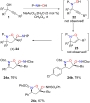
- obtain these isoxazolines would be to realize the propargylic substitution first of all (and consume all of the hydroxylamine) and subsequently perform the cyclization. Since iron(III) was known to be inefficient in the hydration of triple bonds [64][65], we anticipated that its use would lead only to
- even after prolonged reaction at reflux (Scheme 14). Very recently, Darcel described the iron(III) hydration of terminal alkynes [65]. These conditions were attempted to cyclize 22a but in our hands only extensive decomposition was observed. We thus turned our attention to gold-catalyzed cyclization of




Gold-catalyzed oxidation of arylallenes: Synthesis of quinoxalines and benzimidazoles
Beilstein J. Org. Chem. 2011, 7, 860–865, doi:10.3762/bjoc.7.98

- /hydration and oxidative cleavage of allenes to form α-diketones and aldehydes, and the synthesis of quinoxalines and benzimidazoles via the condensation of the resulting α-diketones and aldehydes with benzene-1,2-diamine [45][46][47][48][49][50][51][52][53][54][55][56]. Results and Discussion Our initial
- of quinoxalines and benzimidazoles via the condensation of the resulting α-diketones and aldehydes with benzene-1,2-diamine was achieved in high yields. This reaction appears to proceed via oxidation/hydration and oxidative cleavage of the allene, and investigations into the mechanism of this


Fine-tuning alkyne cycloadditions: Insights into photochemistry responsible for the double-strand DNA cleavage via structural perturbations in diaryl alkyne conjugates
Beilstein J. Org. Chem. 2011, 7, 813–823, doi:10.3762/bjoc.7.93
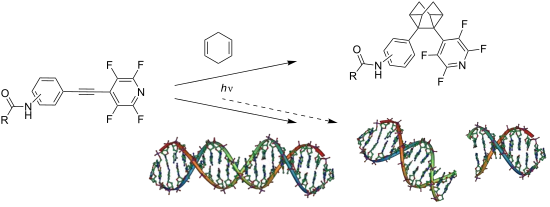
- triple bond. The cyclized product, benzoxazepine 13, and the ketone product 14 were isolated. Whereas 13 was produced by a 7-endo cyclization (unprecedented in these systems), the ketone 14 can be formed either by direct hydration of the alkyne or by a known pathway that involves the corresponding six
- -membered product, a benzoxazine. The formation of benzoxazines has been previously reported by Roberts and coworkers, who suggested cyclization via triplet excitation following hydration [59][60][61][62]. The presence of vinyl peaks at 6.2 and 5.9 ppm in the reaction mixture and their quick disappearance
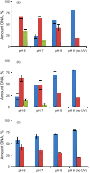
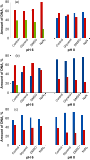
- undergoes further photorearrangement via a formal 1,3-shift. Photocycloaddition of amido acetylenes with 1,4-CHD. Possible mechanism for photochemical hydration of diaryl acetylene moiety catalyzed by the ortho-amide substituent. Stern–Volmer quenching constants (Et3N as a quencher) and singlet lifetimes



Gold-catalyzed heterocyclizations in alkynyl- and allenyl-β-lactams
Beilstein J. Org. Chem. 2011, 7, 622–630, doi:10.3762/bjoc.7.73
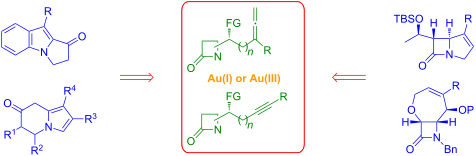
- -azetidinone nucleus [66][67]. Treatment of the terminal alkyne 35a with the catalytic system AuCl3/PTSA gave the desired ketal 36a. Appreciable amounts of a polar ketone arising from alkyne hydration were also produced. Fortunately, the [AuClPPh3]/AgOTf/PTSA system demonstrated better activity. Interestingly



pH-Responsive chromogenic-sensing molecule based on bis(indolyl)methene for the highly selective recognition of aspartate and glutamate
Beilstein J. Org. Chem. 2011, 7, 218–221, doi:10.3762/bjoc.7.29
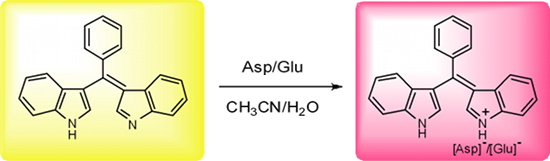
- /deprotonation of, the indolyl moiety modulate the internal charge transfer (ICT) state of bis(indolyl)methene and give rise to large color changes. In aqueous solution, the effective recognition based on strong hydrogen bonding is hardly achieved because of the strong hydration to hydrogen bonding sites of both


A short and efficient synthesis of valsartan via a Negishi reaction
Beilstein J. Org. Chem. 2010, 6, No. 27, doi:10.3762/bjoc.6.27

- and arteries causes the tissues to constrict. AT-II receptors are activated by the octapeptide AT-II. AT-II helps to maintain constant blood pressure [1] despite fluctuations in a person’s state of hydration, sodium intake and other physiological variables. AT-II also performs the regulatory tasks of


Solvent-free and time-efficient Suzuki–Miyaura reaction in a ball mill: the solid reagent system KF–Al2O3 under inspection
Beilstein J. Org. Chem. 2010, 6, No. 7, doi:10.3762/bjoc.6.7
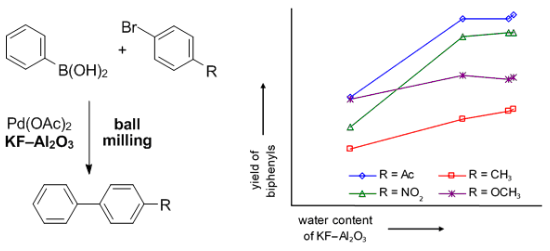
- these results, materials were stored in a desiccator over KOH and vacuum for further applications to avoid uncontrollable uptake of water as indicated in the procedures of Kabalka et al. (“exposed to air over a period of days to allow for hydration of the surface”) [33] as well as for preventing the


Enantioselective synthesis of tricyclic amino acid derivatives based on a rigid 4-azatricyclo[5.2.1.02,6]decane skeleton
Beilstein J. Org. Chem. 2009, 5, No. 81, doi:10.3762/bjoc.5.81

- of 11 delivered the exo-configured alcohol rac-12, which was oxidized with PCC furnishing rac-9 in 79% yield. The asymmetric synthesis of the ketone 9 was realized by enantioselective hydration of the meso-alkene 11 using Hayashi’s method (Scheme 2) [25][26][27][28][29][30]: Hydrosilylation with




1-(4-Alkyloxybenzyl)-3-methyl-1H-imidazol-3-ium organic backbone: A versatile smectogenic moiety
Beilstein J. Org. Chem. 2009, 5, No. 62, doi:10.3762/bjoc.5.62
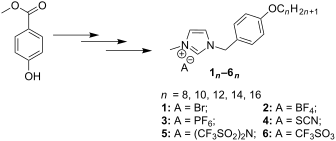
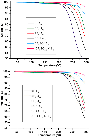
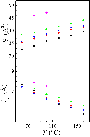
- of the anion but no real tendency can be extracted as a function of chain length. In all series the general order of stability order is SCN− ≈ Br− < BF4− ≈ PF6− < CF3SO3− < (CF3SO2)2N−. To avoid any phenomenon related to the sample preparation (purification, crystallisation, hydration) our reported






Synthesis and properties of calix[4]arene telluropodant ethers as Ag+ selective sensors and Ag+, Hg2+ extractants
Beilstein J. Org. Chem. 2009, 5, No. 59, doi:10.3762/bjoc.5.59

- of ionophore-based ISEs [54] and traditional Ag2S-based [58][59] ISE is largely eliminated in the present of ISEs (logK≤−1.4). It is reasoned that those ions with high hydration energies, such as Na+, K+, NH4+, Ca2+, Mg2+, Pb2+ and most of divalent transition metal ions, can not strongly interact


A convenient method for preparing rigid-core ionic liquid crystals
Beilstein J. Org. Chem. 2009, 5, No. 51, doi:10.3762/bjoc.5.51
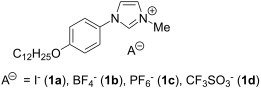
- avoid possible effects of hydration of the materials, all were dried in vacuo before X-ray and DSC analyses. The phase transition temperatures and the corresponding enthalpy changes derived for compounds 1a–e are compiled in Table 2, while typical results are displayed in Figure 5. The high stability of




Radical cascades using enantioenriched 7-azabenzonorbornenes and their applications in synthesis
Beilstein J. Org. Chem. 2008, 4, No. 38, doi:10.3762/bjoc.4.38
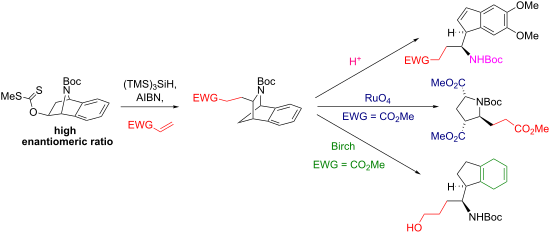
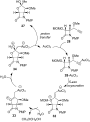
- pyrrolidine. Ring-opening–hydration–oxidation of azacycle 8. Preparation of trisubstituted pyrrolidine (+)-36. Preparation of pyrrolidine diester (+)-35 from Vince’s lactam 37. Acid-catalysed ring-opening–oxidation of azacycle (+)-8. Birch reduction of (+)-8 and 10. Supporting Information Supporting


End game strategies towards the total synthesis of vibsanin E, 3-hydroxyvibsanin E, furanovibsanin A, and 3-O-methylfuranovibsanin A
Beilstein J. Org. Chem. 2008, 4, No. 34, doi:10.3762/bjoc.4.34

- methylated furans using catalytic amounts of mercury triflate. Although verification of this protocol was undertaken on a cycloheptanone derivative, substrate 39 failed to give the desired furan 42 (Scheme 6). Instead, hydration was observed as the major reaction pathway (i.e. 40) with furan 41 being


The enantiospecific synthesis of (+)-monomorine I using a 5-endo- trig cyclisation strategy
Beilstein J. Org. Chem. 2007, 3, No. 39, doi:10.1186/1860-5397-3-39
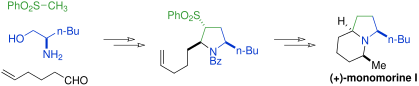
- -mediated hydrolysis led to formation of the N-benzoylaminosulfone 11, presumably by a sequence involving ring-opening by elimination, hydration of the electron-deficient alkenyl sulfone double bond and retro-aldol-like fragmentation. Reductive deprotection proved to be a more fruitful avenue of study