


Search results
Search for "iridium" in Full Text gives 137 result(s) in Beilstein Journal of Organic Chemistry.
Tandem aldehyde–alkyne–amine coupling/cycloisomerization: A new synthesis of coumarins
Beilstein J. Org. Chem. 2013, 9, 180–184, doi:10.3762/bjoc.9.21

- , cobalt, iridium and iron. Similarly, cycloisomerization of alkynols and alkynamines has also been an attractive approach for the synthesis of various known and new heterocyclic frameworks [2][3][4][5][6][7][8][9][10][11][12][13][14][15][16][17][18][19][20][21][22]. Various alkynophilic catalysts such as


Flow photochemistry: Old light through new windows
Beilstein J. Org. Chem. 2012, 8, 2025–2052, doi:10.3762/bjoc.8.229
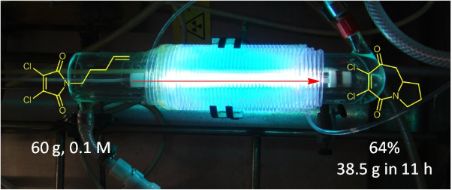
- also be performed with visible-light photocatalysis, in this case with either ruthenium or iridium catalysts (Scheme 14). Again, residence times in the 100 µL microreactor were significantly shorter than those for the batch reactor, and in this case the microflow system also allowed reactions that were


Rh(III)-catalyzed directed C–H bond amidation of ferrocenes with isocyanates
Beilstein J. Org. Chem. 2012, 8, 1844–1848, doi:10.3762/bjoc.8.212
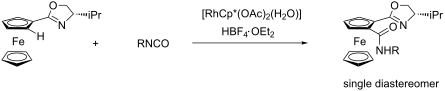
- structures. For instance, a 1,2-disubstituted ferrocenyl ligand, Xyliphos ((R)-1-[(S)-2-(diphenylphosphanyl)ferrocenyl]ethyl bis(3,5-dimethylphenyl)phosphane) is used for iridium-catalyzed enantioselective hydrogenation to produce the herbicide (S)-metolachlor on a scale of more than 10000 tons/year [5


Iridium-catalyzed intramolecular [4 + 2] cycloadditions of alkynyl halides
Beilstein J. Org. Chem. 2012, 8, 1765–1770, doi:10.3762/bjoc.8.201
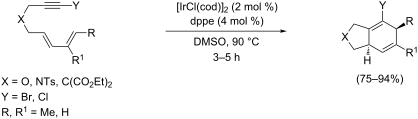
- Andrew Tigchelaar William Tam Guelph-Waterloo Centre for Graduate Work in Chemistry and Biochemistry, Department of Chemistry, University of Guelph, Guelph, Ontario, Canada N1G 2W1 10.3762/bjoc.8.201 Abstract Iridium-catalyzed intramolecular [4 + 2] cycloadditions of diene-tethered alkynyl
- halides were investigated by using [IrCl(cod)]2 as catalyst, and dppe was found to be the most suitable phosphine ligand for the reaction. No oxidative insertion of the iridium into the carbon–halide bond was observed, and the reactions proceeded to provide the halogenated cycloadducts in good yield (75
- –94%). These results are the first examples of cycloadditions of alkynyl halides using an iridium catalyst. Keywords: alkynyl halide; cycloaddition; diene-tethered alkyne; iridium; transition-metal catalyst; Introduction Iridium complexes have been used as catalysts for a wide variety of reactions


Metal–ligand multiple bonds as frustrated Lewis pairs for C–H functionalization
Beilstein J. Org. Chem. 2012, 8, 1554–1563, doi:10.3762/bjoc.8.177
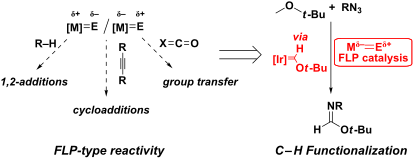
- require cooperative activation of substrates. One well-defined case with iridium(I) carbenes generated by multiple C−H activations is explored as a proof of principle. Note that the purpose of this review is not to provide an exhaustive list of examples of reactivity consistent with the description of
- character of Fe. In contrast to the silylene and borylene examples presented above, square-planar carbene complexes of iridium(I) often react in a fashion that is dictated by the nucleophilic metal center. An early example of this type of complex was an amidophosphine-supported iridium methylene reported by
- release ethylene and make an iridium(I) trimethylphosphine complex (Scheme 10). More recently, Werner reported several square-planar iridium(I) carbene complexes that react with acid to selectively protonate the iridium center (i.e., the more basic/nucleophilic site) [66][67]. Whited and Grubbs explored




Stereoselective synthesis of trans-fused iridoid lactones and their identification in the parasitoid wasp Alloxysta victrix, Part I: Dihydronepetalactones
Beilstein J. Org. Chem. 2012, 8, 1246–1255, doi:10.3762/bjoc.8.140
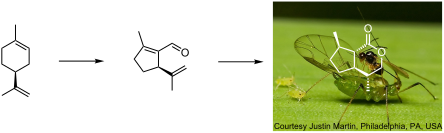
- chain at C5 through chelation. We chose Crabtree’s iridium catalyst ([Ir(cod)PCy3(py)]PF6) which has been reported to furnish excellent facial selectivities during directed hydrogenations of cyclic olefins [32][33][34]. Hydrogenation of acetate 16 in the presence of 11 mol % of Crabtree’s catalyst under


Synthesis of highly functionalized β-aminocyclopentanecarboxylate stereoisomers by reductive ring opening reaction of isoxazolines
Beilstein J. Org. Chem. 2012, 8, 100–106, doi:10.3762/bjoc.8.10
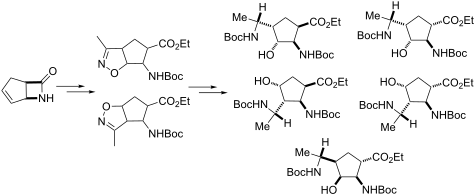
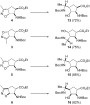
- 3). Combinations of NaBH4 (as a mild and selective reducing agent) with cobalt, nickel, iridium or rhodium halide have previously been employed for cleavage of the isoxazoline ring system, which is otherwise inert to NaBH4 without such metal halide additives [50]. Accordingly, we investigated the


Asymmetric Au-catalyzed cycloisomerization of 1,6-enynes: An entry to bicyclo[4.1.0]heptene
Beilstein J. Org. Chem. 2011, 7, 1021–1029, doi:10.3762/bjoc.7.116
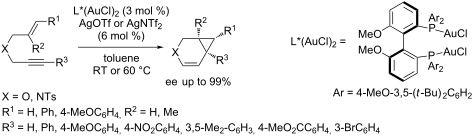
- chiral iridium catalyst [41] (Scheme 1, reaction 2). We and others recently pursued the improvement and development of this enantioselective process, by employing platinum [42][43][44], rhodium [45] or gold [46][47][48] complexes. Following our previous work with chiral gold catalysts [46], we report a
- % isolated yield respectively) resulting from 5-exo- and 6-endo cycloisomerization reactions [20][66]. Thus, the gold catalytic system cannot compete with the results obtained for the cyclizations of nitrogen-tethered enynes in the presence of iridium, platinum or rhodium catalysts [41][42][43][44][45]. The


Advances in synthetic approach to and antifungal activity of triazoles
Beilstein J. Org. Chem. 2011, 7, 668–677, doi:10.3762/bjoc.7.79

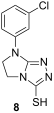
- composition and structure of the inhibitor [70]. Novel heteroleptic iridium complexes containing the 1-substituted-4-phenyl-1H-1,2,3-triazole cyclometalating ligand were synthesized by the [3 + 2] Huisgen dipolar cycloaddition method which was utilized to prepare a class of bidentate ligands by adding
- different substituents to the triazole nucleus. By a judicious choice of ligands, a library of new luminescent ionic iridium complexes was prepared [71]. 3-Amino-1,2,4-triazole is an inhibitor of mitochondrial and chloroplast function. Commercial grade 3-amino-1,2,4-triazole is used as a herbicide and




Functional properties of metallomesogens modulated by molecular and supramolecular exotic arrangements
Beilstein J. Org. Chem. 2009, 5, No. 54, doi:10.3762/bjoc.5.54
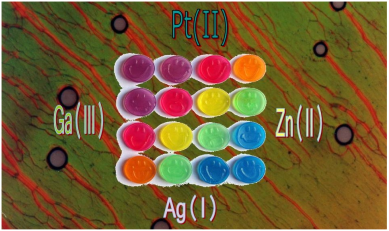
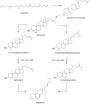
- ligand extensively used in the synthesis of cyclometallated iridium(III) and platinum(II) derivatives [46][47] but whose reactivity towards Pd(II) centres is unexplored. This kind of ligand has been functionalised with a chiral group such as a cholesteryl ester unit, introduced as terminal substituent in


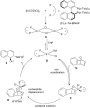
Iridium-catalyzed asymmetric ring-opening reactions of oxabicyclic alkenes with secondary amine nucleophiles
Beilstein J. Org. Chem. 2009, 5, No. 53, doi:10.3762/bjoc.5.53

- Dingqiao Yang Ping Hu Yuhua Long Yujuan Wu Heping Zeng Hui Wang Xiongjun Zuo School of Chemistry and Environment, South China Normal University, Guangzhou 510006, People’s Republic of China, Fax: (+86)-20-39310187; Phone: (+86)-20-85210087 10.3762/bjoc.5.53 Abstract Iridium-catalyzed asymmetric
- and 5 mol % bisphosphine ligand (S)-p-Tol-BINAP. The trans-configuration of 3f was confirmed by X-ray crystallography. Keywords: chiral bisphosphine ligand; iridium catalyst; oxabicyclic alkenes; ring-opening reaction; Introduction Substituted dihydronaphthalenes are important molecules with
- metal catalysts may be used for asymmetric ring-opening reactions of oxabicyclic alkenes. These include complexes of copper [20][21][22][23][24][25], palladium [14][15][26][27][28][29][30][31], iron [32], and nickel [33][34][35][36]. Recently, we reported for the first time iridium-catalyzed asymmetric


Sordarin, an antifungal agent with a unique mode of action
Beilstein J. Org. Chem. 2008, 4, No. 31, doi:10.3762/bjoc.4.31

- -unsaturated ester, which was subjected to Pearlman hydrogenolysis of the benzyl group and selective catalytic reduction of the non-conjugated olefin with iridium black. The latter step proceeded in a predominately syn manner to afford intermediate 12, which was oxidized to cyclopentadiene 13 through TBS





