


Search results
Search for "reductions" in Full Text gives 135 result(s) in Beilstein Journal of Organic Chemistry.
Mitomycins syntheses: a recent update
Beilstein J. Org. Chem. 2009, 5, No. 33, doi:10.3762/bjoc.5.33

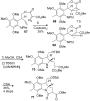
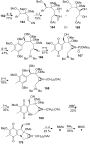
- -electron reduction led to formation of the stable hydroquinone, which can be oxidized back to the quinone in the presence of oxygen [48]. Nonetheless, different results were observed in water where both one- and two-electron reductions gave the same DNA adducts. Moreover, the disproportion of the






The development and evaluation of a continuous flow process for the lipase- mediated oxidation of alkenes
Beilstein J. Org. Chem. 2009, 5, No. 27, doi:10.3762/bjoc.5.27
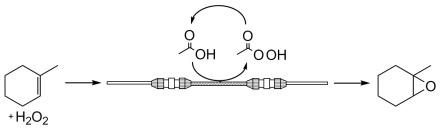
- reagents currently employed, finding use in the synthesis of the aroma linalool oxide and epoxidised soybean oil [16], the reaction times employed for the transformations (< 166 h) and observed reductions in enzyme activity in the presence of H2O2 (2) do not currently make the technique a practical
- crystalline solid. In all cases, the epoxides were synthesised in excellent yield and purity with no hydrolysis products observed. In comparison to the reaction times employed in analogous batch reactions, Table 1, the examples reported herein serve to illustrate the dramatic reductions in reaction time





Synthesis of rigidified flavin–guanidinium ion conjugates and investigation of their photocatalytic properties
Beilstein J. Org. Chem. 2009, 5, No. 26, doi:10.3762/bjoc.5.26

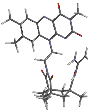
- benzyl ether cleavage, nitro arene reductions and Diels–Alder reactions. However, no significant gain in photocatalytic performance by the guanidinium ion substrate binding site was observed in comparison to flavins lacking the binding site and the rigid Kemp’s acid skeleton. The primary interaction




Diastereoselective and enantioselective reduction of tetralin- 1,4-dione
Beilstein J. Org. Chem. 2008, 4, No. 37, doi:10.3762/bjoc.4.37
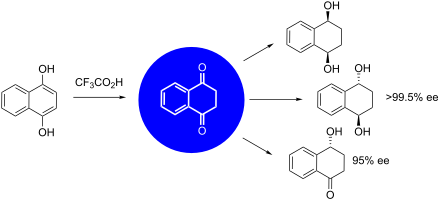
- (yields: 76–98%). Fractional crystallization allowed isolation of the cis-diol and the trans-diol (55% and 66% yield, respectively). Borane was used to cleanly give the mono-reduction product. Highly enantioselective CBS reductions afforded the trans-diol (72% yield, 99% ee) and the mono-reduction product
- (81%, 95% ee). Conclusion Diastereoselective and enantioselective reductions of the unexplored tetralin-1,4-dione provides a very convenient entry into a number of synthetically highly attractive 1,4-tetralindiols and 4-hydroxy-1-tetralone. Keywords: asymmetric; catalysis; ketone; reduction; tautomer
- of our studies of reductions of the carbonyl functions in diketone 2. Results and Discussion Diastereoselective bis-reduction of 2 Reduction of tetralin-1,4-dione (2) with a number of reducing agents afforded mixtures of diastereoisomeric cis-diol 6 and trans-diol 7 in the ratios shown in Table 1. It


C2- symmetric bisamidines: Chiral Brønsted bases catalysing the Diels- Alder reaction of anthrones
Beilstein J. Org. Chem. 2008, 4, No. 28, doi:10.3762/bjoc.4.28
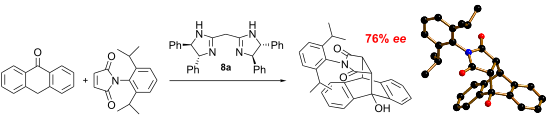
- deprotonated by aqueous sodium hydroxide. As an “artefact” of the sequence rule, the S,S configurated diamine 9d leads to bisamidine ent-8d (Scheme 3). The anthrones 1b (R1: H; R2: Cl) and 1c (R1: Cl; R2: H) resulted from regioselective reductions of 1,8-dichloroanthraquinone [10][11]. Aliphatic side chains of


Combining two-directional synthesis and tandem reactions, part 11: second generation syntheses of (±)-hippodamine and (±)-epi-hippodamine
Beilstein J. Org. Chem. 2008, 4, No. 4, doi:10.1186/1860-5397-4-4
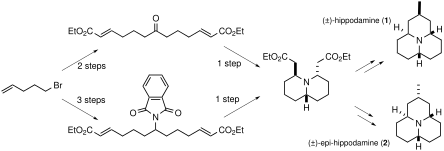
- formally derivatives of perhydro-9b-azaphenalene (Figure 1). Another group of natural enemies, parasitic insects, can cause substantial reductions in populations of ladybird species. Recent research [2] has shown that the parasites locate the ladybirds through perception of certain defence alkaloids that


Part 1. Reduction of S-alkyl- thionocarbonates and related compounds in the presence of trialkylboranes/air
Beilstein J. Org. Chem. 2007, 3, No. 45, doi:10.1186/1860-5397-3-45

- % yield. No other identifiable product could be isolated. Zard and Nozaki mentioned similar reductions from α-acylxanthate[19] and α-acyliodide[20][21] respectively. These authors proposed the formation of an intermediate boron enolate that hydrolyses on work-up. A detailed report of our results


Contemporary organosilicon chemistry
Beilstein J. Org. Chem. 2007, 3, No. 4, doi:10.1186/1860-5397-3-4

- -coupling reactions, and the use of silanes as stoichiometric reductants in a range of chemo-, stereo- and enantioselective catalytic reductions. It is therefore a pleasure to serve as Guest Editor for this first "Thematic Series" in the Beilstein Journal of Organic Chemistry, on "Contemporary Organosilicon
Multiple hydride reduction pathways in isoflavonoids
Beilstein J. Org. Chem. 2006, 2, No. 16, doi:10.1186/1860-5397-2-16
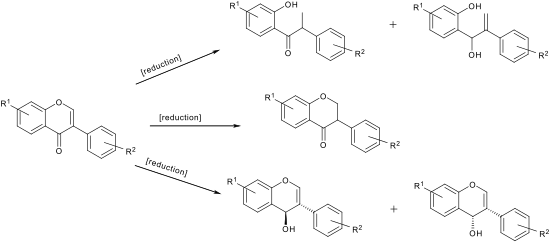
- now reliably available in satisfactory or good yields by hydride reductions to be used as authentic reference compounds in analytical and biological studies. Background The reduction of isoflavones 1 has been actively studied during the last twenty years, owing to the range of interesting biological
- . The discussion is based on the types of reduced isoflavonoid structures formed (Figure 1), i.e., isoflavanones 2, cis-isoflavan-4-ols 3, trans-isoflavan-4-ols 4, the ring opened α-methyldeoxybenzoins 5 and 1,2-diaryl-2-propen-1-ols 6, and isoflavenes 7 and 8 (hydride reductions do not lead to
- cis- and trans-structures for the isoflavanol products and to study their conformational equilibria [32][34]. Borohydride reductions generally give a small preference for the cis products as suggested by Cram's rule [39]. We are not aware of any examples in the literature of single enantiomers of


Methods for the synthesis of polyhydroxylated piperidines by diastereoselective dihydroxylation: Exploitation in the two-directional synthesis of aza-C-linked disaccharide derivatives
Beilstein J. Org. Chem. 2005, 1, No. 2, doi:10.1186/1860-5397-1-2
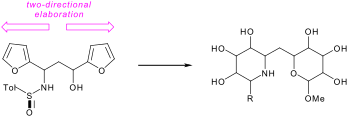
- Luche reduction of piperidinones Diastereoselective dihydroxylation of unsaturated piperidines Diagnostic nOe observations for the piperidine 22A Diagnostic nOe observations for the piperidines 22C and 22D Stereoselectivity of two-directional Luche reductions Two-directional functionalisation by





Other Beilstein-Institut Open Science Activities



