


Search results
Search for "stereogenic centers" in Full Text gives 135 result(s) in Beilstein Journal of Organic Chemistry.
A comparative study of the Au-catalyzed cyclization of hydroxy-substituted allylic alcohols and ethers
Beilstein J. Org. Chem. 2011, 7, 802–807, doi:10.3762/bjoc.7.91
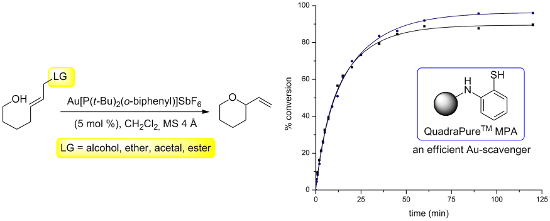
- biologically interesting and structurally complex natural products [1]. These compounds are typically densely functionalized and contain numerous stereogenic centers. Many challenges for the total synthesis of these molecules revolve around issues of selectivity and can be complicated by the presence of


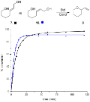
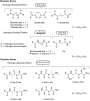
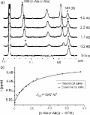
![[Graphic 1]](/bjoc/content/inline/1860-5397-7-91-i3.png?max-width=637&scale=0.59091) = quenched after 1 min;
= quenched after 1 min; ![[Graphic 2]](/bjoc/content/inline/1860-5397-7-91-i4.png?max-width=637&scale=0.709092) = quenched after 3 min;
= quenched after 3 min; ![[Graphic 3]](/bjoc/content/inline/1860-5397-7-91-i5.png?max-width=637&scale=0.709092) = quenched after ...
= quenched after ...

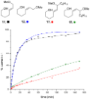
Alkene selenenylation: A comprehensive analysis of relative reactivities, stereochemistry and asymmetric induction, and their comparisons with sulfenylation
Beilstein J. Org. Chem. 2011, 7, 744–758, doi:10.3762/bjoc.7.85

- alkenols 4 is reversed, because of the opposite stereochemistry of the chiral stereogenic centers in 1 versus 2. While not included in this study, it should be emphasized that analogous stereochemical outcomes were observed in the corresponding reactions of chiral electrophiles 1 and 2 with carboxylic


Oxalyl retro-peptide gelators. Synthesis, gelation properties and stereochemical effects
Beilstein J. Org. Chem. 2010, 6, 945–959, doi:10.3762/bjoc.6.106
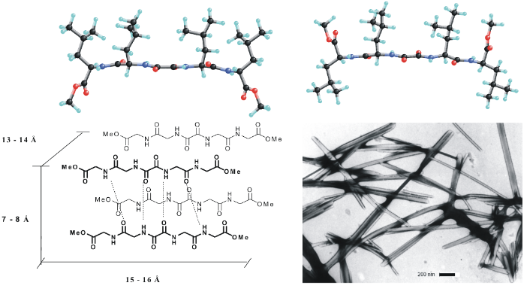
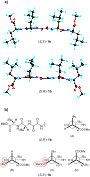
- arrangements of i-Bu groups occur (Figure 10b, Newman projections of two stereogenic centers only). Our earlier results based on single crystal X-ray analysis of bis(amino acid)oxalamides showed that their most stable conformations are characterized by vicinal positioning of the methine proton at the
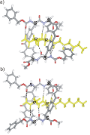
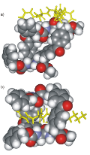
- of (S,S)-1b (top) and (S,R)-1b generated by systematic conformational search (SYBYL package; second graphic); (b) Partial Newman projections of two stereogenic centers of (S,R)-1b and (S,S)-1b showing conformations with cis-arrangement of i-Bu groups in the former (A) and trans- (B, D) and cis- (C
- carboxylic acid, methyl ester and carboxamide, namely (S,S)-bis(LeuLeu) 1a, b, c; (S,S)-bis(PhgPhg) 3a, b, c and (S,S)-bis(PhePhe) 5a, b, c and, the second containing two different amino acids, (S,S)-bis(LeuPhg) 2a, b, c and (S,S)-bis(PhgLeu) 4a, b, c (configurations of only two of the four stereogenic





Novel tetracyclic structures from the synthesis of thiolactone-isatin hybrids
Beilstein J. Org. Chem. 2010, 6, No. 78, doi:10.3762/bjoc.6.78

- carbon and nitrogen pyramidality (χC and χN) and the N-C(=O) and C=O bond lengths (Table 3) all indicate that the bridge amide bond is essentially relaxed. In summary we have described the straightforward synthesis of novel compounds 3 and 4. The latter bears quaternary stereogenic centers and a


Synthesis and binding studies of two new macrocyclic receptors for the stereoselective recognition of dipeptides
Beilstein J. Org. Chem. 2010, 6, No. 5, doi:10.3762/bjoc.6.5
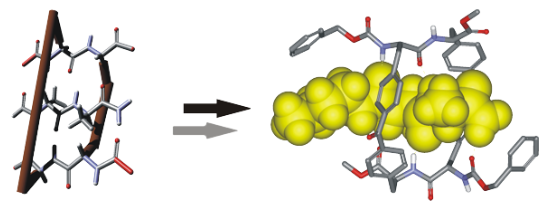
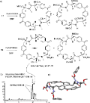
- sheet structure with an included peptide ligand. Conversely, the two outer strands of receptor 2 are oriented parallel to each other (“parallel receptor”), such that the covalent connections between strands join similar stereogenic centers, C-terminus with C-terminus and N-terminus with N-terminus
- . Receptor 2 is anticipated to form an antiparallel sheet structure with the included peptide ligand. This change in connectivity does not involve any inversion of the stereogenic centers but only a modification in the sequence of peptide-coupling reactions that yield the cyclic structure, and will be
- steric clashes between the methyl groups of the target peptide and the benzophenone linking chains, the stereogenic centers in the linkers must have the (S) configuration, opposite to that of the bound peptide (R); b) the benzophenone aromatic ring will also provide a hydrophobic pocket for the







The role of an aromatic group in remote chiral induction during conjugate addition of α-sulfonylallylic carbanions to ethyl crotonate
Beilstein J. Org. Chem. 2008, 4, No. 32, doi:10.3762/bjoc.4.32

- addition products resulting from the formation of two new stereogenic centers (methine carbon atoms 3 and 4 of the ethyl hexenoates, see Scheme 1) only two could be detected in all cases except the 9-anthryl derivative (3h), which indicated a single adduct. Apart from having proceeded regioselectively (α
- yields are obtained with aromatic rings possessing higher electron density (4-methoxyphenyl, 2-thienyl) while the employment of the 9-anthryl nucleus results in complete transmission of chirality to the newly formed stereogenic centers. Ab initio calculations assign an important role to Li+–aromatic π


Stereoselective synthesis of (2S,3S,4Z)-4-fluoro- 1,3-dihydroxy- 2-(octadecanoylamino)octadec- 4-ene, [(Z)-4-fluoroceramide], and its phase behavior at the air/water interface
Beilstein J. Org. Chem. 2008, 4, No. 12, doi:10.3762/bjoc.4.12

- , the D-erythro-configuration of the stereogenic centers is most probable, considering the reaction mechanism we propose in Scheme 2. Moreover, the 3JH,H-coupling constants between the protons at C(2) and C(3), which were determined to be 7.8 Hz and 7.7 Hz for 5 and 6, respectively, support this
- diastereo- and enantioselective synthetic route was presented for the preparation of the first analogues 1b and 2b, fluorinated in 4-position, of the natural signaling molecules sphingosine (1a) and ceramide (2a) with the required D-erythro-configuration (2S,3S) of the stereogenic centers and a Z configured


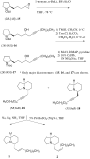
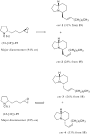
An asymmetric synthesis of all stereoisomers of piclavines A1-4 using an iterative asymmetric dihydroxylation
Beilstein J. Org. Chem. 2007, 3, No. 37, doi:10.1186/1860-5397-3-37
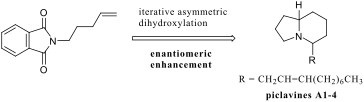
- sequence of iterative AD reactions starting from an achiral N-pentenylphthalimide (11). [9] The two stereogenic centers in 10 were constructed with high enantio-enhancement via a sequence of twofold AD reactions as shown in Scheme 2. We embarked on the synthesis of piclavines A1-4 using the four



Reagent controlled addition of chiral sulfur ylides to chiral aldehydes
Beilstein J. Org. Chem. 2005, 1, No. 4, doi:10.1186/1860-5397-1-4
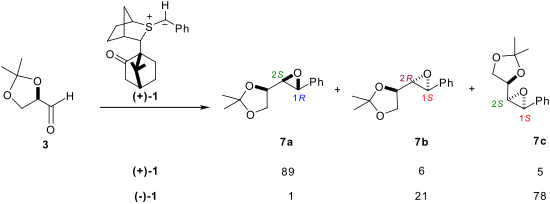
- of the two enantiomers of the chiral benzyl sulfonium salt 1 with glyceraldehyde acetonide were studied in detail. Of the two new stereogenic centers created, it was found that the C1 stereochemistry was largely controlled by the reagent, whereas control at the C2 center was dependent on the aldehyde


Mixtures of monodentate P-ligands as a means to control the diastereoselectivity in Rh-catalyzed hydrogenation of chiral alkenes
Beilstein J. Org. Chem. 2005, 1, No. 3, doi:10.1186/1860-5397-1-3
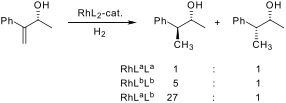
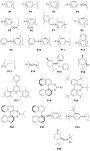
- even two stereogenic centers. Ligands P18, P20 and P21[32] were used in the (S)-form. In the case of the menthyl-derivative P15, a single stereoisomer was employed, although the configuration at phosphorus is unknown.[33] The menthol-derived ligand P23 having the (S)-configuration at phosphorus was


Other Beilstein-Institut Open Science Activities



