


Search results
Search for "sulfone" in Full Text gives 133 result(s) in Beilstein Journal of Organic Chemistry.
Synthesis, characterization and photoinduced curing of polysulfones with (meth)acrylate functionalities
- Cemil Dizman,
- Sahin Ates,
- Lokman Torun and
- Yusuf Yagci
Beilstein J. Org. Chem. 2010, 6, No. 56, doi:10.3762/bjoc.6.56
- bands for the polyether sulfone backbone. The new broad but weak peak around 3435 cm−1 indicates the presence of phenolic end groups. Attachment of polymerizable acrylate and methylacrylate functional groups through the esterification process was evidenced by the disappearance of this peak and the
- appears in all the spectra at 1.69 ppm. The shifts between 6.70 and 7.86 ppm correspond to the aromatic protons of the poly(ether sulfone) backbone. The phenolic protons were not observed, probably due to the relatively high molecular weight of the precursor polymers. Distinctively, the aromatic protons
- important components of UV curable formulations for obtaining networks that could have application in coatings and membranes. Experimental Materials Bisphenol A and bis(p-chlorophenyl) sulfone (Hallochem Pharma Co. Ltd, China), methanol (Merck), dimethylacetamide (DMA, 99%, Merck) were used without any

Graphical Abstract

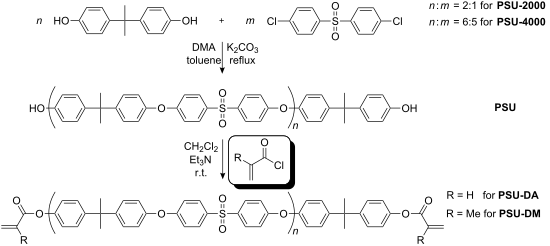
Scheme 1: Synthesis of polysulfone macromonomers.

Figure 1: FT-IR spectra of PSU-2000, PSU-DA-2000 and PSU-DM-2000.

Figure 2: 1H NMR spectra of PSU-2000 (a), PSU-DA-2000 (b) and PSU-DM-2000 (c) in CDCl3.
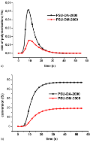
Figure 3: Rate (a) and conversion (b) of photo induced polymerization of PSU-DA-2000 and PSU-DM-2000.
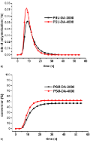
Figure 4: Rate (a) and conversion (b) of photo induced polymerization of PSU-DAs with different molecular wei...

Figure 5: TGA thermograms of the precursor oligomers (PSU-2000) (a), and macromonomer, PSU-DA-2000 before (b)...

Figure 6: DSC results of the precursor oligomer (PSU-2000) (a), and macromonomer, PSU-DA-2000 before (b), and...
Mitomycins syntheses: a recent update
- Jean-Christophe Andrez
Beilstein J. Org. Chem. 2009, 5, No. 33, doi:10.3762/bjoc.5.33


Graphical Abstract

Scheme 1: Aziridine containing natural products.

Scheme 2: Mitomycin structures and nomenclature.

Scheme 3: Base catalysed epimerization of mitomycin B.

Scheme 4: Biosynthesis of mitomycin C (MMC) 7.

Scheme 5: Mode of action of mitomycin C.

Scheme 6: The N–C3–C9a disconnection.

Scheme 7: Danishefsky’s Retrosynthesis of mitomycin K.

Scheme 8: Hetero Diels–Alder reaction en route to mitomycins.

Scheme 9: Nitroso Diels–Alder cycloaddition.

Scheme 10: Frank azide cycloadddition.

Scheme 11: Final steps of mitomycin K synthesis. aPDC, DCM; bPhSCH2N3, PhH, 80 °C; cL-selectride, THF, −78 °C; ...

Scheme 12: Naruta–Maruyama retrosynthesis.

Scheme 13: Synthesis of a leucoaziridinomitosane by nitrene cycloaddition. aAlCl3-Et2O; bNaH, ClCH2OMe; cn-BuL...

Scheme 14: Thermal decomposition of azidoquinone 51.

Scheme 15: Diastereoselectivity during the cycloaddition.

Scheme 16: Oxidation with iodo-azide.

Scheme 17: Williams’ approach towards mitomycins.aDEIPSCl, Imidazole, DCM; bPd/C, HCO2NH4, MeOH; cAllocCl, NaH...

Scheme 18: Synthesis of pyrrolidones by homoconjugate addition.
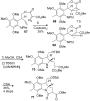
Scheme 19: Homoconjugate addition on the fully functionalized substrate.

Scheme 20: Introduction of the olefin.

Scheme 21: Retrosynthesis of N–C9a, N–C3 bond formation.

Scheme 22: Synthesis of the pyrrolo[1,2]indole 82 using N-PSP activation.aAc2O, Py; bAc2O, Hg(OAc)2, AcOH, 90%...

Scheme 23: Synthesis of an aziridinomitosane. am-CPBA, DCM then iPr2NH, CCl4 reflux; bK2CO3, MeOH; cBnBr, KH; d...

Scheme 24: Oxidation products of a leucoaziridinomitosane obtained from a Polonovski oxidation.

Scheme 25: Polonovski oxidation of an aziridinomitosane. am-CPBA; bPd/C, H2; cDimethoxypropane, PPTS.

Scheme 26: The C1–C9a disconnection.

Scheme 27: Ziegler synthesis of desmethoxymitomycin A.aIm2C=O, THF; bNH3; cTMSOTf, 2,6-di-tert-butylpyridine, ...

Scheme 28: Transformation of sodium erythorbate.aTBDMSCl; bNaN3; cPPh3; d(Boc)2O, DMAP; eTBAF; fTf2O, Pyr.

Scheme 29: Formation of C9,C10-unsaturation in the mitomycins. am-CPBA, DCM; bO3, MeOH; cMe2S; dKHMDS, (EtO)3P...

Scheme 30: Fragmentation mechanism.

Scheme 31: Michael addition-cyclisation.

Scheme 32: SmI2 8-endo-dig cyclisation.

Scheme 33: Synthesis of pyrrolo[1,2-a]indole by 5-exo-dig radical cyclization.

Scheme 34: The C9–C9a disconnection.

Scheme 35: Intramolecular nitrile oxide cycloaddition.

Scheme 36: Regioselectivity of the INOC.

Scheme 37: Fukuyama’s INOC strategy.

Scheme 38: Synthesis of a mitosane core by rearrangement of a 1-(1-pyrrolidinyl)-1,3-butadiene.

Scheme 39: Sulikowski synthesis of an aziridinomitosene. aPd(Tol3P)2Cl2, Bu3SnF, 140; bH2, Pd/C; cTFAA, Et3N; d...

Scheme 40: Enantioselective carbene insertion.

Scheme 41: Parson’s radical cyclization.

Scheme 42: Cha’s mitomycin B core synthesis.

Scheme 43: The N-aromatic disconnection.

Scheme 44: Kishi retrosynthesis.

Scheme 45: Kishi synthesis of a starting material. aallyl bromide, K2CO3, acetone, reflux; bN,N-Dimethylanilin...
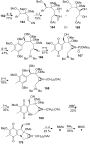
Scheme 46: Kishi synthesis of MMC 7. aLDA, THF, −78 °C then PhSeBr, THF, −78 °C; bH2O2, THF-EtOAc; cDIBAL, DCM...

Scheme 47: Acid catalyzed degradation of MMC 7.

Scheme 48: In vivo formation of apomitomycin B.

Scheme 49: Advanced intermediate for apomitomycin B synthesis.

Scheme 50: Remers synthesis of a functionalized mitosene. aTMSCl, Et3N, ZnCl2 then NBS; bAcOK; cNH2OH; dPd/C, H...

Scheme 51: Coleman synthesis of desmethoxymitomycin A. aSnCl2, PhSH, Et3N, CH3CN; bClCO2Bn, Et3N; cPPh3, DIAD,...

Scheme 52: Transition state and pyrrolidine synthesis.

Scheme 53: Air oxidation of mitosanes and aziridinomitosanes.

Scheme 54: The C9-aromatic disconnection.

Scheme 55: Synthesis of the aziridine precursor. aLHMDS, THF; bNaOH; c(s)-α-Me-BnNH2, DCC, HOBT; dDIBAL; eK2CO3...

Scheme 56: Synthesis of 206 via enamine conjugate addition.

Scheme 57: Rapoport synthesis of an aziridinomitosene.

Scheme 58: One pot synthesis of a mitomycin analog.

Scheme 59: Synthesis of compound 218 via intramolecular Heck coupling. aEtMgCl, THF, then 220; bMsCl, Et3N; cN...

Scheme 60: Elaboration of indole 223. aEt3N, Ac2O; bAcOH; cSOCl2, Et3N; dNaN3, DMF; eH2SO4, THF; fK2CO3, MeOH; ...

Scheme 61: C9-C9a functionalization from indole.

Scheme 62: Synthesis of mitomycin K. a2 equiv. MoO5.HMPA, MeOH; bPPh3, Et3N, THF-H2O; cMeOTf, Py, DCM; dMe3SiCH...

Scheme 63: Configurational stability of mitomycin K derivatives.

Scheme 64: Epimerization of carbon C9a in compound 227b.

Scheme 65: Corey–Chaykovsky synthesis of indol 235.

Scheme 66: Cory intramolecular aza-Darzens reaction for the formation of aziridinomitosene 239.

Scheme 67: Jimenez synthesis of aziridinomitosene 242.

Scheme 68: Von Braun opening of indoline 244.

Scheme 69: C9a oxidation of an aziridinomitosane with DDQ/OsO4.

Scheme 70: Synthesis of epi-mitomycin K. aNaH, Me2SO4; bH2, Pd/C; cMitscher reagent [165]; d[(trimethylsilyl)methyl...

Scheme 71: Mitomycins rearrangement.

Scheme 72: Fukuyama’s retrosynthesis.

Scheme 73: [2+3] Cycloaddition en route to isomitomycin A. aToluene, 110 °C; bDIBAL, THF, −78 °C; cAc2O, Py.; d...

Scheme 74: Final steps of Fukuyama’s synthesis.

Scheme 75: “Crisscross annulation”.

Scheme 76: Synthesis of 274; the 8-membered ring 274 was made using a crisscross annulation. a20% Pd(OH)2/C, H2...

Scheme 77: Conformational analysis of compound 273 and 275.

Scheme 78: Synthesis of a mitomycin analog. aNa2S2O4, H2O, DCM; bBnBr (10 equiv), K2CO3, 18-crown-6 (cat.), TH...

Scheme 79: Vedejs retrosynthesis.

Scheme 80: Formation of the azomethine ylide.

Scheme 81: Vedejs second synthesis of an aziridinomitosene. aDIBAL; bTPAP, NMO; c287; dTBSCl, imidazole.

Scheme 82: Trityl deprotection and new aziridine protecting group 300.

Scheme 83: Ene reaction towards benzazocinones.

Scheme 84: Benzazocenols via homo-Brook rearrangement.

Scheme 85: Pt-catalyzed [3+2] cycloaddition.

Scheme 86: Carbonylative lactamization entry to benzazocenols. aZn(OTf)2, (+)-N-methylephedrine, Et3N, TMS-ace...

Scheme 87: 8 membered ring formation by RCM. aBOC2O, NaHCO3; bTBSCl, Imidazole, DMF; callyl bromide, NaH, DMF; ...

Scheme 88: Aziridinomitosene synthesis. aTMSN3; bTFA; cPOCl3, DMF; dNaClO2, NaH2PO4, 2-methyl-2-butene; eMeI, ...

Scheme 89: Metathesis from an indole.

Scheme 90: Synthesis of early biosynthetic intermediates of mitomycins.
Reduction of arenediazonium salts by tetrakis(dimethylamino)ethylene (TDAE): Efficient formation of products derived from aryl radicals
- Mohan Mahesh,
- John A. Murphy,
- Franck LeStrat and
- Hans Peter Wessel
Beilstein J. Org. Chem. 2009, 5, No. 1, doi:10.3762/bjoc.5.1
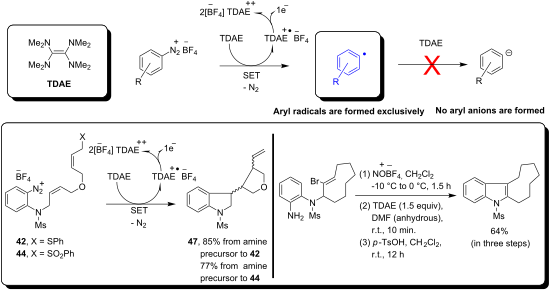
- like a sulfide, sulfoxide or sulfone is necessary for the self-termination of the 5-exo-trig radical cyclization reactions to avoid competing intermolecular radical side-reactions. The TDAE-mediated radical-based addition-elimination route for the construction of indole ring systems warranted anhydrous

Graphical Abstract

Scheme 1: Aza- and thia-substituted electron donors.

Scheme 2: Radical-polar crossover reaction of arenediazonium salts by TTF.

Scheme 3: Studies on the reductive radical cyclization of arenediazonium salt 16 by TDAE.

Scheme 4: Preparation of the arenediazonium salts 31a–d. Reagents and conditions: (a) 23, NaH, THF, 0 °C, 0.5...

Scheme 5: Cascade radical cyclizations of arenediazonium salts 42 and 44 by TDAE. Reagents and conditions: (a...

Scheme 6: TDAE-mediated radical based addition-elimination route to indoles.

Scheme 7: Cyclization of the arenediazonium salts 49b–d by TDAE. Reagents and conditions: (a) NOBF4, CH2Cl2, ...

Scheme 8: Cyclization of the arenediazonium salt 62 by TDAE. Reagents and conditions: (a) 2-Nitrobenzenesulfo...

Scheme 9: Mechanism for the formation of the tetracyclic sulfonamide 65.

Scheme 10: Possible mechanism for the formation of indole (63) and indole sulfonamide 64.
Recent progress on the total synthesis of acetogenins from Annonaceae
- Nianguang Li,
- Zhihao Shi,
- Yuping Tang,
- Jianwei Chen and
- Xiang Li
Beilstein J. Org. Chem. 2008, 4, No. 48, doi:10.3762/bjoc.4.48
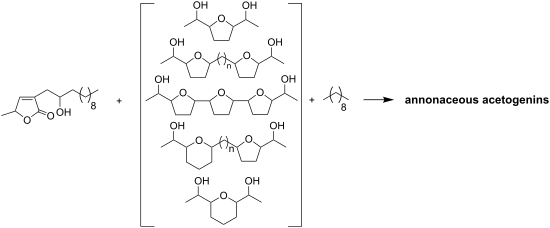
- intermediate 31; further manipulation and chain elongation at both ends of 31 produced an advanced intermediate 32. The anion of the phenyl sulfone 33, readily prepared from D-glutamic acid, was condensed directly with the ester function of 32 to give the α-keto sulfone 34, which was futher elaborated to ester

Graphical Abstract

Scheme 1: Total synthesis of longifolicin by Marshall’s group.

Scheme 2: Total synthesis of corossoline by Tanaka’s group.

Scheme 3: Total synthesis of corossoline by Wu’s group.

Scheme 4: Total synthesis of pseudo-annonacin A by Hanessian’s group.

Scheme 5: Total synthesis of tonkinecin by Wu’s group.

Scheme 6: Total synthesis of gigantetrocin A by Shi’s group.

Scheme 7: Total synthesis of annonacin by Wu’s group.

Scheme 8: Total synthesis of solamin by Kitahara’s group.

Scheme 9: Total synthesis of solamin by Mioskowski’s group.

Scheme 10: Total synthesis of cis-solamin by Makabe’s group.

Scheme 11: Total synthesis of cis-solamin by Brown’s group.

Scheme 12: The formal synthesis of (+)-cis-solamin by Donohoe’s group.

Scheme 13: Total synthesis of cis-solamin by Stark’s group.

Scheme 14: Total synthesis of mosin B by Tanaka’s group.

Scheme 15: Total synthesis of longicin by Hanessian’s group.

Scheme 16: Total synthesis of murisolin and 16,19-cis-murisolin by Tanaka’s group.

Scheme 17: Synthesis of a stereoisomer library of (+)-murisolin by Curran’s group.

Scheme 18: Total synthesis of murisolin by Makabe’s group.

Scheme 19: Total synthesis of reticulatain-1 by Makabe’s group.

Scheme 20: Total synthesis of muricatetrocin C by Ley’s group.

Scheme 21: Total synthesis of (4R,12S,15S,16S,19R,20R,34S)-muricatetrocin (146) and (4R,12R,15S,16S,19R,20R,34S...

Scheme 22: Total synthesis of parviflorin by Hoye’s group.

Scheme 23: Total synthesis of parviflorin by Trost’s group.

Scheme 24: Total synthesis of trilobacin by Sinha’s group.

Scheme 25: Total synthesis of 15-epi-annonin I 181b by Scharf’s group.

Scheme 26: Total synthesis of squamocin A and squamocin D by Scharf’s group.

Scheme 27: Total synthesis of asiminocin by Marshall’s group.

Scheme 28: Total synthesis of asiminecin by Marshall’s group.

Scheme 29: Total synthesis of (+)-(30S)-bullanin by Marshall’s group.

Scheme 30: Total synthesis of uvaricin by the group of Sinha and Keinan.

Scheme 31: Formal synthesis of uvaricin by Burke’s group.

Scheme 32: Total synthesis of trilobin by Marshall’s group.

Scheme 33: Total synthesis of trilobin by the group of Sinha and Keinan.

Scheme 34: Total synthesis of asimilobin by the group of Wang and Shi.

Scheme 35: Total synthesis of squamotacin by the group of Sinha and Keinan.

Scheme 36: Total synthesis of asimicin by Marshall’s group.

Scheme 37: Total synthesis of asimicin by the group of Sinha and Keinan.

Scheme 38: Total synthesis of asimicin by Roush’s group.

Scheme 39: Total synthesis of asimicin by Marshall’s group.

Scheme 40: Total synthesis of 10-hydroxyasimicin by Ley’s group.

Scheme 41: Total synthesis of asimin by Marshall’s group.

Scheme 42: Total synthesis of bullatacin by the group of Sinha and Keinan.

Scheme 43: Total synthesis of bullatacin by Roush’s group.

Scheme 44: Total synthesis of bullatacin by Pagenkopf’s group.

Scheme 45: Total synthesis of rollidecins C and D by the group of Sinha and Keinan.

Scheme 46: Total synthesis of 30(S)-hydroxybullatacin by Marshall’s group.

Scheme 47: Total synthesis of uvarigrandin A and 5(R)-uvarigrandin A by Marshall’s group.

Scheme 48: Total synthesis of membranacin by Brown’s group.

Scheme 49: Total synthesis of membranacin by Lee’s group.

Scheme 50: Total synthesis of rolliniastatin 1 and rollimembrin by Lee’s group.

Scheme 51: Total synthesis of longimicin D by the group of Maezaki and Tanaka.

Scheme 52: Total synthesis of the structure proposed for mucoxin by Borhan’s group.

Scheme 53: Modular synthesis of adjacent bis-THF annonaceous acetogenins by Marshall’s group.

Scheme 54: Total synthesis of 4-deoxygigantecin by Tanaka’s group.

Scheme 55: Total synthesis of squamostatins D by Marshall’s group.

Scheme 56: Total synthesis of gigantecin by Crimmins’s group.

Scheme 57: Total synthesis of gigantecin by Hoye’s group.

Scheme 58: Total synthesis of cis-sylvaticin by Donohoe’s group.

Scheme 59: Total synthesis of 17(S),18(S)-goniocin by Sinha’s group.

Scheme 60: Total synthesis of goniocin and cyclogoniodenin T by the group of Sinha and Keinan.

Scheme 61: Total synthesis of jimenezin by Takahashi’s group.

Scheme 62: Total synthesis of jimenezin by Lee’s group.

Scheme 63: Total synthesis of jimenezin by Hoffmann’s group.

Scheme 64: Total synthesis of muconin by Jacobsen’s group.

Scheme 65: Total synthesis of (+)-muconin by Kitahara’s group.

Scheme 66: Total synthesis of muconin by Takahashi’s group.

Scheme 67: Total synthesis of muconin by the group of Yoshimitsu and Nagaoka.

Scheme 68: Total synthesis of mucocin by the group of Sinha and Keinan.

Scheme 69: Total synthesis of mucocin by Takahashi’s group.

Scheme 70: Total synthesis of (−)-mucocin by Koert’s group.

Scheme 71: Total synthesis of mucocin by the group of Takahashi and Nakata.

Scheme 72: Total synthesis of mucocin by Evans’s group.

Scheme 73: Total synthesis of mucocin by Mootoo’s group.

Scheme 74: Total synthesis of (−)-mucocin by Crimmins’s group.

Scheme 75: Total synthesis of pyranicin by the group of Takahashi and Nakata.

Scheme 76: Total synthesis of pyranicin by Rein’s group.

Scheme 77: Total synthesis of proposed pyragonicin by the group of Takahashi and Nakata.

Scheme 78: Total synthesis of pyragonicin by Rein’s group.

Scheme 79: Total synthesis of pyragonicin by Takahashi’s group.

Scheme 80: Total synthesis of squamostanal A by Figadère’s group.

Scheme 81: Total synthesis of diepomuricanin by Tanaka’s group.

Scheme 82: Total synthesis of (−)-muricatacin [(R,R)-373a] and its enantiomer (+)-muricatacin [(S,S)-373b] by ...

Scheme 83: Total synthesis of epi-muricatacin (+)-(S,R)-373c and (−)-(R,S)-373d by Scharf’s group.

Scheme 84: Total synthesis of (−)-muricatacin 373a and 5-epi-(−)-muricatacin 373d by Uang’s group.

Scheme 85: Total synthesis of four stereoisomers of muricatacin by Yoon’s group.

Scheme 86: Total synthesis of (+)-muricatacin by Figadère’s group.

Scheme 87: Total synthesis of (+)-epi-muricatacin and (−)-muricatacin by Couladouros’s group.

Scheme 88: Total synthesis of muricatacin by Trost’s group.

Scheme 89: Total synthesis of (−)-(4R,5R)-muricatacin by Heck and Mioskowski’s group.

Scheme 90: Total synthesis of muricatacin (−)-373a by the group of Carda and Marco.

Scheme 91: Total synthesis of (−)- and (+)-muricatacin by Popsavin’s group.

Scheme 92: Total synthesis of (−)-muricatacin by the group of Bernard and Piras.

Scheme 93: Total synthesis of (−)-muricatacin by the group of Yoshimitsu and Nagaoka.

Scheme 94: Total synthesis of (−)-muricatacin by Quinn’s group.

Scheme 95: Total synthesis of montecristin by Brückner’s group.

Scheme 96: Total synthesis of (−)-acaterin by the group of Franck and Figadère.

Scheme 97: Total synthesis of (−)-acaterin by Singh’s group.

Scheme 98: Total synthesis of (−)-acaterin by Kumar’s group.

Scheme 99: Total synthesis of rollicosin by Quinn’s group.

Scheme 100: Total synthesis of Rollicosin by Makabe’s group.

Scheme 101: Total synthesis of squamostolide by Makabe’s group.

Scheme 102: Total synthesis of tonkinelin by Makabe’s group.
Radical cascades using enantioenriched 7-azabenzonorbornenes and their applications in synthesis
- David M. Hodgson and
- Leonard H. Winning
Beilstein J. Org. Chem. 2008, 4, No. 38, doi:10.3762/bjoc.4.38
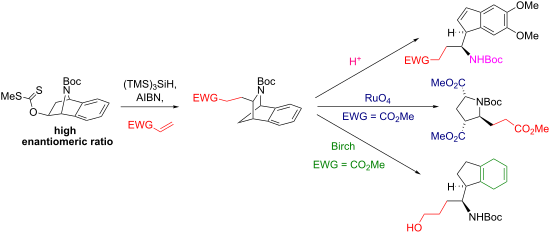
- -observed trend that alkenes bearing less strongly electron-withdrawing substituents were less effective electrophiles in this reaction. Phenyl vinyl sulfone gave trapped rearranged azacycle 13 in 43% yield, with rearranged–reduced azacycle 8 also isolated in 38% yield, suggesting that the rate of
- electrophile trapping with the sulfone corresponds approximately to the rate of hydrogen atom transfer from (TMS)3SiH. Attempted reaction with methyl vinyl ketone, N,N-dimethylacrylamide and methyl propiolate gave rearranged-reduced azacycle 8 in modest yields, as well as small quantities of hydrosilylated
- electrophile (for details see Supporting Information File 1) [26]. Having probed the generality of the reaction, attempts were made to optimise the yields of the electrophile trapping. These studies were performed with phenyl vinyl sulfone, since this had undergone partial electrophile trapping and partial

Graphical Abstract

Scheme 1: Cyclopropylmethyl–homoallyl and nortricyclyl–norbornenyl radical systems.

Scheme 2: Deoxygenation-rearrangement-electrophile trapping.

Figure 1: Radical SOMO/α-nitrogen lone-pair interaction in the rearranged radical 7.

Figure 2: Other products obtained from xanthate 5 by tandem deoxygenation–rearrangement–electrophile trapping....

Scheme 3: Asymmetric hydroboration–oxidation of alkenes 14, 16 and 18.

Scheme 4: Deoxygenation–rearrangement–isomerisation of xanthates 20 and 23.

Scheme 5: Deoxygenation–rearrangement–electrophile trapping of xanthates 20 and 23.

Scheme 6: 2-Azabenzonorbornene as a masked pyrrolidine.

Scheme 7: Ring-opening–hydration–oxidation of azacycle 8.

Scheme 8: Preparation of trisubstituted pyrrolidine (+)-36.

Scheme 9: Preparation of pyrrolidine diester (+)-35 from Vince’s lactam 37.

Scheme 10: Acid-catalysed ring-opening–oxidation of azacycle (+)-8.

Scheme 11: Birch reduction of (+)-8 and 10.
The role of an aromatic group in remote chiral induction during conjugate addition of α-sulfonylallylic carbanions to ethyl crotonate
- Shlomo Levinger,
- Ranjeet Nair and
- Alfred Hassner
Beilstein J. Org. Chem. 2008, 4, No. 32, doi:10.3762/bjoc.4.32

- -substituted allyl sulfone 1, containing a stereogenic center, proceeded with diastereoselectivity of greater than 8:2 (ratio of 3 to 4), when the Ar substituent in 1 was phenyl or 1-naphthyl (Scheme 1). On the other hand, when this substituent (Ar in Scheme 1) was cyclohexyl, no selectivity at all was
- observed (dr 1:1). We had proposed that π–Li+ interaction may be responsible for this phenomenon. We had shown earlier [2] that conjugate addition of lithiated allyl sulfone 5 to unsaturated esters of type 2 takes place α-regioselectively and almost exclusively in an anti fashion (where the syn and anti
- by X-ray analysis) to have the 3R,4S absolute configuration [1]. It was important to examine the effect of other aromatic substituents Ar in amino-substituted sulfone 1 and their influence on this remote induction of chirality, in the hope of further improving the remote diastereoselectivity. We

Graphical Abstract

Scheme 1: Transmission of asymmetry in the conjugate addition of allyl sulfones to ethyl crotonate depending ...

Scheme 2: Preparation of donor precursors for conjugate addition (1), bearing a remote stereogenic center.

Scheme 3: Borch reductive amination of acetophenones.

Scheme 4: Preparation of [(9-anthryl)alkyl]- and (mesitylalkyl)amines 6h and 6j from nitriles via imines 8.

Figure 1: Calculated minimum energy conformation of lithiated amino-substituted sulfone 1a showing π-interact...
Efficient 1,4-addition of α-substituted fluoro(phenylsulfonyl)methane derivatives to α,β-unsaturated compounds
- G. K. Surya Prakash,
- Xiaoming Zhao,
- Sujith Chacko,
- Fang Wang,
- Habiba Vaghoo and
- George A. Olah
Beilstein J. Org. Chem. 2008, 4, No. 17, doi:10.3762/bjoc.4.17
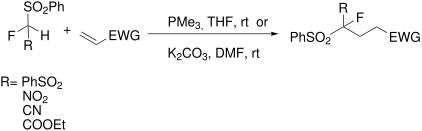
- -addition to α,β-unsaturated esters, ketones, sulfone, nitriles and propynoates. Supporting Information Supporting Information File 83: Experimental procedures, full spectroscopic data and spectra. Supporting Information File 84: Spectra. Acknowledgements Support of our work by the Loker Hydrocarbon

Graphical Abstract

Scheme 1: Reaction mechanism for phosphine catalyzed 1,4-addition to α,β-unsaturated compounds.
The enantiospecific synthesis of (+)-monomorine I using a 5-endo- trig cyclisation strategy
- Malcolm B. Berry,
- Donald Craig,
- Philip S. Jones and
- Gareth J. Rowlands
Beilstein J. Org. Chem. 2007, 3, No. 39, doi:10.1186/1860-5397-3-39
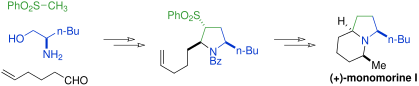
- University, Private Bag 11 222, Palmerston North, New Zealand 10.1186/1860-5397-3-39 Abstract We have developed a general strategy for the synthesis of 2,5-syn disubstituted pyrrolidines that is based on the multi-faceted reactivity of the sulfone moiety and a 5-endo-trig cyclisation. This methodology was
- , such as tetrahydrofurans and pyrrolidines, makes these motifs attractive targets for synthesis. Over the last decade we have developed a powerful general strategy for the preparation of such compounds based upon the multi-faceted reactivity of the sulfone group and the formally disfavoured 5-endo-trig
- mode of cyclisation. [1][2][3][4][5][6] The methodology allows the conversion of epoxides (X = O) or aziridines (X = N-PG) (2) into the desired trisubstituted tetrahydrofurans or pyrrolidines (5) via a series of sulfone-mediated transformations (Scheme 1). Ring-opening 2 with the sulfone-stabilised

Graphical Abstract

Scheme 1: General strategy for the synthesis of heterocycles via 5-endo-trig cyclisation

Scheme 2: Retrosynthesis of (+)-monomorine I
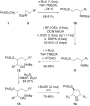
Scheme 3: The sulfone-mediated synthesis of 2,5-syn disubstituted pyrrolidines via a 5-endo-trig cyclisation

Scheme 4: The deprotection of N-benzoylpyrrolidines

Scheme 5: Synthesis of N-benzoyl protected pyrrolidine required for the preparation of (+)-monomorine I

Scheme 6: Mercury-mediated hydroamination

Scheme 7: Proposed transition state for mercury-mediate hydroamination

Scheme 8: Model study for the reductive amination-based cyclisation

Scheme 9: The synthesis of (+)-monomorine I



