


Search results
Search for "1,3-dipolar cycloaddition" in Full Text gives 165 result(s) in Beilstein Journal of Organic Chemistry.
Chiral gold(I) vs chiral silver complexes as catalysts for the enantioselective synthesis of the second generation GSK-hepatitis C virus inhibitor
Beilstein J. Org. Chem. 2011, 7, 988–996, doi:10.3762/bjoc.7.111
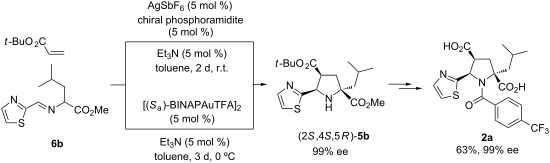
- , Apdo. 1072, E-20018 San Sebastián, Spain 10.3762/bjoc.7.111 Abstract The synthesis of a GSK 2nd generation inhibitor of the hepatitis C virus, by enantioselective 1,3-dipolar cycloaddition between a leucine derived iminoester and tert-butyl acrylate, was studied. The comparison between silver(I) and
- origin of the enantioselectivity of the chiral gold(I) catalyst was justified according to DFT calculations, the stabilizing coulombic interaction between the nitrogen atom of the thiazole moiety and one of the gold atoms being crucial. Keywords: BINAP; 1,3-dipolar cycloaddition; gold; HCV
- synthesis of the endo-pyrrolidine core of 5 is the key step for the preparation of these antiviral agents, and can be efficiently achieved by a 1,3-dipolar cycloaddition (1,3-DC) between the corresponding azomethine ylide and an alkyl acrylate [14][15][16][17][18] (Scheme 1). The first synthesis of racemic




High chemoselectivity in the phenol synthesis
Beilstein J. Org. Chem. 2011, 7, 794–801, doi:10.3762/bjoc.7.90
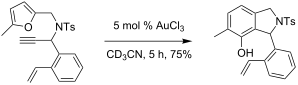
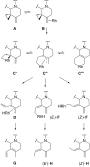
- intermediates A or B. Apart from intermolecular trapping [26][27][28][29][30][31][32][33], intramolecular trapping of such carbenoids has also been reported [34]. One option would be to offer a competing carbonyl group, to produce a carbonyl ylide, which could then undergo a 1,3-dipolar cycloaddition [35]. The
- b). The latter would form intermediate H, which could then either afford product 17 via intramolecular 1,3-dipolar cycloaddition with the olefin, or could form the diene 19 by proton migration. The synthesis of 16 was only possible by a 9-step sequence (Scheme 8). The starting point was a Claisen


Synthetic applications of gold-catalyzed ring expansions
Beilstein J. Org. Chem. 2011, 7, 767–780, doi:10.3762/bjoc.7.87
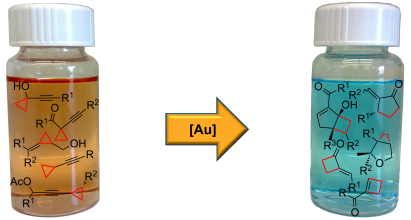
- formation of the 1,4-furan dipole (Scheme 21). In fact, a resonance structure of 60 can be envisaged entailing a gold–carbene and a carbonyl ylide 63. Upon 1,3-dipolar cycloaddition with the alkoxy vinyl ether, bridged bicycle 64 is formed. 1,2-Alkyl migration and bridge opening produces a spiro cation 66


Advances in synthetic approach to and antifungal activity of triazoles
Beilstein J. Org. Chem. 2011, 7, 668–677, doi:10.3762/bjoc.7.79

- which an azide and an alkyne undergo a 1,3-dipolar cycloaddition reaction in the presence of a catalyst such as copper (Scheme 1) or ruthemium (Scheme 2) [27]. Some new synthetic methods for 1,2,3-triazoles are given below (Scheme 3, Scheme 4) [28][29]. Structure activity relationships have revealed
- occupies the most important place in the treatment of fungal diseases. The triazole derivatives noted below were synthesized by various groups and show antifungal activity. Novel 1,2,3-triazole-linked with β-lactam–bile acid conjugates were prepared via 1,3-dipolar cycloaddition reactions of azido β
- ]. Holla et al. synthesized triazole derivatives by the 1,3-dipolar cycloaddition reaction of 4-azido-8-trifluoromethylquinoline with ethyl acetoacetate and acetylacetone, respectively, and tested for antifungal activity against Candida albicans. Among the various synthesized compounds, 1-(1-(8


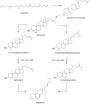


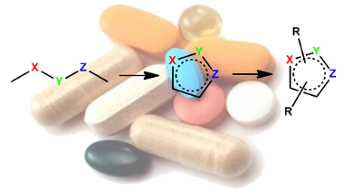
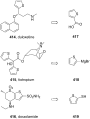
An overview of the key routes to the best selling 5-membered ring heterocyclic pharmaceuticals
Beilstein J. Org. Chem. 2011, 7, 442–495, doi:10.3762/bjoc.7.57
- pyrazole [74]. However, preparation of the alkyne intermediates involves a number of steps and often requires extensive column chromatography, which makes it an unattractive method for synthesis on a larger scale (Scheme 48). A novel 1,3-dipolar cycloaddition between a nitrile imide 244 and an



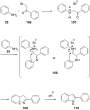




Rh-Catalyzed rearrangement of vinylcyclopropane to 1,3-diene units attached to N-heterocycles
Beilstein J. Org. Chem. 2011, 7, 298–303, doi:10.3762/bjoc.7.39

- domino 1,3-dipolar cycloaddition/thermal rearrangement sequence, were converted by Wittig methylenation to the corresponding vinylcyclopropanes (VCPs), which underwent rearrangement to 1,3-dienes in the presence of the Wilkinson Rh(I) complex under microwave heating. The previously unexplored Rh(I
- shift in the cyclopropanated 1,6-diradical intermediate, which in this case is probably facilitated by the enhanced mobility of the benzylic hydrogen and by the formation of the conjugationally stabilized imine 9 [11]. The 1,3-dipolar cycloaddition/thermal rearrangement domino reaction of BCP (2) with
- (Scheme 6). Conclusion Azaheterocycles 14, 15 and 17 containing a spiro-annelated VCP moiety have been synthesized starting from cyclic nitrones and BCP by a three-step two-pot sequence consisting of a 1,3-dipolar cycloaddition, thermal rearrangement and Wittig methylenation. These compounds in the


Calix[4]arene-click-cyclodextrin and supramolecular structures with watersoluble NIPAAM-copolymers bearing adamantyl units: “Rings on ring on chain”
Beilstein J. Org. Chem. 2010, 6, 784–788, doi:10.3762/bjoc.6.83
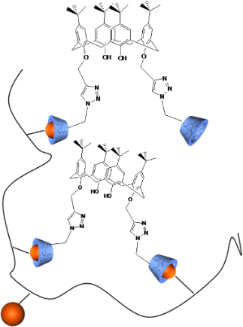
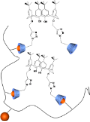
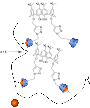
- -cyclodextrin combi-receptor (4) was synthesized via copper-catalyzed Huisgen 1,3-dipolar cycloaddition. Investigations of the interactions with an adamantyl moiety containing copolymer have been carried out, showing the existence of a supramolecular structure. Due to deprotonation of the calixarene moieties at

Addition of lithiated enol ethers to nitrones and subsequent Lewis acid induced cyclizations to enantiopure 3,6-dihydro-2H-pyrans – an approach to carbohydrate mimetics
Beilstein J. Org. Chem. 2010, 6, No. 75, doi:10.3762/bjoc.6.75

- further diversification of our pyran derivatives, e.g., by 1,3-dipolar cycloaddition leading to isoxazole derivatives [22] or, by addition of nucleophiles to this electrophilic unit [9]. Compounds 8 and 21 proved to be excellent precursors for the stereoselective preparation of enantiopure aminopyrans


New amphiphilic glycopolymers by click functionalization of random copolymers – application to the colloidal stabilisation of polymer nanoparticles and their interaction with concanavalin A lectin
Beilstein J. Org. Chem. 2010, 6, No. 58, doi:10.3762/bjoc.6.58
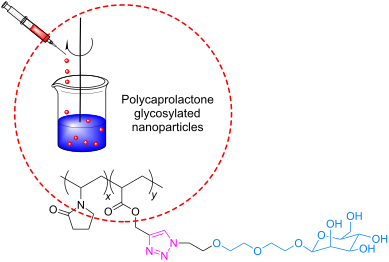
- surface of the nanoparticles Results and Discussion Synthesis and characterization of the polymer surfactants Besides well-known functionalization of anhydride-based copolymers, the grafting of carbohydrate moieties on a polymer backbone by Huisgen [2 + 3] cycloaddition (CuI-catalyzed 1,3-dipolar
- cycloaddition of azide and alkynes, CuAAC) constitutes another interesting approach. The versatile nature of this reaction has led to a tremendous amount of work, mainly due to the quantitative yields and the possibility of carrying out the synthesis in either organic solvents or water. Moreover, since various


An expedient and new synthesis of pyrrolo[1,2-b]pyridazine derivatives
Beilstein J. Org. Chem. 2009, 5, No. 66, doi:10.3762/bjoc.5.66

- cycloaddition of dimethyl acetylenedicarboxylate to the Reissert compound of pyridazine [20], the 1,3-dipolar cycloaddition of pyridazinium dichloromethylide generated by the carbene method [21], and the cycloaddition of alkylidene cyclopropane derivatives to pyridazine in the presence of Pd(PPh3)4 [22


Mitomycins syntheses: a recent update
Beilstein J. Org. Chem. 2009, 5, No. 33, doi:10.3762/bjoc.5.33

- the planned construction of the aziridine by tandem SN2 displacement. Exploiting the facial selectivity of compound 38, the direct introduction of an aziridine equivalent was attempted by 1,3-dipolar cycloaddition of an alkyl azide. As Frank noted, cycloaddition of azides to 3H-pyrrolo [1,2-a]indoles




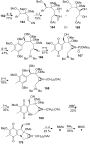


Dimerization of propargyl and homopropargyl 6-azido- 6-deoxy- glycosides upon 1,3-dipolar cycloaddition
Beilstein J. Org. Chem. 2008, 4, No. 30, doi:10.3762/bjoc.4.30

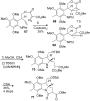
- Nikolas Pietrzik Daniel Schmollinger Thomas Ziegler Institute of Organic Chemistry, University of Tuebingen, Auf der Morgenstelle 18, 72076 Tuebingen, Germany. 10.3762/bjoc.4.30 Abstract Copper-catalyzed, thermal or microwave promoted 1,3-dipolar cycloaddition (Click Reaction) of 2-propynyl and 3
- -triazoles which are known to be easily generated through a copper-catalyzed 1,3-dipolar cycloaddition of an organic azide and an alkynyl derivative (Click Reaction) [5][6][7]. For review articles on copper-catalyzed Click Reactions see references [8][9][10][11]. Recently, we applied this approach to a
- series of 1,2,3-triazole containing per-O-acetyl-glycosides which were prepared by copper-catalyzed 1,3-dipolar cycloaddition either between fully acetylated propargyl 1-thio-glycosides and t-butyl (S)-4-azido-3-fluorenylmethyloxycarbamido-butyrate or between Fmoc-L-Asp(OtBu)-propargyl amide and 2,3,4,6


Synthesis of new triazole- based trifluoromethyl scaffolds
Beilstein J. Org. Chem. 2008, 4, No. 19, doi:10.3762/bjoc.4.19

- derivatives to afford 1,4-disubstituted 1,2,3-triazoles through a Huisgen 1,3-dipolar cycloaddition. The reaction is catalyzed by a Cu(I) species in acetonitrile, and the corresponding products are obtained in good yields. This process thus offers an entry to new trifluoromethyl peptidomimetics as interesting
- trifluoromethyl groups on the conformation of peptidomimetics, we decided to explore the preparation of trifluoromethyl triazole derivatives. Herein we turn our attention to the synthesis of new triazoles from trifluoromethyl propargylamines using the Huisgen 1,3-dipolar cycloaddition [27][28][29]. Results and
- Discussion The synthetic approach depicted in Scheme 1 shows that the desired compounds could be easily obtained via a 1,3-dipolar cycloaddition from the corresponding propargylamines which are obtained using an efficient procedure from the trifluoromethyl imines previously described by our group [30][31][32


Synthesis of densely functionalized enantiopure indolizidines by ring- closing metathesis (RCM) of hydroxylamines from carbohydrate- derived nitrones
Beilstein J. Org. Chem. 2007, 3, No. 44, doi:10.1186/1860-5397-3-44

- . [5][6][7][8][9][10][11][12][13][14][15][16][17][18] We accomplished the total syntheses of some indolizidine alkaloids and of several non-natural analogues employing chiral nitrones as key intermediates, either as dipolarophiles in 1,3-dipolar cycloaddition chemistry [19][20] or as electrophiles in


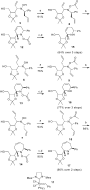

Aroylketene dithioacetal chemistry: facile synthesis of 4-aroyl- 3-methylsulfanyl- 2-tosylpyrroles from aroylketene dithioacetals and TosMIC
Beilstein J. Org. Chem. 2007, 3, No. 31, doi:10.1186/1860-5397-3-31

- heterocyclic systems, examples of their participation in the cycloaddition reactions are rare. In continuation of our interest on ketene acetals [5][6][7] we considered that 1,3-dipolar cycloaddition of the anion generated from the von Leusen's reagent (p-tolylsulfonyl)methyl isocyanide (TosMIC) 2 to AKDTAs 1





