


Search results
Search for "C–C bond formation" in Full Text gives 153 result(s) in Beilstein Journal of Organic Chemistry.
Convenient methods for preparing π-conjugated linkers as building blocks for modular chemistry
Beilstein J. Org. Chem. 2009, 5, No. 11, doi:10.3762/bjoc.5.11
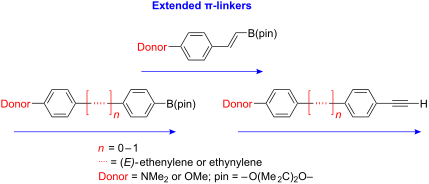
- the extension or shortening of the π-conjugated path between the donor and acceptor [19][21][23][24][25]. Thus, the latter modular synthetic approach seems to be more suitable for the property tuning described above. The final combination, C–C bond formation, of the donor and acceptor chromophore


Reduction of arenediazonium salts by tetrakis(dimethylamino)ethylene (TDAE): Efficient formation of products derived from aryl radicals
Beilstein J. Org. Chem. 2009, 5, No. 1, doi:10.3762/bjoc.5.1
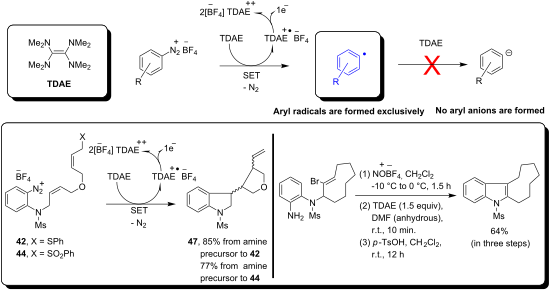
- vinblastine (58a) and vincristine (58b) contain such a system. Aryl C-C bond formation As a final extension of this methodology, we probed the feasibility of this methodology in aryl-aryl C-C bond formation reactions. Accordingly, the diazonium salt 62 was prepared from indoline (59), and treated with one
- reaction conditions for greater efficiency. A preliminary study on TDAE-mediated aryl-aryl C-C bond formation reaction has also been discussed. TDAE possesses a distinct advantage over other organic reducing agents as the oxidized products of TDAE are water soluble – thus the purification process is highly


Mixtures of monodentate P-ligands as a means to control the diastereoselectivity in Rh-catalyzed hydrogenation of chiral alkenes
Beilstein J. Org. Chem. 2005, 1, No. 3, doi:10.1186/1860-5397-1-3
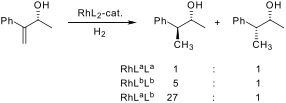
- using a 1:1 mixture of triphenylphosphine and a certain phosphinine (substituted phospha-benzene), 95% regioselectivity in favor of C-C bond formation at the higher substituted C-atom was achieved, whereas the use of the pure ligands as traditional homo-combinations led to low degrees of


Other Beilstein-Institut Open Science Activities



