


Search results
Search for "chlorination" in Full Text gives 154 result(s) in Beilstein Journal of Organic Chemistry.
Synthesis of methylenebisamides using CC- or DCMT- activated DMSO
Beilstein J. Org. Chem. 2008, 4, No. 51, doi:10.3762/bjoc.4.51

- on the chlorination [10] and etherification [11] of benzyl alcohols and from other references [12][13][14], we believe the reaction between 2,4,6-trichloro[1,3,5]triazine (cyanogen chloride, or CC) and DMSO produces a reactive sulfonium salt intermediate. Therefore, it was of interest to study the


Ru-catalyzed dehydrogenative coupling of carboxylic acids and silanes - a new method for the preparation of silyl ester
Beilstein J. Org. Chem. 2008, 4, No. 27, doi:10.3762/bjoc.4.27

- chlorination of silanes, either with chlorine gas [7] or with hydrochloric acid under Pd/C catalysis [25][26], the synthesis of silyl esters from the corresponding silanes requires two reaction steps. Some newer synthetic protocols to silyl esters have been developed and a lot of literature focuses itself on


Trifluoromethyl ethers – synthesis and properties of an unusual substituent
Beilstein J. Org. Chem. 2008, 4, No. 13, doi:10.3762/bjoc.4.13

- works well with electron-deficient anisoles cannot be applied to anisole itself. In fact, halogen attack on the phenyl ring proceeds more easily than radical chlorination of the methyl group. Louw and Franken could show that with elemental chlorine, photostimulated in refluxing tetrachloromethane
- , essentially trichloromethylanisole is obtained [20]. The fluorination of the trichloromethyl ether succeeds then easily as shown above. The chlorination/fluorination sequence described above can be simplified by producing the trichloromethyl aryl ethers without isolation and through in situ conversion into
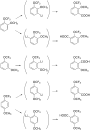
- developed an approach based on the readily accessible, although highly toxic aryl chlorothionoformates 1. They can be cleanly converted by chlorination into trichloromethyl aryl ethers [17]. This step is then followed by fluorination using antimony trifluoride and a catalytic amount of antimony




Development of potential manufacturing routes for substituted thiophenes – Preparation of halogenated 2-thiophenecarboxylic acid derivatives as building blocks for a new family of 2,6-dihaloaryl 1,2,4-triazole insecticides
Beilstein J. Org. Chem. 2007, 3, No. 23, doi:10.1186/1860-5397-3-23
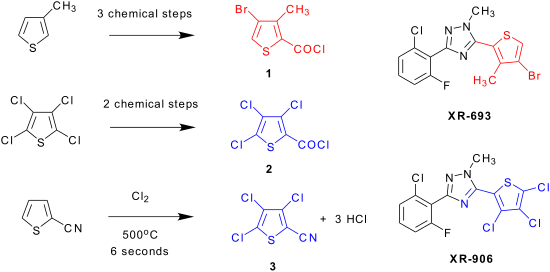
- /debromination procedure developed for 3-methylthiophene gave 2,4-dibromo-3-methylthiophene. Carboxylic acid functionality was then introduced either by a Grignard metallation followed by carbonation with CO2, or by a palladium catalyzed carbonylation procedure under CO pressure. The vapor phase chlorination of
- thiophene ring without isolation of the tribromo intermediate 6. The final low-melting acid chloride 1 was readily purified by vacuum distillation on a 250 g laboratory scale to remove a small amount of tar and gave 1 as a light-yellow colored product. Vapor Phase Chlorination Studies. Routes to 3,4,5
- from 2-chloromethyl-3,4,5-trichlorothiophene. [21] However, since 2-thiophenecarbonitrile 20 was commercially available, we investigated the vapor phase chlorination of this starting material as a potential convenient manufacturing route to 3 that could be carried out on a multi-Kg scale (Scheme 3


Other Beilstein-Institut Open Science Activities



