


Search results
Search for "free-radical" in Full Text gives 160 result(s) in Beilstein Journal of Organic Chemistry.
Novel multi-responsive P2VP-block-PNIPAAm block copolymers via nitroxide-mediated radical polymerization
Beilstein J. Org. Chem. 2010, 6, 756–765, doi:10.3762/bjoc.6.89
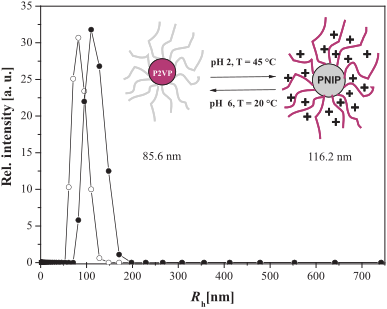
- radical polymerization (CRP), based on the idea of reversible chain termination, decreases the disadvantage of the free radical polymerization and permits the synthesis of defined block copolymer structures [13]. The growing demand for well-defined and functional soft materials in nanoscale applications


Calix[4]arene-click-cyclodextrin and supramolecular structures with watersoluble NIPAAM-copolymers bearing adamantyl units: “Rings on ring on chain”
Beilstein J. Org. Chem. 2010, 6, 784–788, doi:10.3762/bjoc.6.83
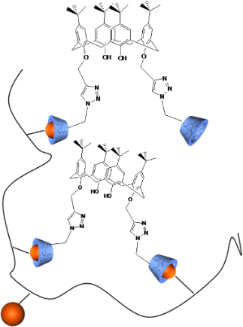
- intermolecular electrostatic repulsion. Accordingly, the hydrodynamic diameter of 4 decreased in NaOH solution from 150 nm to 9.0 nm, which can actually be attributed to the existence of trimers. Host–guest complexion of 4 and 5 An adamantane containing copolymer 5 was prepared via free radical polymerization of

RAFT polymers for protein recognition
Beilstein J. Org. Chem. 2010, 6, No. 66, doi:10.3762/bjoc.6.66
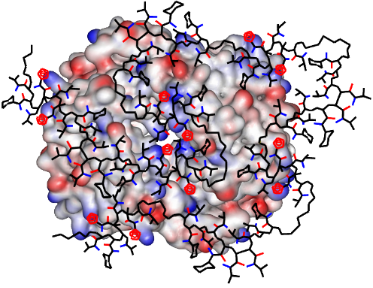
- protein affinities [8], accompanied in a number of cases with promising protein selectivities [9]. These linear polymers were all prepared by free radical copolymerization in DMF followed by deprotection of the binding monomers in polymer-analogous transformations. Thus, a polymerized bisphosphonate


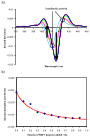


Free radical homopolymerization of a vinylferrocene/cyclodextrin complex in water
Beilstein J. Org. Chem. 2010, 6, No. 60, doi:10.3762/bjoc.6.60
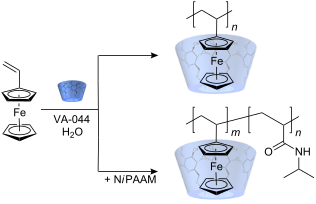
- insoluble in water. Complexation of 1 with methyl-β-cyclodextrin 2 results in clearly water-soluble structures due to incorporation of the ferrocene moiety into the cyclodextrin cavity. After free radical polymerization of the water-soluble complexed monomer, corresponding to polyvinylferrocene (PVFc), the
- scanning calorimetry (DSC), and lower critical solution temperature (LCST) measurements. Keywords: cyclodextrin; free radical polymerization; polyvinylferrocene; vinylferrocene; Introduction Since its discovery in 1951, ferrocene [1] and its derivatives and their applications have been the subject of
- [17][18][19][20][21][22][23][24][25]. The hydrophobic part of the monomer molecule is included in the more hydrophobic cyclodextrin cavity yielding completely water-soluble complexes capable of polymerization. In this publication we wish to present our results of the aqueous free radical


Synthesis and crossover reaction of TEMPO containing block copolymer via ROMP
Beilstein J. Org. Chem. 2010, 6, No. 59, doi:10.3762/bjoc.6.59
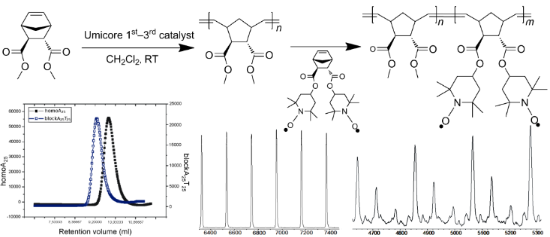
- and 9, initiated via the catalysts U1–U3, as well as mass spectrometric investigations of the crossover reactions via MALDI methods. The incorporation of the free radical 9 into block copolymer is an important contribution in the generation of polymers for reversible charge storage materials, as
- precision and chain length control up to molecular weights of ~31000 g/mol. Conclusion The synthesis of new block copolymers containing free radical centers within one block via ROMP has been described. MALDI analyses especially provide a detailed picture of the crossover reaction. Basically, the NEOLYST
- synthesis of block copolymers containing free-radical species in high densities. Experimental General Remarks Solvents/Reagents/Materials: Catalysts G1, G2 and G3 were obtained from Sigma-Aldrich. Catalysts U1, U2 and U3 were obtained as gifts from the Umicore chemical company. All reagents used for the


Synthesis of bis(3-{[2-(allyloxy)ethoxy]methyl}-2,4,6-trimethylbenzoyl)(phenyl)phosphine oxide – a tailor-made photoinitiator for dental adhesives
Beilstein J. Org. Chem. 2010, 6, No. 26, doi:10.3762/bjoc.6.26
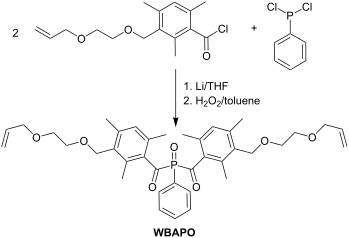
- photopolymerization of dimethacrylate resins, dental adhesives or composites and undergo an α-cleavage with the formation of benzoyl and germyl radicals, which may initiate the free-radical polymerization of the monomers present. In addition, bisacylphosphine oxides, such as commercially available bis(2,4,6


Mechanistic aspects of the isomerization of Z-vinylic tellurides double bonds in the synthesis of potassium Z-vinyltrifluoroborate salts
Beilstein J. Org. Chem. 2008, 4, No. 9, doi:10.1186/1860-5397-4-9
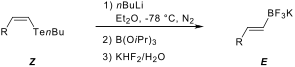
- that occurs during the reaction to prepare the alkenyltrifluoroborate salts. The results presented above support a free radical pathway for the trans-cis double bond isomerization. Scheme 3 was proposed to account for the E-vinyl and nBuBF3K salts. In the first step, the butyl radical 5 is formed by


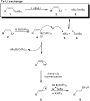
Part 1. Reduction of S-alkyl- thionocarbonates and related compounds in the presence of trialkylboranes/air
Beilstein J. Org. Chem. 2007, 3, No. 45, doi:10.1186/1860-5397-3-45

- Et3B/O2 is not limited to compounds where such shifts are possible and that such hydrogen migration does not pertain to the method used to generate the radical but to the intrinsic reactivity of radical B, as it is generally admitted that the fate of a free radical is independent of the method used to


Effect of transannular interaction on the redox- potentials in a series of bicyclic quinones
Beilstein J. Org. Chem. 2006, 2, No. 26, doi:10.1186/1860-5397-2-26

- to the free radical redox-processes, involving triptycene-quinones and reactive oxygen species [2]. Better understanding of the transannular influence of a substituent on the redox-potentials of bicyclo[2.2.2]octane-derived quinones will help in the design of new compounds with controlled biological


The Elbs and Boyland- Sims peroxydisulfate oxidations
Beilstein J. Org. Chem. 2006, 2, No. 22, doi:10.1186/1860-5397-2-22
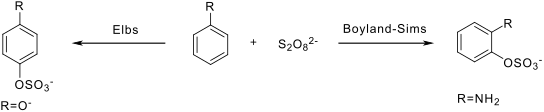
- solvent. The sulfate ester remains in the aqueous phase. Hydrolysis of the sulfate ester in aqueous acid produces the (usually) organic-soluble dihydric phenol. Reactions are usually run at room temperature or below to reduce the incursion of free radical reactions. The rates are rather slow with typical


Other Beilstein-Institut Open Science Activities



