


Search results
Search for "initiation" in Full Text gives 155 result(s) in Beilstein Journal of Organic Chemistry.
Synthesis and crossover reaction of TEMPO containing block copolymer via ROMP
Beilstein J. Org. Chem. 2010, 6, No. 59, doi:10.3762/bjoc.6.59
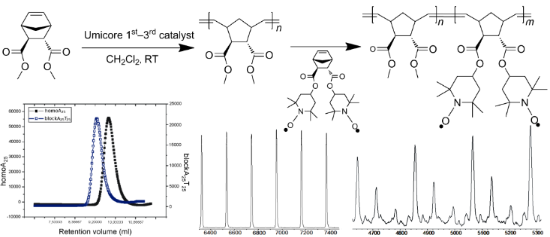
- molybdenum catalysts [7][8][9]. Often, the polydispersity indices of the resulting polymers obtained with initiator G1 are large with values ranging between 1.3 and 1.5 arising from an unfavorable rate of initiation (ki) relative to propagation (kp) as well as considerable secondary metathesis (backbiting
- ). Grubbs’ second generation catalyst G2 displays an activity comparable to the Schrock type initiators. It exhibits a higher functional group tolerance than G1, but initiation by catalyst G2 is often slow as a result of the slow dissociation of the phosphine group, sometimes limiting its application in
- polymer synthesis. Alternatively, Grubbs’ third generation catalyst G3 introduced by Grubbs et al. [10] has an ultrafast initiating ruthenium benzylidene. The rate of reaction of G3 with ethyl vinyl ether thus is six orders of magnitude higher than for G2 [10], leading to a faster initiation and often


From discovery to production: Scale- out of continuous flow meso reactors
Beilstein J. Org. Chem. 2009, 5, No. 29, doi:10.3762/bjoc.5.29
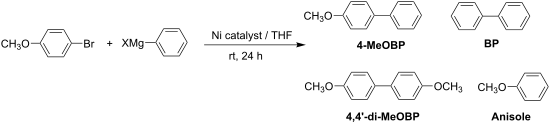
- product so the possibility arises that the catalyst takes an alternative pathway (route B) once the catalyst initiation has occurred. As the cross-coupled product is observed as the highest yielding product, it was proposed that the rate constant for route A is smaller than for route B. The proposed


Radical cascades using enantioenriched 7-azabenzonorbornenes and their applications in synthesis
Beilstein J. Org. Chem. 2008, 4, No. 38, doi:10.3762/bjoc.4.38
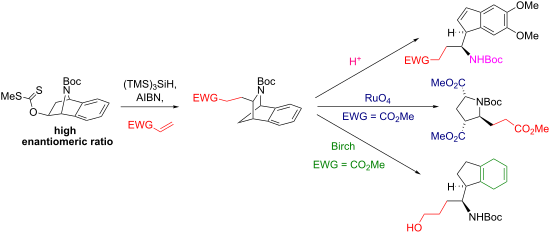
- under conditions [refluxing toluene, thermal initiation by AIBN] similar to those we had previously reported for the tandem deoxygenation–rearrangement–reduction of 7-azabenzonorbornenyl xanthates (e.g. 5 to 8, Scheme 2), although the work in our laboratory had employed a syringe pump in order to


Stereoselective synthesis of (2S,3S,4Z)-4-fluoro- 1,3-dihydroxy- 2-(octadecanoylamino)octadec- 4-ene, [(Z)-4-fluoroceramide], and its phase behavior at the air/water interface
Beilstein J. Org. Chem. 2008, 4, No. 12, doi:10.3762/bjoc.4.12

- [12][13]. The specific initiation of apoptosis by suitable derivatives of these signal molecules is discussed as a new method for treatment of numerous diseases [1][14][15], and of cancer in particular [16][17][18]. A few years ago Herdewijn et al. showed that fluorinated ceramide and dihydroceramide


Part 3. Triethylborane- air: a suitable initiator for intermolecular radical additions of S-2-oxoalkyl- thionocarbonates (S-xanthates) to olefins
Beilstein J. Org. Chem. 2007, 3, No. 47, doi:10.1186/1860-5397-3-47

- viewpoint, the results reported herein may be rationalised as follows (Scheme 2). The initiation of the process is governed by interaction of dioxygen with Et3B to give Et•. This reaction occurs within a wide range of temperatures. The reaction of ethyl radical with the highly radicophilic species A leads



Other Beilstein-Institut Open Science Activities



