


Search results
Search for "phosphonate" in Full Text gives 158 result(s) in Beilstein Journal of Organic Chemistry.
Fused bicyclic piperidines and dihydropyridines by dearomatising cyclisation of the enolates of nicotinyl-substituted esters and ketones
Beilstein J. Org. Chem. 2010, 6, No. 22, doi:10.3762/bjoc.6.22
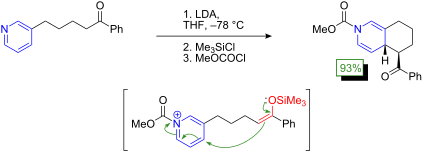
- deficient pyridines in the presence of trimethylsilyl triflate, tetrabutylammonium fluoride or a montmorillonite clay. The cyclisation precursor was synthesised by using the procedure of Hayashi [48] employing a Horner–Wadsworth–Emmons olefination between nicotinaldehyde and phosphonate 10. The resulting


A review of new developments in the Friedel–Crafts alkylation – From green chemistry to asymmetric catalysis
Beilstein J. Org. Chem. 2010, 6, No. 6, doi:10.3762/bjoc.6.6
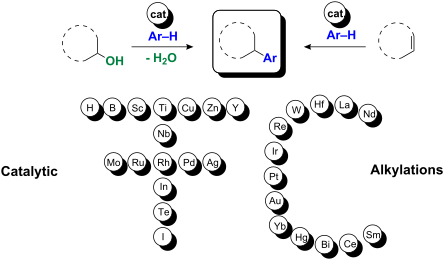
- chiral benzyl acetates were efficiently substituted employing low amounts of catalyst (1–5 mol%). While nitro-, cyano- and methyl ester derivatives gave remarkable anti-selectivity, the corresponding α-phosphonate showed high syn-selectivity. In general, the diastereoselectivity can be explained by


N-alkyl-N-(phosphonoethyl) substituted (meth)acrylamides – new adhesive monomers for self-etching self-priming one part dental adhesive
Beilstein J. Org. Chem. 2009, 5, No. 72, doi:10.3762/bjoc.5.72

- , trimethylbromosilane, butylamine, 3,6-dioxaoctane-1,8-diamine, camphorquinone and 4-(N,N-dimethylamino)benzoic acid ethyl ester, diethyl (hydroxymethyl)phosphonate, 2,2′-azobisisobutyronitrile (AIBN) and 2,6-di-tert-butyl-4-methylphenol were purchased from Sigma-Aldrich and phenylbis(2,4,6-trimethylbenzoyl)phosphine
- ), 62.3 (2), 48.2 (5), 32.5 (4), 25.1 (3), 19.3 (10), 16.4 (1) ppm. 31P NMR (CH3OH-d4): δ = 21.0/21.3 and 24.6/26.0 ppm. Methacrylic acid phosphonomethyl ester (4): This compound was synthesized by esterification of methacrylic acid with diethyl (hydroxymethyl)phosphonate and subsequent methanolysis of
- phosphonic acids 3c, 3e, 3f and 3g in a formulation of an aqueous ethanol solution of N,N′-diethyl-1,3-bis(acrylamido)propane, phosphonic acid 3, and 3(4),8(9)-bis(acrylamidomethyl)tricyclo[5.2.1.02,6]decane. Synthesis of novel N-alkyl-N-(ethyl phosphonate) (meth)acrylamides 3. For 2a, 2b, 3a, 3b: R1 = H, x


Synthesis of phosphonate and phostone analogues of ribose-1-phosphates
Beilstein J. Org. Chem. 2009, 5, No. 37, doi:10.3762/bjoc.5.37

- Pitak Nasomjai David O'Hagan Alexandra M. Z. Slawin School of Chemistry and Centre for Biomolecular Sciences, University of St Andrews, North Haugh, St Andrews, Fife, KY16 9ST, UK 10.3762/bjoc.5.37 Abstract The synthesis of phosphonate analogues of ribose-1-phosphate and 5-fluoro-5-deoxyribose-1
- -phosphate is described. Preparations of both the α- and β-phosphonate anomers are reported for the ribose and 5-fluoro-5-deoxyribose series and a synthesis of the corresponding cyclic phostones of each α-ribose is also reported. These compounds have been prepared as tools to probe the details of
- both 5′-FDA and adenosine, and thus the presence or absence of fluorine at the C-5′-position is not a requisite for catalysis. The next enzymatic step involves a ring opening isomerisation of the ribose-1-phosphate 5. In this paper we report the synthesis of phosphonate analogues 8 and 9 of ribose-1


An expedient synthesis of 5-n-alkylresorcinols and novel 5-n-alkylresorcinol haptens
Beilstein J. Org. Chem. 2009, 5, No. 22, doi:10.3762/bjoc.5.22

- few papers have reported Wittig reactions in water without an organic solvent, although the related Horner-Wadsworth-Emmons reactions, using ester enolate type stabilized phosphonate ylids, have often been conducted in aqueous solutions [29]. The existing cases have mostly been targeted for the


Synthesis and redox behavior of new ferrocene- π-extended- dithiafulvalenes: An approach for anticipated organic conductors
Beilstein J. Org. Chem. 2009, 5, No. 6, doi:10.3762/bjoc.5.6
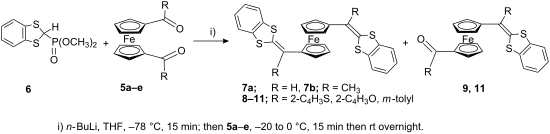
- derivatives 5a and 5b were synthesized cleanly and in high yields according to previously reported methods [12][13][15]. The 1,3-benzodithiole-2-phosphonate 6 was obtained in relatively high yield as described previously in literature [14][28][29]. Reaction of ferrocene-1,1′-dicarboxaldehyde (5a) or 1,1
- ′-diacetylferrocene (5b) with 1,3-benzodithiole-2-phosphonate (6) in dry THF in the presence of n-BuLi at −78 °C following the Wittig–Horner reaction method afforded the corresponding 1,1′-bis[(1,3-dithiol-2-ylidene)methyl]ferrocenes 7a and 7b in good yields (Scheme 1). The 1,1′-bis(1,3-dithiafulvalene)ferrocene 7a
- ]. However, upon reaction of the diacylferrocene 5c with the 1,3-benzodithiole-2-phosphonate 6 using a slight modification of the Wittig–Horner procedures, by carrying out the reaction at −20 to 0 °C and subsequently purifying by column chromatography using chloroform/hexane mixture, the 1,1′-bis(1,3-DTF)Fc


Unexpected degradation of the bisphosphonate P-C-P bridge under mild conditions
Beilstein J. Org. Chem. 2008, 4, No. 7, doi:10.1186/1860-5397-4-7
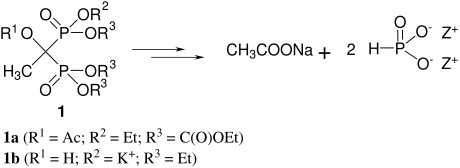
- reaction conditions in two of the prepared etidronate derivatives. Earlier, Szymczak et. al. [24] have described the formation of H-phosphonate (also known as phosphite) and phosphate components from a phosphonate-phosphate compound (same kind of structure as 8 in Scheme 1) either in CH3CN/Et3N/H2O (v/v
- ) or phosphate buffer, pH 7.4 at 37 °C. Szajnman et. al. [25] has reported loss of two molecules of phosphite in tetraethyl oxirane-2,2-diylbis(phosphonate); however the kind of degradation which we will discuss in this paper has not been previously reported. Results and Discussion As mentioned in the
- ) partial transesterification of bisphosphonate 1a before degradation of P-C-P bridge, 2) partial esterification of phosphonate group after the carbonate groups (R3) decomposition from compound 1a (this is proposed to occur rapidly after the addition of 40% NaOH) and before the degradation of P-C-P bridge


Synthesis of novel (1-alkanoyloxy- 4-alkanoylaminobutylidene)-1,1-bisphosphonic acid derivatives
Beilstein J. Org. Chem. 2006, 2, No. 2, doi:10.1186/1860-5397-2-2

- have also recently described the method for the preparation of (1-alkoxycarbonyloxyethylidene)-1,1-bisphosphonic acid derivatives [20] and novel fatty acid derivatives of etidronate [21] which may represent prodrugs of etidronate. In the case of etidronic acid, we have shown that simple phosphonate


Other Beilstein-Institut Open Science Activities



