


Search results
Search for "complex formation" in Full Text gives 179 result(s) in Beilstein Journal of Organic Chemistry.
Templated versus non-templated synthesis of benzo-21-crown-7 and the influence of substituents on its complexing properties
Beilstein J. Org. Chem. 2010, 6, No. 14, doi:10.3762/bjoc.6.14
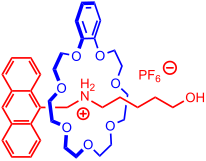
- the phenyl group in 5-H•PF6 is too bulky to thread through the cavity of C7 [23]. Complex formation thus immediately indicates that the crown ether must have a larger cavity than C7. As seen in Figure 1b, the spectra of the equimolar mixture of 5-H•PF6 and C7 is the simple superimposition of their
- individual spectra (Figure 1a,Figure 1c). However, addition of 5-H•PF6 to the fraction containing the larger oligomers 2-(n) caused shifts of all signals for both of guest and host indicative of complex formation (Figure 1d,Figure 1e). From these experiments, we can conclude that crown ethers larger than C7


Recognition properties of receptors consisting of imidazole and indole recognition units towards carbohydrates
Beilstein J. Org. Chem. 2010, 6, No. 9, doi:10.3762/bjoc.6.9
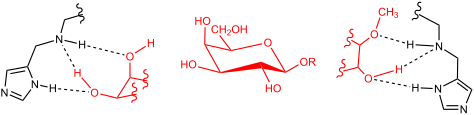
- equiv of the receptor, indicating important contribution of the OH groups of 6a to the complex formation. Furthermore, the addition of 4 or 5 to a CDCl3 solution of β-glucoside 6a caused significant upfield shift of the CH signals of 6a, indicating the participation of the sugar CH units in the




An enantiomerically pure siderophore type ligand for the diastereoselective 1 : 1 complexation of lanthanide(III) ions
Beilstein J. Org. Chem. 2009, 5, No. 78, doi:10.3762/bjoc.5.78
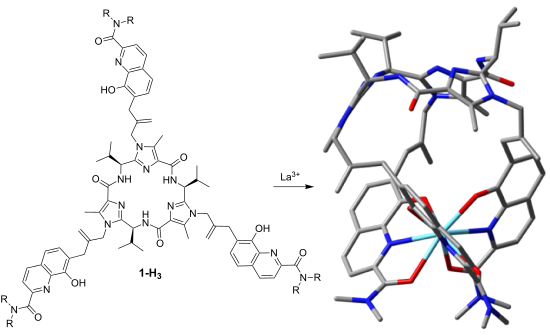
- facile synthesis of a highly preorganized tripodal enterobactine-type ligand 1a-H3 consisting of a chiral C3-symmetric macrocyclic peptide and three tridentate 2-amido-8-hydroxyquinoline coordinating units is presented. Complex formation with various metal ions (Al3+, Ga3+, Fe3+, La3+ and Eu3+) was
- described dissociation equilibrium in solution uncoordinated ligand can be observed as well at m/z = 1464.9 {K(1a-H3)}+. UV and CD titration experiments As a sensitive technique for the investigation of the complex formation of ligand 1a-H3 with a series of trivalent metal ions we performed UV–vis as well
- simplification reduces the number of optimization steps in the calculations and should not affect the extent of diastereoselectivity for the complex formation. In principle the C3-symmetric 1b·La complex can adopt four different conformations (Λ1, Λ2, Δ1, Δ2): The 8-hydroxyquinoline units can be present in two




An efficient synthesis of novel pyrano[2,3-d]- and furopyrano[2,3-d]pyrimidines via indium- catalyzed multi- component domino reaction
Beilstein J. Org. Chem. 2006, 2, No. 11, doi:10.1186/1860-5397-2-11
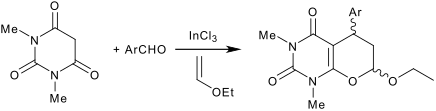
- %). Introduction The emergence of indium(III) compounds as efficient Lewis acid catalysts presents new and exciting opportunities for organoindium chemistry. [1][2] It was found that the low reactivity of trivalent organoindium reagents can be increased by complex formation with organolithium compounds.[3] The


Other Beilstein-Institut Open Science Activities



