


Search results
Search for "deuterium" in Full Text gives 177 result(s) in Beilstein Journal of Organic Chemistry.
Part 2. Mechanistic aspects of the reduction of S-alkyl- thionocarbonates in the presence of triethylborane and air
Beilstein J. Org. Chem. 2007, 3, No. 46, doi:10.1186/1860-5397-3-46

- also be the source of hydrogen. However, the deuterium incorporations in experiments aimed at elucidating the mechanism are relatively low,[6] and obviously the experimental results do not support the hypothesis that the O-H group is the sole source of the hydrogen transferred. Results and discussion
- at the end of the first part of this series.[3] On the other hand, we proved that a similar 1,5-hydrogen shift in which the acetyl group would be implicated does not occur either (see below). The standard experiment (entry 1) performed without any source of deuterium serves to evaluate the natural
- abundance of 13C in compound 1c and to calibrate the deuterium measurements. A possible source of hydrogen could be an alcohol present as a contaminant in various solvents, therefore we chose to examine the effect of addition of methanol to the reaction mixture. When xanthate 1a was treated with Et3B/dry


Allylsilanes in the synthesis of three to seven membered rings: the silylcuprate strategy
Beilstein J. Org. Chem. 2007, 3, No. 16, doi:10.1186/1860-5397-3-16
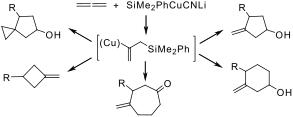
- quenching with D2O undergoes deuterio-decupration introducing deuterium exclusively in the vinylic position C-2. As mentioned in the introduction, the use of lower order cuprates such as silylcyanocuprate 1 leads selectively to allylsilanes. Trapping of the intermediate vinylcuprate 2 with α,β-unsaturated







Other Beilstein-Institut Open Science Activities



