


Search results
Search for "electron donor" in Full Text gives 184 result(s) in Beilstein Journal of Organic Chemistry.
Synthesis of rigidified flavin–guanidinium ion conjugates and investigation of their photocatalytic properties
Beilstein J. Org. Chem. 2009, 5, No. 26, doi:10.3762/bjoc.5.26

- the presence of sacrificial electron donor substrates, such as aliphatic amines, flavins can photoreduce nitro arenes to anilines under blue light irradiation (Scheme 4). 4-Nitrophenyl phosphate was used as a substrate for photoreduction in water and in acetonitrile. The results summarized in Table 2




Convenient methods for preparing π-conjugated linkers as building blocks for modular chemistry
Beilstein J. Org. Chem. 2009, 5, No. 11, doi:10.3762/bjoc.5.11
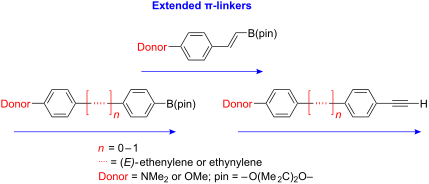
- ], organic light-emitting diodes (OLED) [9] or functional polymers [10][11][12][13]. A typical push-pull chromophore consists of a polar A-π-D system with a planar π-system end-capped by a strong electron donor (D) and a strong electron acceptor (A). The π-conjugated system ensuring charge-transfer (CT


New diarylmethanofullerene derivatives and their properties for organic thin- film solar cells
Beilstein J. Org. Chem. 2009, 5, No. 7, doi:10.3762/bjoc.5.7
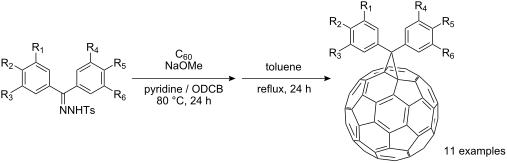
- -hexylthiophene) (P3HT) as the electron-donor and diarylmethanofullerene derivatives as the electron-acceptor material were examined. The {(methoxycarbonyl)phenyl[bis(octyloxy)phenyl]methano}fullerene showed power conversion efficiency as high as PCBM, but had higher solubility in a variety of organic solvents
- [19]. These first reduction potential data showed that the diarylmethanofullerene derivatives can be a better electron acceptor than PCBM [27]. Photovoltaic Devices A series of solar cells was fabricated with P3HT as the electron-donor and diarylmethanofullerene derivatives as the electron-acceptor




Synthesis and redox behavior of new ferrocene- π-extended- dithiafulvalenes: An approach for anticipated organic conductors
Beilstein J. Org. Chem. 2009, 5, No. 6, doi:10.3762/bjoc.5.6
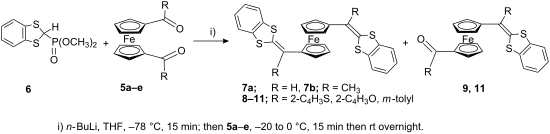
- Abstract A number of new ferrocene-π-extended-dithiafulvalenes were successfully synthesized as new electron donor compounds. The chemical structures and electrochemical behaviors of these compounds were investigated using several spectroscopic methods. The synthesis of these compounds was achieved using
- characterized a donor-acceptor dyad system involving tetrathiafulvalene (TTF) as electron donor attached by a flexible spacer to perylene derivatives as electron acceptor [5]. They have shown that the fluorescence of the tetrathiafulvalene–perylene derived dyad can be reversibly modulated by the transformation
- was extensively recognized [6][7]. For instance, π-extended-dithiafulvalenes have been successfully used as multi-electron donor moieties with high electrical conductivities in the preparation of new charge transfer (CT) complexes [8][9]. However, a number of modifications of the TTF framework have


Reduction of arenediazonium salts by tetrakis(dimethylamino)ethylene (TDAE): Efficient formation of products derived from aryl radicals
Beilstein J. Org. Chem. 2009, 5, No. 1, doi:10.3762/bjoc.5.1
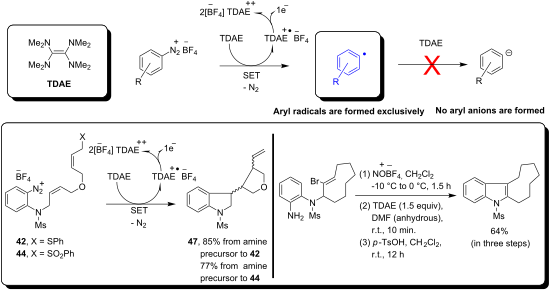
- , employing tetrathiafulvalene (TTF, 4a, Scheme 1) as electron donor. A number of functionalised heterocycles [5][6][7][8][9][10][11][12][13][14][15][16][17] such as dihydrobenzofurans, indolines and indoles have been synthesized using this methodology and the radical-polar methodology has been employed
- available and economically attractive tetrakis(dimethylamino)ethylene (TDAE, 1). This paper describes the results of our investigations on reactions of TDAE as a neutral organic electron donor with arenediazonium salts. TDAE (1), has been widely exploited as a strong electron donor [21][22][23][24][25][26
- electron donor. Additionally, we have described the utility of the aryl radicals in the construction of indolines and indoles by intramolecular radical cyclization of aryl radicals onto appropriately placed alkenes bearing terminal radical leaving groups. The presence of a suitable radical leaving group


Inversion symmetry and local vs. dispersive interactions in the nucleation of hydrogen bonded cyclic n-mer and tape of imidazolecarboxamidines
Beilstein J. Org. Chem. 2008, 4, No. 23, doi:10.3762/bjoc.4.23
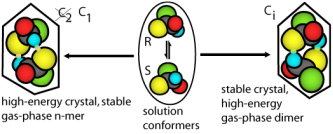
- weaker electron donor, agrees with previous studies of competitive solid state hydrogen bonding [19]. Rotamer/tautomer 4 was not observed in the crystalline phases, providing further control and predictability. Crystallization requires non-equilibrium conditions to progress [20][21]; however, predictions


Trifluoromethyl ethers – synthesis and properties of an unusual substituent
Beilstein J. Org. Chem. 2008, 4, No. 13, doi:10.3762/bjoc.4.13

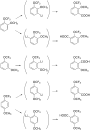
- at the ortho and para position. This means the inductive electron-withdrawing effect compromises the attack of the electrophile, but is counterbalanced, to some extent, by the capacity of the ether oxygen to act through resonance as an electron donor. This antagonistic behavior is well known for




Hydrogen bonding patterns in the cocrystals of 5-nitrouracil with several donor and acceptor molecules
Beilstein J. Org. Chem. 2005, 1, No. 15, doi:10.1186/1860-5397-1-15
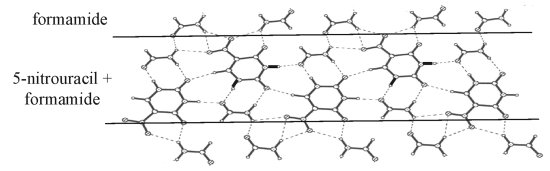
- cocrystals of I with other electron donor compounds such as piperazine, N,N'-dimethylpiperazine, 3-aminopyridine and diazabicyclo [2.2.2]octane. Crystallographic structures of the cocrystals so obtained have revealed interesting changes in the hydrogen bonding pattern of I in the presence of other molecules
- (14A)...O(12), 2.400(3) Å). The pyridine molecules make linear N-H...N, (H(12A)...N(21), 1.810(3) Å) and C-H...O, (H(23A)...O(11), 2.216(4) Å) bonds with the nitrouracil molecules. Pyridine being a strong electron donor, it is not surprising that the characteristic hydrogen-bonded dimeric structure





Towards practical biocatalytic Baeyer- Villiger reactions: applying a thermostable enzyme in the gram- scale synthesis of optically- active lactones in a two-liquid- phase system
Beilstein J. Org. Chem. 2005, 1, No. 10, doi:10.1186/1860-5397-1-10
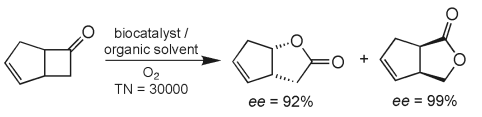
- effective stoichiometric sacrificial electron donor, resulted in significantly decreased stability of both enzymes used. The maximum concentration of isopropanol under which both enzymes show optimal activity was found to be 5% (v/v). In order to enhance conversion, we added surplus reducing equivalents in


Other Beilstein-Institut Open Science Activities



