


Search results
Search for "fluorination" in Full Text gives 182 result(s) in Beilstein Journal of Organic Chemistry.
DBFOX- Ph/metal complexes: Evaluation as catalysts for enantioselective fluorination of 3-(2-arylacetyl)-2-thiazolidinones
Beilstein J. Org. Chem. 2008, 4, No. 16, doi:10.3762/bjoc.4.16
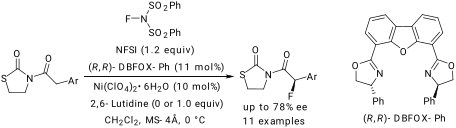
- enantioselective fluorination of 3-(2-arylacetyl)-2-thiazolidinones 1 with N-fluorobenzenesulfonimide (NFSI) by DBFOX-Ph/metal complexes under a variety of conditions. After optimization of the metal salts, solvents and additives, we found that the fluoro-2-thiazolidinones 2 were obtained in good to high yields
- with moderate to good enantioselectivities (up to 78% ee) when the reaction was carried out in the presence of DBFOX-Ph (11 mol%), Ni(ClO4)2·6H2O (10 mol%) and 2,6-lutidine (0 or 1.0 equiv) in CH2Cl2. Keywords: fluorination; enantioselective; nickel; Lewis acid; catalyst; Background Enantioselective
- electrophilic fluorination represents an important and straightforward strategy for C-F bond formation at a carbon stereocenter, providing easy access to chiral fluoro-organic compounds [1][2]. Due to the significance of chiral fluoro-organic compounds, such as fluorinated quinolones [3][4] and liquid crystals


Trifluoromethyl ethers – synthesis and properties of an unusual substituent
Beilstein J. Org. Chem. 2008, 4, No. 13, doi:10.3762/bjoc.4.13

- , essentially trichloromethylanisole is obtained [20]. The fluorination of the trichloromethyl ether succeeds then easily as shown above. The chlorination/fluorination sequence described above can be simplified by producing the trichloromethyl aryl ethers without isolation and through in situ conversion into
- developed an approach based on the readily accessible, although highly toxic aryl chlorothionoformates 1. They can be cleanly converted by chlorination into trichloromethyl aryl ethers [17]. This step is then followed by fluorination using antimony trifluoride and a catalytic amount of antimony
- desulfurization-fluorination has been disclosed by Hiyama [24][25][26][27]. When dithiocarbonates (2, xanthogenates) are exposed to a huge excess of hydrogen fluoride-pyridine and 1,3-dibromo-5,5-dimethylhydantoin, trifluoromethyl ethers form in moderate to excellent yields (Scheme 5 and Table 5). What makes this




Themed series in organo- fluorine chemistry
Beilstein J. Org. Chem. 2008, 4, No. 11, doi:10.3762/bjoc.4.11
- practiced particularly when tuning the properties of molecules for specialist functions. Of particular prominence is the role fluorine substitution finds in pharmaceutical development [1], and selective fluorination has made a major contribution to the bioactivity of a wide range of agrochemical products [2
- ]. Organo-fluorine compounds have also found a significant role in soft materials chemistry such as liquid crystals, photoresist polymers and self assembling monolayers [3]. Allied to this breadth of activity is a steady development in the number and range of fluorination reagents and methodologies. DAST
Single and double stereoselective fluorination of (E)-allylsilanes
Beilstein J. Org. Chem. 2007, 3, No. 34, doi:10.1186/1860-5397-3-34

- Marcin Sawicki Angela Kwok Matthew Tredwell Veronique Gouverneur University of Oxford, Chemistry Research Laboratory, Mansfield Road, Oxford, OX1 3TA, UK 10.1186/1860-5397-3-34 Abstract Acyclic allylic monofluorides were prepared by electrophilic fluorination of branched (E)-allylsilanes with
- Selectfluor. These reactions proceeded with efficient transfer of chirality from the silylated to the fluorinated stereocentre. Upon double fluorination, an unsymmetrical ethyl syn-2,5-difluoroalk-3-enoic ester was prepared, the silyl group acting as an anti stereodirecting group for the two C-F bond forming
- events. Findings Asymmetric C-F bond formation continues to challenge chemists, inspiring the development of increasingly effective protocols for stereocontrolled fluorination. [1][2][3][4][5][6][7][8][9][10][11] Studies from our laboratory illustrated that allylsilanes undergo electrophilic


Contemporary organosilicon chemistry
Beilstein J. Org. Chem. 2007, 3, No. 4, doi:10.1186/1860-5397-3-4
- fluorination, cyclopropane chemistry and the development of silicon-containing drug candidates should be available shortly. Be sure to check back to keep abreast of the latest developments as the Series grows. Steve Marsden Guest Editor
The vicinal difluoro motif: The synthesis and conformation of erythro- and threo- diastereoisomers of 1,2-difluorodiphenylethanes, 2,3-difluorosuccinic acids and their derivatives
Beilstein J. Org. Chem. 2006, 2, No. 19, doi:10.1186/1860-5397-2-19
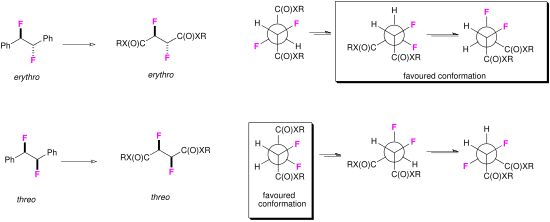
- . Early synthetic methods to vicinal difluoro compounds have involved direct fluorination of alkenes with for eg. elemental fluorine (F2) [4] or XeF2 [5]. Such methods however are either difficult to carry out in a standard laboratory environment or they suffer from very poor stereoselectivity. The direct
- (bromo/iodo)fluorination of alkenes followed by halide substitution with silver fluoride [15]. The reaction has been applied to a variety of alkenes some of which (eg 6-9) are illustrated in Scheme 3. We were interested in accessing diastereomerically pure samples of erythro- and threo- 2,3
- -difluorosuccinic acids 19. The preparation of stereoisomers of 2,3-difluorosuccinic acids, has involved conversions of tartaric acids (esters) [6][7], as described above in Scheme 1. Other approaches have involved the direct fluorination of fumaric acid [16] and the catalytic hydrogenation of 2,3-difluoromaleic




Stereoselective α-fluoroamide and α-fluoro- γ-lactone synthesis by an asymmetric zwitterionic aza-Claisen rearrangement
Beilstein J. Org. Chem. 2005, 1, No. 13, doi:10.1186/1860-5397-1-13
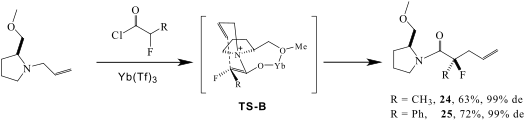
- Background Asymmetric introduction of fluorine α-to a carbonyl has become popular recently, largely because the direct fluorination of enolates by asymmetric electrophilic fluorinating reagents has improved, and as a result such compounds are becoming attractive synthons. We have sought an alternative but
- are finding increasing utility in pharmaceutical, fine chemicals and materials research. The zwitterionic aza-Claisen rearrangement proved to be an effective and competitive complement to asymmetric electrophilic fluorination strategies and provides access to versatile synthetic intermediates with
- -actives of pharmaceutical interest.[15] It is well known too that selective fluorination can improve pharmacokinetics and the fluorine substituent can often modify bio-activity in an advantageous manner.[16] For example in the structural series relevant to this study the α-fluorinated-γ-lactone 5 is a key


Other Beilstein-Institut Open Science Activities



