


Search results
Search for "linkers" in Full Text gives 193 result(s) in Beilstein Journal of Organic Chemistry.
Self-assembly of Ru4 and Ru8 assemblies by coordination using organometallic Ru(II)2 precursors: Synthesis, characterization and properties
Beilstein J. Org. Chem. 2012, 8, 313–322, doi:10.3762/bjoc.8.34
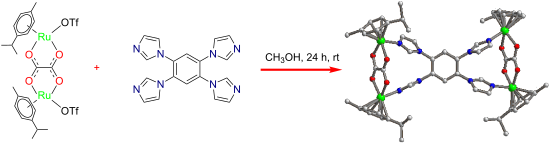
- allowed the formation of the 3D cage 2c. The use of imidazole-based donor linkers in combination with organometallic half-sandwich ruthenium(II) precursors may generate a wide variety of complex molecular architectures with interesting functional properties. Experimental Materials and methods The acceptor


Fifty years of oxacalix[3]arenes: A review
Beilstein J. Org. Chem. 2012, 8, 201–226, doi:10.3762/bjoc.8.22
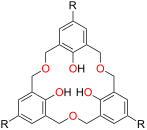
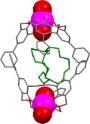
- incorporate porphyrin linkers between two oxacalix[3]arenes, but, due to the size of the porphyrins and their rigidity, only the capsular form was found [50]. Treatment with zinc(II) acetate introduced three equivalents of the metal, one for each porphyrin unit. 3.2.3 Capping the upper rim: Capping the upper












Imidazole as a parent π-conjugated backbone in charge-transfer chromophores
Beilstein J. Org. Chem. 2012, 8, 25–49, doi:10.3762/bjoc.8.4
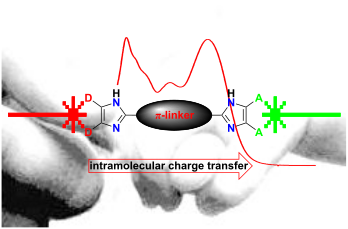
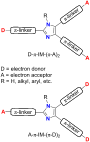
- -dicarbonitrile (methylvinazene, 3) [28][29][30]. These derivatives were recently utilized as suitable precursors for the construction of various CT chromophores (see below). Y-shaped imidazole-derived chromophores Triarylimidazoles (lophines) and derivatives with larger π-linkers represent the simplest D-π-IM-(π
- nitro, dialkylamino, and hydroxy groups as acceptor and donors [13]. Whereas the imidazole- and thiazole-based chromophores 10a,b possess two extended π-linkers with the imino spacers at the imidazole C4/C5 and nitro and dimethylamino groups as acceptor and donor [15], chromophore 11 (VPDPI) represents
- derivatives 14 bearing a cyanoacrylic moiety connected to imidazole C2 by thiophene or thiazole π-linkers were recently utilized as dye-sensitized solar cells with an efficiency up to 6.3% [41]. Several similar classes of imidazole-derived push–pull compounds can be found in the literature. They were mainly




Dependency of the regio- and stereoselectivity of intramolecular, ring-closing glycosylations upon the ring size
Beilstein J. Org. Chem. 2011, 7, 1609–1619, doi:10.3762/bjoc.7.189
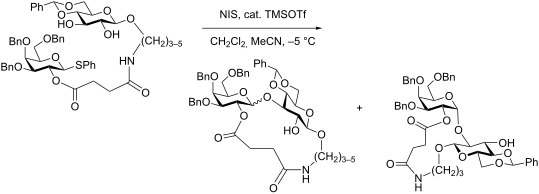
- 1-thio-galactosyl donor and a 4,6-O-benzylidene-glucose acceptor tethered by peptide-bond-containing linkers of variable size, in order to study systematically the parameters influencing the outcome of the intramolecular, ring-closing glycosylation step. In order to further provide a rationalization


Ratiometric fluorescent probe for enantioselective detection of D-cysteine in aqueous solution
Beilstein J. Org. Chem. 2011, 7, 1508–1515, doi:10.3762/bjoc.7.176

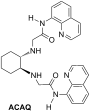
- solutions. Interestingly, the probe is only slightly responsive to Hcy and GSH. Results and Discussion N-Alkylation of trans-1,2-diaminocyclohexane with a pair of 9-carboxamidoquinoline moieties through methylene linkers afforded multifunctionalized ACAQ (Figure 2). Bearing six metal ligating sites, ACAQ




Multicomponent synthesis of artificial nucleases and their RNase and DNase activity
Beilstein J. Org. Chem. 2011, 7, 1135–1140, doi:10.3762/bjoc.7.131

- centers of natural RNases A and T1 have been described [13][14][15]. RNA cleavage was shown to be more efficient in the presence of aliphatic hydrophobic linkers [16]. However, the potential role of the alkyl chain of the catalyst remains unclear. Interaction of hydrophobic residues in peptides was
- groups as well as various aliphatic linkers. With these diamides in hand we began the investigation of their biological activity. Currently, real-time PCR is the better method for the quantitation of the target nucleic acids because of its high specificity and sensitivity of up to a few genome
- with cDNA after reverse transcription irrespective of the structures of their substituents and the length of polymethylene linkers. Double-stranded circular plasmid DNA was partially destroyed possibly because of single-stranded DNA breaks. The mechanism has been previously shown for several artificial


Intramolecular hydroamination of alkynic sulfonamides catalyzed by a gold–triethynylphosphine complex: Construction of azepine frameworks by 7-exo-dig cyclization
Beilstein J. Org. Chem. 2011, 7, 951–959, doi:10.3762/bjoc.7.106
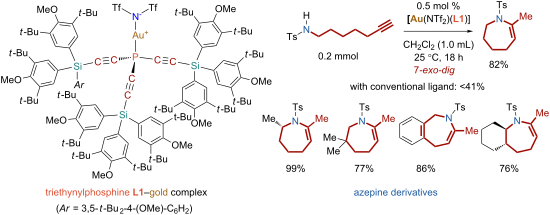
- that the reactivity of the substrates is affected by the balance between nucleophilicity of the nitrogen atom and acidity of the N–H bond as well as a steric factor. Effect of substituents in acyclic linkers Next, we explored the substrate scope by introducing one or two substituents in the acyclic


Hoveyda–Grubbs type metathesis catalyst immobilized on mesoporous molecular sieves MCM-41 and SBA-15
Beilstein J. Org. Chem. 2011, 7, 22–28, doi:10.3762/bjoc.7.4
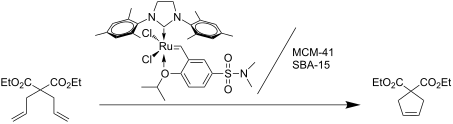
- supports: (a) by exchanging halide ligands X [7][8][9][10][11], (b) by exchanging phosphine and NHC ligands L [12][13], and (c) through the alkylidene ligand [14][15][16][17][18][19]. For these purposes, special ligand molecules with tags suitable for the reaction with the support surface (linkers) are
- catalysts was reported [20]. A second generation Hoveyda–Grubbs catalyst was immobilized on silica without any linkers by simply placing the Ru complex in contact with silica in a suspension. Heterogeneous catalysts (loading from 0.05 to 0.6 wt % Ru) were prepared, which were active in ring-opening


Functionalized copolyimide membranes for the separation of gaseous and liquid mixtures
Beilstein J. Org. Chem. 2010, 6, 789–800, doi:10.3762/bjoc.6.86
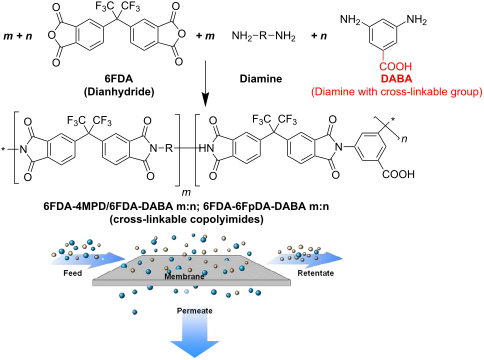
- reaction. In the following sections it will be shown which cross-linking method, ionic or covalent, will be the most effective to reduce undesired plasticization effects occurring in different separations. Furthermore, different ionic cross-linkers are compared, since it was expected that higher cation


Preparation of aminoethyl glycosides for glycoconjugation
Beilstein J. Org. Chem. 2010, 6, 699–703, doi:10.3762/bjoc.6.81

- ; glycoarrays; glycoconjugation; glycosylation; Introduction The chemical conjugation of carbohydrates through the anomeric centre to biomolecules such as peptides, proteins, lipids, metabolites and to array surfaces is an important synthetic challenge [1][2][3][4][5]. A diverse range of linkers and spacers


Novel tetracyclic structures from the synthesis of thiolactone-isatin hybrids
Beilstein J. Org. Chem. 2010, 6, No. 78, doi:10.3762/bjoc.6.78

- the formation of by-products (tetracycles) observed in the reaction of 5 with the N-alkylated isatin intermediates 6 bearing the n = 3–5 linkers (Table 1). The tetracycle 4 had a slightly lower Rf than the desired hybrid 3 and was colorless or light yellow compared to the orange-colored hybrid 3. We


Concise methods for the synthesis of chiral polyoxazolines and their application in asymmetric hydrosilylation
Beilstein J. Org. Chem. 2010, 6, No. 29, doi:10.3762/bjoc.6.29

- the linkers and the substituents present on the oxazoline rings on the yield and enantioselectivity investigated. Compound 2 was identified as the best ligand of this family for the hydrosilylation of aromatic ketones. Keywords: aromatic ketone; hydrosilylation; polyoxazoline; rhodium; synthesis
- the coordination of 5 to [Rh(COD)Cl]2. In addition, the experimental results also show that flexible linkers of oxazoline rings result in low enantioselectivities (entries 11, 12, 14, 15). Table 2 shows that bisoxazoline 2 with benzyl group (entry 10) gave a higher ee than its counterpart
- –7) are described, which are much simpler and more efficient in comparison to those reported in the literature. With these chiral ligands as templates, the rhodium-catalyzed asymmetric hydrosilylation of aromatic ketones was carried out. The effects of the linkers of oxazoline rings and the


(Pseudo)amide-linked oligosaccharide mimetics: molecular recognition and supramolecular properties
Beilstein J. Org. Chem. 2010, 6, No. 20, doi:10.3762/bjoc.6.20
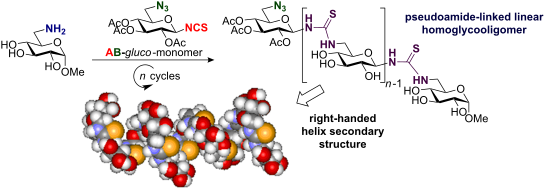
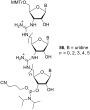
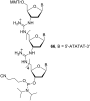
- access pseudoamide-type oligosaccharide mimics. Calystegine B2 analogues 38 and 39 with urea-linked disaccharide structure. Rotameric equilibrium shift of 40 by formation of a bidentate hydrogen bond. Nucleotide analogues with thiourea and S-methylisothiouronium linkers. Rotameric equilibria for β-(1→6



Synthetic incorporation of Nile Blue into DNA using 2′-deoxyriboside substitutes: Representative comparison of (R)- and (S)-aminopropanediol as an acyclic linker
Beilstein J. Org. Chem. 2010, 6, No. 13, doi:10.3762/bjoc.6.13
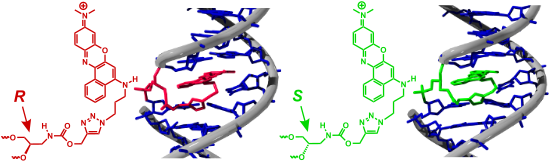
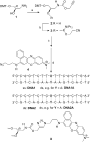
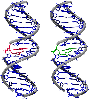
- the 2′-deoxyriboside between the phosphodiester bridges. Similar propanediol derivatives have been used extensively as alternative and simplified phosphodiester linkers in the 1990s [19][20][21][22][23], and have been further explored for glycol nucleic acid (GNA) [24][25][26] twisted intercalating
- experimental result can be imaged by geometrically optimized DNA models. Our result is remarkable regarding opposite results with the L-/D-threoninol linkers [37][38][39][40] that revealed strong differences in stacking and also in function of attached chromophores depending on the chirality of the linker. We




Synthesis and binding studies of two new macrocyclic receptors for the stereoselective recognition of dipeptides
Beilstein J. Org. Chem. 2010, 6, No. 5, doi:10.3762/bjoc.6.5
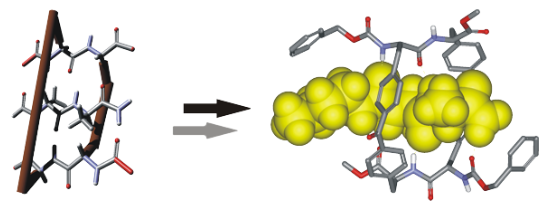
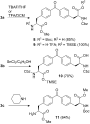
- synthetic receptors for peptides [11][12][13][14][15][16]. However, we believe that our design includes some novelties. To reduce the conformational flexibility and confer a certain degree of preorganization to this type of receptor, the use of one or two linkers connecting the two peptide strands is
- introduction of two linkers connecting the two peptide strands affording, a macrocyclic structure. In doing so, we expect that the molecular recognition properties of the designed receptor will also benefit from the macrocyclic effect [17][18][19][20]. Simple molecular modeling studies [21] revealed that a
- macrocycle, also allows for the possibility of binding short amino acid sequences not necessarily located on the edges of larger peptides. Other considerations, apart from preventing intramolecular hydrogen bond formation, related to the use of bis(alanyl)benzophenone rigid linkers include: a) to avoid







Versatile supramolecular reactivity of zinc-tetra(4-pyridyl)porphyrin in crystalline solids: Polymeric grids with zinc dichloride and hydrogen-bonded networks with mellitic acid
Beilstein J. Org. Chem. 2009, 5, No. 77, doi:10.3762/bjoc.5.77
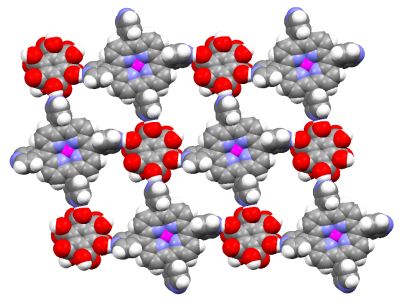
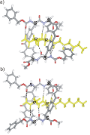
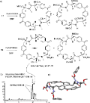
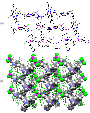
- chemistry. In this work, it was found to be reactive in the assembly of both (a) a 2D polymeric array by a unique combination of self-coordination and coordination through external zinc dichloride linkers and (b) an extended heteromolecular hydrogen-bonded network with mellitic acid sustained by multiple
- , in which the porphyrin units are inter-coordinated via exocyclic metal ion linkers (e.g., tetrahedral CuI), has also been observed [5]. The latter mode of coordination polymerization, in which the peripheral pyridyl sites of different TPyP/MTPyP moieties can be readily bridged by various metal ion
- assemblies of varying dimensionality with the aid of exocyclic metal ion linkers capable of coordinating simultaneously to several neighboring ZnTPyP units [5][6][7][8][9][10][11]. The ZnTPyP can adopt in the above constructs either five-coordinate or six-coordinate geometries, which affects the architecture



Silica- bound benzoyl chloride mediated the solid- phase synthesis of 4H-3,1-benzoxazin- 4-ones
Beilstein J. Org. Chem. 2009, 5, No. 13, doi:10.3762/bjoc.5.13
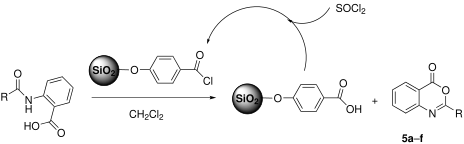
- . Apparently, owing to porous nature of silica chloride, a significant fraction of the silyl chloride linkers remains unreacted even in treatment with excess 4-hydroxybenzoic acid during the loading process. On the other hand, and for the same reason, many of the graft sites may be unavailable or more hindered


Convenient methods for preparing π-conjugated linkers as building blocks for modular chemistry
Beilstein J. Org. Chem. 2009, 5, No. 11, doi:10.3762/bjoc.5.11
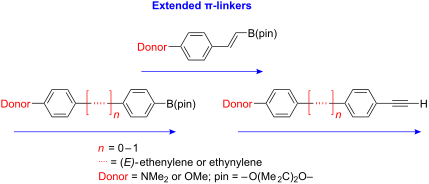
- π-conjugated linkers are described. Either unsubstituted or 4-donor substituted π-linkers bearing a styryl, biphenyl, phenylethenylphenyl, and phenylethynylphenyl π-conjugated backbone are functionalized with boronic pinacol esters as well as with terminal acetylene moieties allowing their further
- moieties is usually accomplished by cross-coupling reactions, in particular by the Suzuki–Miyaura [26][27] or the Sonogashira [28] reactions. Consequently, the availability of the suitably substituted π-conjugated linkers of various lengths bearing boronic ester functionality or terminal acetylene is
- crucial for such a synthetic approach. Hence, we report here a convenient synthesis as well as characterization of either unsubstituted (R = H) or donor substituted (R = NMe2, OMe) π-conjugated linkers designed for the Suzuki–Miyaura and Sonogashira cross-couplings with a systematically varied and





