


Search results
Search for "organization" in Full Text gives 194 result(s) in Beilstein Journal of Organic Chemistry.
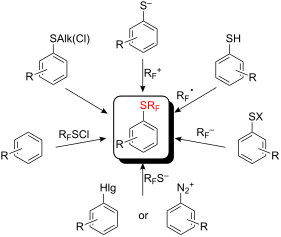
Aromatic and heterocyclic perfluoroalkyl sulfides. Methods of preparation
Beilstein J. Org. Chem. 2010, 6, 880–921, doi:10.3762/bjoc.6.88


Synthesis, characterization and photoinduced curing of polysulfones with (meth)acrylate functionalities
Beilstein J. Org. Chem. 2010, 6, No. 56, doi:10.3762/bjoc.6.56
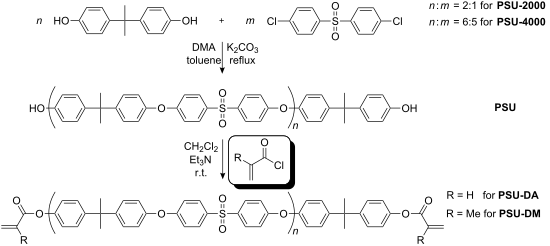
- polysulfones. Acknowledgements The authors thank the State Planning Organization of Turkey (DPT) for the financial support (Project no: 2005K120920). We also want to thank Nursen Turdu for NMR studies and Zekayi Korlu for TGA studies. Special thanks go to Turgay Balci for the technical support.




Self-assembled ordered structures in thin films of HAT5 discotic liquid crystal
Beilstein J. Org. Chem. 2010, 6, No. 51, doi:10.3762/bjoc.6.51
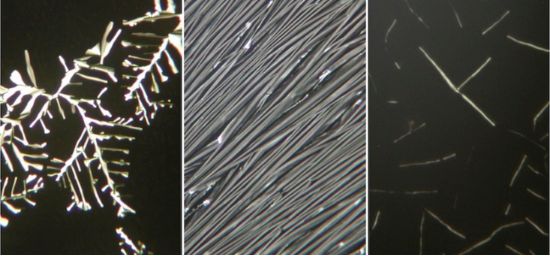
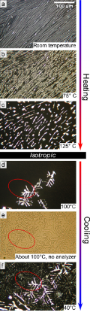
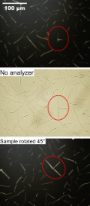
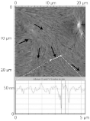
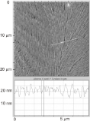
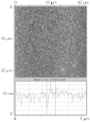
- compared to the bulk situation, where the same material crystallizes into a polymorphic structure at 68 °C. Keywords: AFM; discotic liquid crystals; hexapentyloxytriphenylene; self-organization; thin films; Introduction Discotic liquid crystals are an interesting type of organic semiconductors that allow
- long-range charge transport thanks to the spontaneous formation of channels as a result of molecular self-organization into columns and the orbital overlap of neighboring molecules [1][2]. In particular, columnar phases are very appealing for applications since the transport of charges occurs along the
- between indium tin oxide (ITO)-coated glass plates at micrometer distance, very little is known about the organization of HAT5 in films of submicrometer thickness and their characteristics. Such films, produced by drop-casting and spin-coating, are the focus of this study. Results and Discussion Different





Molecular recognition of organic ammonium ions in solution using synthetic receptors
Beilstein J. Org. Chem. 2010, 6, No. 32, doi:10.3762/bjoc.6.32
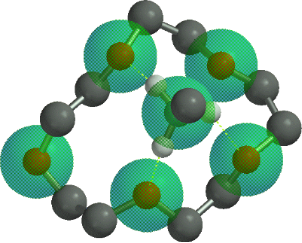
- selective recognition of ammonium ions depends on steric and molecular complementarity and the pre-organization [17] of interacting functional groups. As far back as 1890, Fischer suggested that enzyme–substrate interactions function like a “lock and key” between an initially empty host and a guest that
- “key” in the complementary binding site or an inclusion compound. This host pre-organization leads to a major enhancement of the overall energy of guest complexation. The binding is energetically favored: Both enthalpic – a less solvent accessible area leads to a less strongly solvated guest with fewer
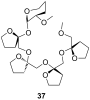
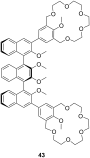
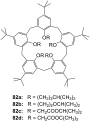
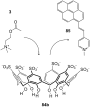
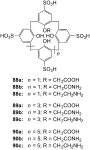
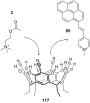
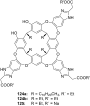
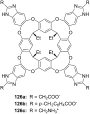
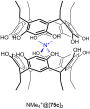
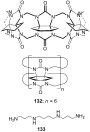
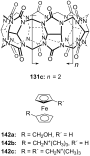
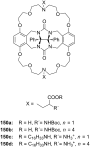
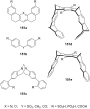
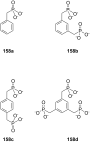
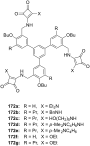
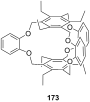
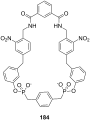
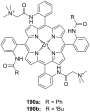
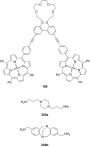
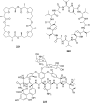
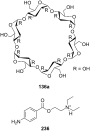
- hetero crown ethers) and N+–H bonds [101]. The cyclic arrangement leads to a pre-organization of the host [102], whereby selectivity is determined by the ring size. Primary ammonium ions are complexed with highest affinity by 18-crown-6 derivatives [9] (Figure 2). Table 1 summarizes exemplarily the
















































Synthesis of a new class of aminocyclitol analogues with the conduramine D-2 configuration
Beilstein J. Org. Chem. 2010, 6, No. 15, doi:10.3762/bjoc.6.15
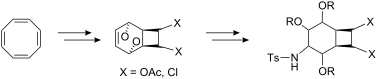
- 16: Experimental Section The experimental section describes the synthesis, purification and characterization data of all substances given in this article. Acknowledgements The authors are indebted to the Department of Chemistry (Atatürk University), state planning organization of Turkey (DPT) for


The subtle balance of weak supramolecular interactions: The hierarchy of halogen and hydrogen bonds in haloanilinium and halopyridinium salts
Beilstein J. Org. Chem. 2010, 6, No. 4, doi:10.3762/bjoc.6.4
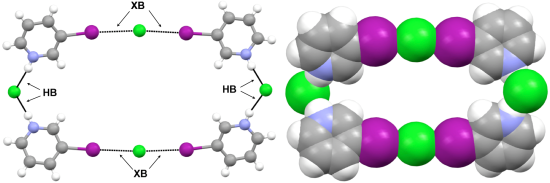
- bonded 1 and the only hydrogen bonded 4. When the polarizability of the halogen atom is increased (I > Br > Cl > F), thus increasing the effect of the halogen bond, the changed balance of the intermolecular interactions will influence the spatial organization of the adjacent molecules leading to a


Versatile supramolecular reactivity of zinc-tetra(4-pyridyl)porphyrin in crystalline solids: Polymeric grids with zinc dichloride and hydrogen-bonded networks with mellitic acid
Beilstein J. Org. Chem. 2009, 5, No. 77, doi:10.3762/bjoc.5.77
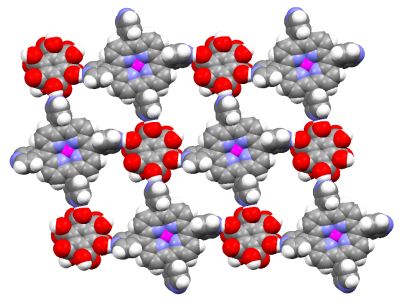
- functions, the 4-pyridyl substituents in ZnTPyP acting as proton acceptors and the carboxylic residues in mellitic acid as complementary proton donors. The heteromeric COOH···Npyridyl interaction results in a relatively strong hydrogen bond, which frequently directs supramolecular organization in organic



1-(4-Alkyloxybenzyl)-3-methyl-1H-imidazol-3-ium organic backbone: A versatile smectogenic moiety
Beilstein J. Org. Chem. 2009, 5, No. 62, doi:10.3762/bjoc.5.62
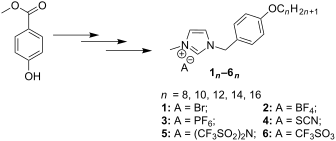
- core (N–CH3 and N–CH2) localized respectively around 4 ppm and 5.3 ppm. Correlated to the crystal structure of compound 112 these observations were made on all the protons used for the organization of the polar part by multiple anion-cation and cation-cation interactions [21]. These NMR studies carried
- )sulfonyl]amide), are ionic liquid compounds without any supramolecular organization into mesophase. This is also the case in the series of compounds 5n with n < 12 (only a monotropic mesophase was observed for 512), and finally for 38. Supramolecular arrangement Despite the significant tendency of these
- , corresponding to the molten alkyl chain in liquid-like order (A), whilst in the low-angle part of the diffractogram one to three equidistant sharp and intense peaks were observed, characteristic of the layered organization. The very intense first sharp peak was directly correlated to the periodicity value. In






Functional properties of metallomesogens modulated by molecular and supramolecular exotic arrangements
Beilstein J. Org. Chem. 2009, 5, No. 54, doi:10.3762/bjoc.5.54
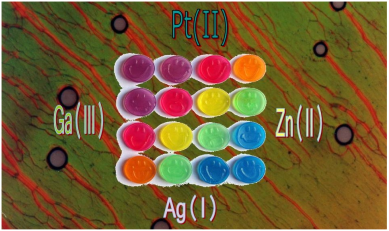
- time, order, mobility, and changes in molecular organization in response to external stimuli could be a good strategy for developing new soft materials for innovative applications. In this context the same 2,2′-bipyridines have been coordinated to Zn(II) ions where the tetrahedral geometry of the Zn(II
- introducing of further aromatic rings equipped with several aliphatic tails each. Hence the synthesis of a series of cis-dichloro hexacatenar Zn(II) complexes has been performed (Figure 5) [56]. In this case the molecular organization in the mesophase, mainly driven by intermolecular attractive interactions
- molecular building blocks, it is possible to modulate the interactions necessary for organization of single molecules in to supramolecular architectures to give rise to the desired metallomesogenic material. Moreover, preliminary measurements of photoconductivity on these complexes doped with C60 to


Novel banana-discotic hybrid architectures
Beilstein J. Org. Chem. 2009, 5, No. 52, doi:10.3762/bjoc.5.52
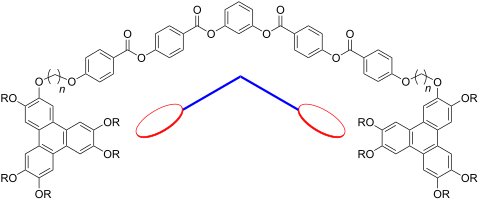
- organization into layers. Since the molecules are closely packed within the smectic layers and additionally, the rotation about their long axes is strongly hindered, the bent directions align parallel in each layer. As a result of this directed organization, each layer develops a spontaneous polarization. On


A convenient method for preparing rigid-core ionic liquid crystals
Beilstein J. Org. Chem. 2009, 5, No. 51, doi:10.3762/bjoc.5.51
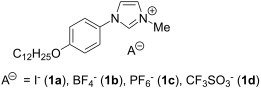
- along an orientational axis), smectic phases (orientational/positional order in the layers) and columnar phases (orientational/positional order in the columns). The lyotropic compounds display not only lamellar and columnar organization but also hierarchical self-assembly in spheres (micelles), ribbons



Chiral amplification in a cyanobiphenyl nematic liquid crystal doped with helicene-like derivatives
Beilstein J. Org. Chem. 2009, 5, No. 50, doi:10.3762/bjoc.5.50
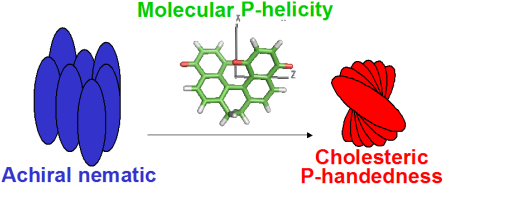
- Abstract The addition of a chiral non-racemic dopant to a nematic liquid crystal (LC) has the effect of transferring the molecular chirality to the phase organization and a chiral nematic phase is formed. This molecular chirality amplification in the LC provides a unique possibility for investigating the
- relationship between molecular structure, intermolecular interactions, and mesoscale organization. It is known that axially chiral or helical-shaped molecules with reduced conformational disorder are good candidates for high helical twisting power derivatives. In particular, biaryl derivatives are known to be
- dopant to a nematic liquid crystal has the effect of transferring the molecular chirality to the phase organization and a chiral nematic (or cholesteric) phase is formed, in which the director rotates perpendicularly to an axis in a helical way (see Figure 1) [1]. For a given nematic host, the handedness




Synthesis of mesogenic phthalocyanine-C60 donor–acceptor dyads designed for molecular heterojunction photovoltaic devices
Beilstein J. Org. Chem. 2009, 5, No. 49, doi:10.3762/bjoc.5.49
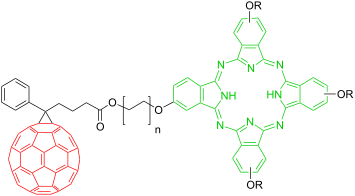
- expect that for such high order of self-organization, liquid crystalline (LC) materials will be beneficial, because they combine order and fluidity, which allows the self-healing of structural defects [8]. One of the most widely used molecules in the bulk heterojunction PV devices is fullerene C60
- comparatively high yields (up to 24%) for this type of reaction. Upon the favorable combination of the length of the linker with the length of peripheral substituents on the phthalocyanine, bulky C60 moiety can be accommodated in the LC mesophase. Detailed analysis of this supramolecular organization, as well


Acid- mediated reactions under microfluidic conditions: A new strategy for practical synthesis of biofunctional natural products
Beilstein J. Org. Chem. 2009, 5, No. 40, doi:10.3762/bjoc.5.40
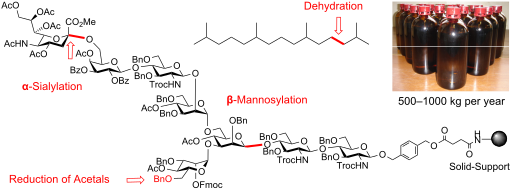
- the Project of Micro-Chemical Technology for Production, Analysis, and Measurement Systems financially supported by New Energy and Industrial Technology Development Organization (NEDO). This work was also partially supported by Grants-in-Aid for Scientific Research No. 19681024 and 19651095 from the


New diarylmethanofullerene derivatives and their properties for organic thin- film solar cells
Beilstein J. Org. Chem. 2009, 5, No. 7, doi:10.3762/bjoc.5.7
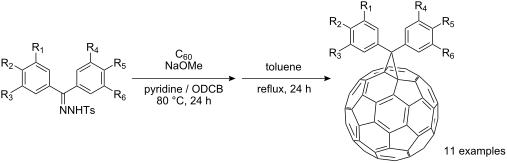
- temperatures Supporting Information Experimental procedures for the preparation of derivatives 1b–k, 2. Supporting Information File 10: Experimental methods Acknowledgements This work was supported by the Incorporated Administrative Agency New Energy and Industrial Technology Development Organization (NEDO




Quinoline based receptor in fluorometric discrimination of carboxylic acids
Beilstein J. Org. Chem. 2008, 4, No. 52, doi:10.3762/bjoc.4.52

- experiments at different concentrations in which the intensities of the ratio of excimer to monomer emission changed gradually (Figure 9). The formation of strong excimers in the presence of hydroxy dicarboxylic acids could be attributed to the guest acid templated hydrogen bond induced organization of the


Synthesis of thienyl analogues of PCBM and investigation of morphology of mixtures in P3HT
Beilstein J. Org. Chem. 2008, 4, No. 33, doi:10.3762/bjoc.4.33
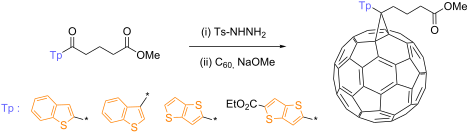
- for all new compounds Acknowledgements This research work is supported in part by the New Energy and Industrial Technology Development Organization (NEDO) of the Ministry of Economy, Trade and Industry of Japan.


Conformational rigidity of silicon- stereogenic silanes in asymmetric catalysis: A comparative study
Beilstein J. Org. Chem. 2007, 3, No. 9, doi:10.1186/1860-5397-3-9
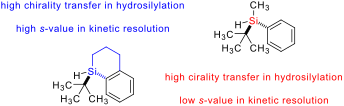
- silane 1: A cyclic framework leading to a locked conformation [11] improving the degree of organization in the stereochemistry-determining transition state 11. In summary, we have shown for the first time that an excellent chirality transfer from silicon to carbon is also realized with suitably


Asymmetric aza-Diels- Alder reaction of Danishefsky's diene with imines in a chiral reaction medium
Beilstein J. Org. Chem. 2006, 2, No. 18, doi:10.1186/1860-5397-2-18
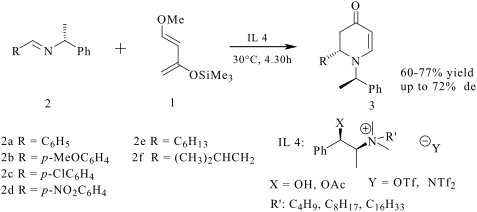
- in mind: to promote 'green reaction media' and most importantly to provide a highly efficient chirality transfer due to the high degree of organization of the chiral ionic liquids. Chiral solvents are reported to have been already used as a sole inducer of enantiomeric excess in organic reactions
- ionic liquids, due to their unique properties and especially their high degree of organization as chiral reaction medium in this reaction. Further investigations to provide useful insights into the understanding of the use of chiral ILs in asymmetric induction are in progress in our laboratory. The





