


Search results
Search for "[1]rotaxane" in Full Text gives 5 result(s) in Beilstein Journal of Organic Chemistry.
Effect of a photoswitchable rotaxane on membrane permeabilization across lipid compositions
Beilstein J. Org. Chem. 2025, 21, 2498–2512, doi:10.3762/bjoc.21.192
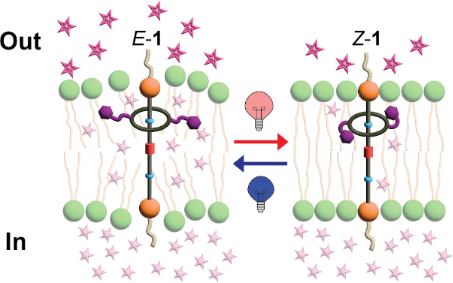
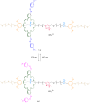
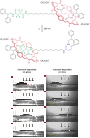
- rotaxanes (PEG, polyethylene glycol chain; BAA (benzylalkylammonium hexafluorophosphate); MTA (N-methyltriazolium hexafluorophosphate). b) Illustration of a rotaxane within a lipid bilayer. c) Chemical structures of rotaxane 1, rotaxane 2, and axle 3. Photoisomerization of rotaxane 1. Reversible
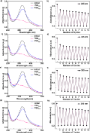
- irradiation; b) dye release after the addition of rotaxane 1, 2, and axle 3 and exposure to five alternating light-irradiation cycles (370 nm and 467 nm). Percentage of sulforhodamine B released from EYPC/Chol 8:2 LUVs upon five irradiation cycles after the addition of rotaxane 1, rotaxane 2, and axle 3 in 10




Rotaxanes with integrated photoswitches: design principles, functional behavior, and emerging applications
Beilstein J. Org. Chem. 2025, 21, 2345–2366, doi:10.3762/bjoc.21.179
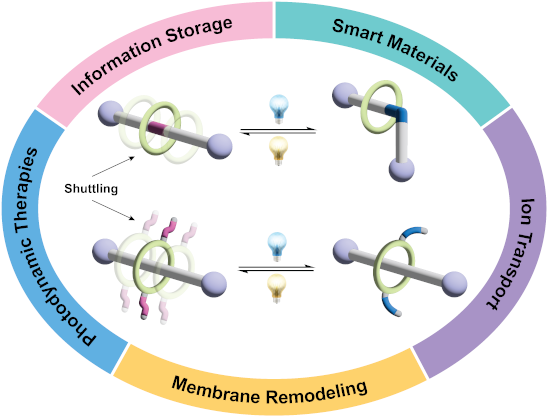
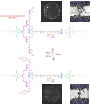
- biomembrane-compatible rotaxanes are promising for designing artificial ion transporters to address channelopathies. Song and co-workers developed a system in which the azobenzene in the axle is encapsulated within a chiral β-cyclodextrin, affording a self-locked [1]rotaxane [15]. The intramolecular host
- , regenerating the fluorescence. Notably, the application of this rotaxane in photoswitchable patterning allowed for a sequence of letters to be “erased” with UV light (Figure 7). Following similar principles, Khang and co-workers synthesized a [1]rotaxane featuring a dithienylethene photoswitch in the axle
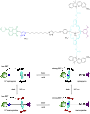
- property, in addition to facilitating their study and isolation, is advantageous for various applications. The first stiff-stilbene-based rotaxane was reported in 2018 [79]. This [1]rotaxane used stiff-stilbene as one of the stoppers, and its photoisomerization produced the translation of a pillar[5]arene





Tetrathiafulvalene – a redox-switchable building block to control motion in mechanically interlocked molecules
Beilstein J. Org. Chem. 2018, 14, 2163–2185, doi:10.3762/bjoc.14.190
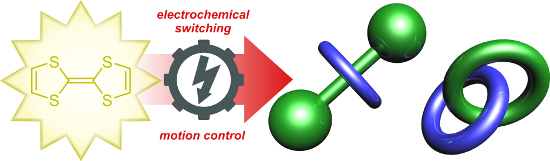
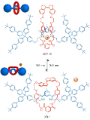
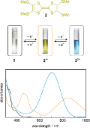
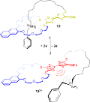
- is transferred into a controlled molecular motion in MIMs, the TTF-based pseudo[1]rotaxane 12 recently reported by us is shown in Figure 9 [70]. In a pseudo[1]rotaxane, the axle molecule is covalently bound to the wheel component. The self-inclusion structure mimics the conformation of a molecular









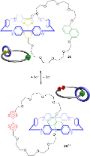


Synthesis of diamido-bridged bis-pillar[5]arenes and tris-pillar[5]arenes for construction of unique [1]rotaxanes and bis-[1]rotaxanes
Beilstein J. Org. Chem. 2018, 14, 1660–1667, doi:10.3762/bjoc.14.142

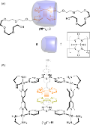
- ]arene di(oxybutoxy)benzoic acid with monoamido-functionalized pillar[5]arenes resulted in the diamido-bridged tris-pillar[5]arenes, which successfully form the unique bis-[1]rotaxanes bearing longer than diaminopropylene diamido bridges. Keywords: bis-[1]rotaxane; mechanically interlocked molecule
- ; pillar[5]arene; [1]rotaxane; self-assembly; Introduction The construction and dynamic motion of the mechanically interlocked molecules (MIMs) have attracted significant research interests due to their intrinsic self-assembled nature and potential applications in various aspects [1][2][3][4]. Pseudo[1
- ]rotaxane and [1]rotaxane are one of particular supramolecular assembly system and are considered as an important building block in the construction of diverse MIMs [5][6][7][8][9][10]. [1]Rotaxane has a macrocyclic wheel component connected with a self-locked chain axle, and a bulky stopper at the terminal


Synthesis of an organic-soluble π-conjugated [3]rotaxane via rotation of glucopyranose units in permethylated β-cyclodextrin
Beilstein J. Org. Chem. 2014, 10, 2800–2808, doi:10.3762/bjoc.10.297

- prepared organic-soluble host–guest-linked PMCD derivatives that can undergo intramolecular self-inclusion to form an insulated molecule with an [1]rotaxane structure in methanolic aqueous solutions, where PMCD derivatives are soluble in. We recently developed a new method for synthesizing π-conjugated
- IMWs with polyrotaxane structures via polymerization of π-conjugated [1]rotaxane monomers bearing PMCDs as macrocycles [14]. Further, we confirmed that such IMWs with poly[1]rotaxane structure are highly soluble in a variety of organic solvents and have good rigidity, photoluminescence efficiency [15
- ], and charge mobility [16][17]. A key step for the synthesis of these IMWs is the preparation of insulated π-conjugated monomers with [1]rotaxane structures by self-inclusion of π-conjugated monomer-linked PMCDs followed by elongation of the π-conjugated units via cross-coupling in a hydrophilic solvent


Other Beilstein-Institut Open Science Activities



