


Search results
Search for "Bestmann ylide" in Full Text gives 2 result(s) in Beilstein Journal of Organic Chemistry.
Chemoenzymatic synthesis of the cardenolide rhodexin A and its aglycone sarmentogenin
Beilstein J. Org. Chem. 2025, 21, 2637–2644, doi:10.3762/bjoc.21.204
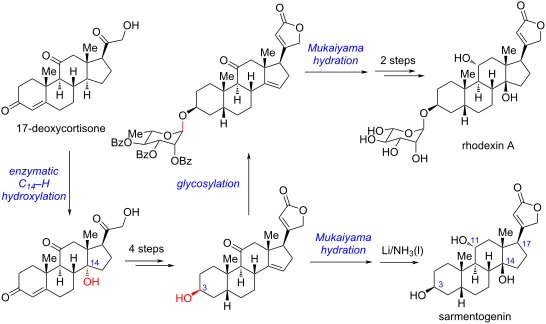
- aglycone sarmentogenin in 7 steps from 17-deoxycortisone. The synthesis features a scalable enzymatic C14–H α-hydroxylation, a Bestmann ylide-enabled one-step construction of the butenolide motif, a late stage Mukaiyama hydration, and a stereoselective C11 carbonyl reduction. Keywords: cardiac glycosides
- C14 β-OH group. The revised synthetic route is described in Scheme 2. At first, 4 was subjected to a Pd/C-catalyzed hydrogenation to afford the desired A/B-cis fused intermediate 7 along with its C5 epimer as a 2:1 separable mixture in a quantitative yield. By treating 7 with the Bestmann ylide
- Bestmann ylide-enabled one-step construction of the butenolide motif, a late-stage Mukaiyama hydration, and a stereoselective C11 carbonyl reduction. We believe this chemoenzymatic synthetic strategy will inspire future endeavors towards the practical synthesis of complex steroids and other bioactive



Preparation of conjugated dienoates with Bestmann ylide: Towards the synthesis of zampanolide and dactylolide using a facile linchpin approach
Beilstein J. Org. Chem. 2015, 11, 1815–1822, doi:10.3762/bjoc.11.197

- Jingjing Wang Samuel Z. Y. Ting Joanne E. Harvey Centre for Biodiscovery, School of Chemical and Physical Sciences, Victoria University of Wellington, PO Box 600, Wellington 6140, New Zealand 10.3762/bjoc.11.197 Abstract Bestmann ylide [(triphenylphosphoranylidene)ketene] acts as a chemical
- linchpin that links nucleophilic entities, such as alcohols or amines, with carbonyl moieties to produce unsaturated esters and amides, respectively. In this work, the formation of α,β,γ,δ-unsaturated esters (dienoates) is achieved through the coupling of Bestmann ylide, an alcohol and an α,β-unsaturated
- products zampanolide and dactylolide is investigated using Bestmann ylide to link the C16–C20 alcohol with the C3–C8 aldehyde fragment. Keywords: Bestmann ylide; dactylolide; dienoate; (triphenylphosphoranylidene)ketene; zampanolide; Introduction (Triphenylphosphoranylidene)ketene, Ph3P=C=C=O (1), was


Other Beilstein-Institut Open Science Activities



