


Search results
Search for "Clauson–Kaas pyrrole synthesis" in Full Text gives 2 result(s) in Beilstein Journal of Organic Chemistry.
Clauson–Kaas pyrrole synthesis using diverse catalysts: a transition from conventional to greener approach
Beilstein J. Org. Chem. 2023, 19, 928–955, doi:10.3762/bjoc.19.71
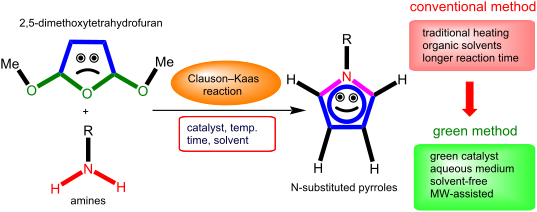
- acid catalysts and transition metal catalysts. The goal of this review is to summarize the synthesis of various N-substituted pyrrole derivatives using a modified Clauson–Kaas reaction under diverse conventional and greener reaction conditions. Keywords: catalyst; Clauson–Kaas pyrrole synthesis; 2,5
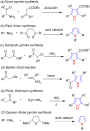
- –Kaas synthesis [37][38], Piloty–Robinson synthesis [39][40][41], and Barton–Zard reaction [42][43][44] (Scheme 1). Among these, the Clauson–Kaas pyrrole synthesis has received much attention because the synthesized pyrrole contains unsubstituted carbons that can be used for further functionalization
- comprehensive review on Clauson–Kaas pyrrole synthesis has not yet been published. Therefore, a review on this topic was required, describing various reaction conditions used in the Clauson–Kaas reaction. At the end, this review is divided into two sections. The conventional Clauson-Kaas pyrrole synthesis




Knorr- Rabe partial reduction of pyrroles: Application to the synthesis of indolizidine alkaloids
Beilstein J. Org. Chem. 2008, 4, No. 3, doi:10.1186/1860-5397-4-3

- using the modified Knorr-Rabe zinc reduction and synthesised the known 5-methyl derivative 18 (Scheme 7) as a model. The methyl ester of (±)-alanine was subjected to the modified Clauson-Kaas pyrrole synthesis to give an α-pyrrolic ester 19 which was subjected to two carbon homologation by ester


Other Beilstein-Institut Open Science Activities



