


Search results
Search for "Illicium sesquiterpene" in Full Text gives 2 result(s) in Beilstein Journal of Organic Chemistry.
Recent advances in total synthesis of illisimonin A
Beilstein J. Org. Chem. 2025, 21, 2571–2583, doi:10.3762/bjoc.21.199
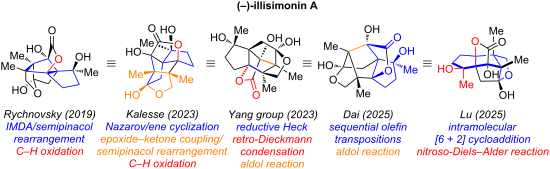
- total synthesis. Keywords: bioinspired synthesis; biosynthetic pathway; Illicium sesquiterpene; illisimonin A; total synthesis; Introduction The genus Illicium, the sole member of the family Illiciaceae, is a rich source of sesquiterpenoid natural products. To date, a wide variety of sesquiterpenes
- ][23][24][25]. In 2017, Yu and co-workers isolated a new Illicium sesquiterpene, namely illisimonin A, from the fruits of Illicium simonsii [26]. Unlike other Illicium sesquiterpenes, illisimonin A features an unprecedented bridged tricyclo[5.2.1.01,5]decane carbon framework that incorporates a highly
- strained trans-pentalene subunit. This carbon ring system is further bridged with a γ-lactone and a γ-lactol ring, forming a caged pentacyclic scaffold with a 5/5/5/5/5 ring arrangement. Illisimonin A was thus classified as an illisimonane-type Illicium sesquiterpene, and its carbon skeleton was designated


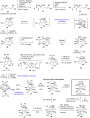


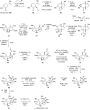


Vicinal ketoesters – key intermediates in the total synthesis of natural products
Beilstein J. Org. Chem. 2022, 18, 1236–1248, doi:10.3762/bjoc.18.129
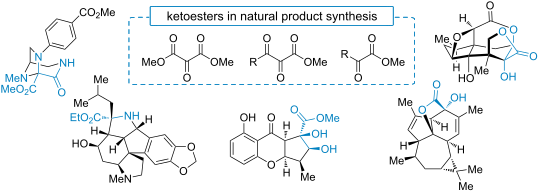
- ). (−)-Jiadifenoxolane A The Illicium sesquiterpenes containing a seco-prezizaane carbon framework are highly oxidized, structurally complex natural products. Maimone et al. published a remarkable synthesis of the Illicium sesquiterpene (−)-jiadifenoxolane A (36), starting from the abundant sesquiterpene (+)-cedrol (31


Other Beilstein-Institut Open Science Activities



