


Search results
Search for "Pseudomonas species" in Full Text gives 6 result(s) in Beilstein Journal of Organic Chemistry.
N-Salicyl-amino acid derivatives with antiparasitic activity from Pseudomonas sp. UIAU-6B
Beilstein J. Org. Chem. 2025, 21, 1388–1396, doi:10.3762/bjoc.21.103
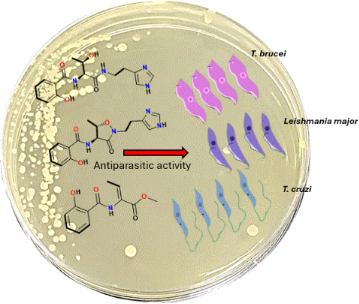
- remaining compounds showed activity at the highest concentrations tested. The plausible biosynthetic hypotheses toward the compounds were also proposed. Keywords: antiparasitic activity; biosynthesis pathway; phenolic siderophores; Pseudomonas species; pseudomonine; Introduction Species of the genus


Isolation and characterization of new phenolic siderophores with antimicrobial properties from Pseudomonas sp. UIAU-6B
Beilstein J. Org. Chem. 2021, 17, 2390–2398, doi:10.3762/bjoc.17.156
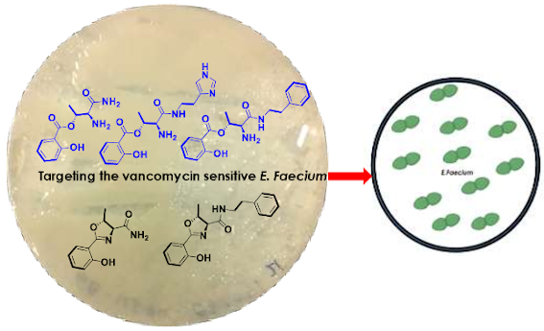
- pseudomonine [28] are produced under iron deficiency by various Pseudomonas species to acquire iron which is essential for cell metabolism and growth [29][30]. Studies show that siderophore–antibiotic complexes may be used as a Trojan horse strategy in which the antibiotics utilize the iron-siderophore


Synthesis and biological activity of methylated derivatives of the Pseudomonas metabolites HHQ, HQNO and PQS
Beilstein J. Org. Chem. 2019, 15, 187–193, doi:10.3762/bjoc.15.18
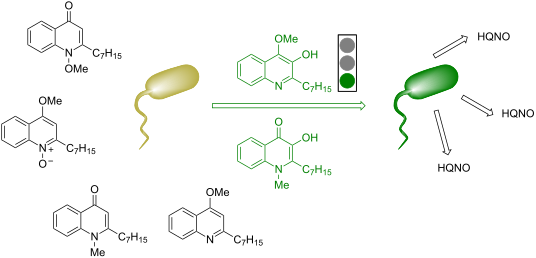
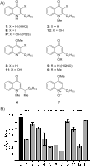
- )-quinolones (AQs) have been identified as natural products produced by higher plants of the Rutaceae family as well as by some microorganisms including Alteromonas, Burkholderia and Pseudomonas species [1][2][3][4][5][6][7][8][9]. Plant-derived AQs occur with alkyl chains of different lengths, branches and




Biosynthesis of α-pyrones
Beilstein J. Org. Chem. 2016, 12, 571–588, doi:10.3762/bjoc.12.56
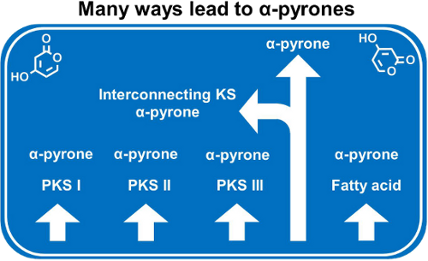
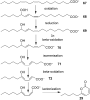
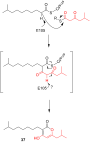
- different locations in the genome sequences of the different Pseudomonas species: On a taxonomic level closely related strains harbor the ppyS homologue in the same region of their genome. Therefore, it can be assumed that the genetic information coding for the enzyme needed to synthesize pseudopyronines
- was acquired several times. Hence, Pseudomonas species from different habitats, e.g., rhizosphere, soil, water, acquired the gene set independently [86]. In summary different types of chain-interconnecting KSs which catalyze α-pyrone ring formation were identified in the last years. One mechanism is






Recent highlights in biosynthesis research using stable isotopes
Beilstein J. Org. Chem. 2015, 11, 2493–2508, doi:10.3762/bjoc.11.271
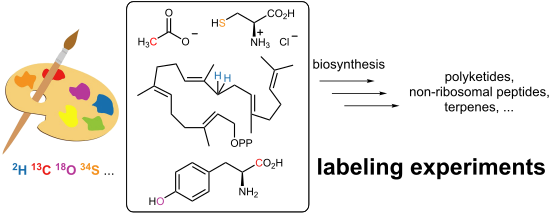
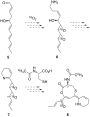
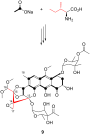
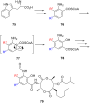
- study the sulfur source in tropodithietic acid (TDA, 74, Scheme 13) biosynthesis [78]. TDA is a marine antibiotic which was originally isolated from Pseudomonas species [79] showing no observable resistance in important pathogens up to now [80]. The biosynthesis of the tropone core proceeds via the









New modification of the Perkow reaction: halocarboxylate anions as leaving groups in 3-acyloxyquinoline- 2,4(1H,3H)-dione compounds
Beilstein J. Org. Chem. 2005, 1, No. 17, doi:10.1186/1860-5397-1-17
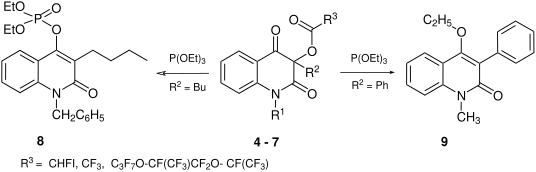
- fluorinated but-2-enolide rings. The 3-alkyl-3-hydroxyquinoline-2,4(1H,3H)-dione metabolites of Pseudomonas species exhibit antibiotic or lipoxygenase inhibitor activity[1] that may be modified by the introduction of an annulated pharmacophoric but-2-enolide ring. [2] The annulation was successfully carried




Other Beilstein-Institut Open Science Activities



