


Search results
Search for "acaricidal activity" in Full Text gives 2 result(s) in Beilstein Journal of Organic Chemistry.
Synthesis and acaricidal activity against Varroa destructor of α- and γ-costic acid dimers
Beilstein J. Org. Chem. 2026, 22, 1088–1096, doi:10.3762/bjoc.22.87
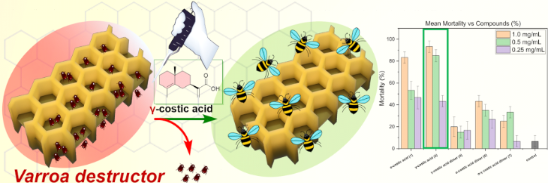
- possessing diverse biological activities. Among these, the most promising property for practical application is its acaricidal activity against Varroa destructor, considered the most important and dangerous parasite of the honeybee (Apis mellifera L.). Infestations of V. destructor can decimate bee
- were approximately 50% less active than the parent costic acids, they exhibited higher potency than the previously reported α-costic acid methyl ester. Among all, γ-costic acid, whose acaricidal activity is reported here for the first time, shows the highest activity with mortality higher than 90
- are currently associated with significant yield losses and extensive reliance on synthetic pesticides. Keywords: acaricidal activity; α-costic acid; γ-costic acid; diesters; Varroa destructor; Introduction 11(13)-Eudesman-12-oic acids are sesquiterpene plant metabolites widely distributed in nature


Use of costic acid, a natural extract from Dittrichia viscosa, for the control of Varroa destructor, a parasite of the European honey bee
Beilstein J. Org. Chem. 2017, 13, 952–959, doi:10.3762/bjoc.13.96

- . Costic acid exhibited potent in vivo acaricidal activity against the parasite. Initial experiments showed that the compound is not toxic for human umbilical vein endothelial cells (HUVEC) at concentrations of up to 230 micromolar (μM), indicating that costic acid could be used as a safe, low-cost and
- against the parasite [33][34]. The use of natural products against varroosis is an eco-friendly approach to this severe problem. Field tests on the use of methanolic extracts of Lepidium latifolium and Zataria multiflora indicated that these preparations exhibited acaricidal activity against the mites [35
- -α and IFN-γ-stimulated chemokine production [48]. Costic acid exhibited selective cytotoxic effects to Spodoptera littoralis-derived Sf9 cells [49]. In spite of the diversity in biological activity, however, no acaricidal activity of either costic acid or D. viscosa extracts against V. destructor


Other Beilstein-Institut Open Science Activities



