


Search results
Search for "anion extraction" in Full Text gives 1 result(s) in Beilstein Journal of Organic Chemistry.
Silica gel with covalently attached bambusuril macrocycle for dicyanoaurate sorption from water
Beilstein J. Org. Chem. 2025, 21, 2604–2611, doi:10.3762/bjoc.21.201
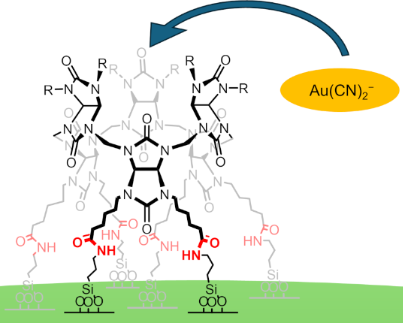
- competing dicyanoargentate(I) anions. We also examine the recyclability of the material and assess its stability in organic solvents, comparing its performance with that of a previously developed material containing noncovalently bound bambusuril. Keywords: anion binding; anion extraction; anion receptor
- ]. In the field of anion extraction, there is growing interest in solid-phase substrates functionalized with synthetic macrocyclic receptors. These materials employ a supramolecular approach based on specific host–guest interactions between the immobilized macrocycle and the guest in solution, often
- during previous washing step (Figure S6B, Supporting Information File 1). Conclusion In summary, we have developed organic–inorganic hybrid materials for anion extraction. Through a two-step modification of silica gel, two materials were obtained: SG-NHCO-BU1, in which the BU1 macrocycle is covalently


Other Beilstein-Institut Open Science Activities



