


Search results
Search for "azaphilones" in Full Text gives 2 result(s) in Beilstein Journal of Organic Chemistry.
A chiral LC–MS strategy for stereochemical assignment of natural products sharing a 3-methylpent-4-en-2-ol moiety in their terminal structures
Beilstein J. Org. Chem. 2025, 21, 2243–2249, doi:10.3762/bjoc.21.171
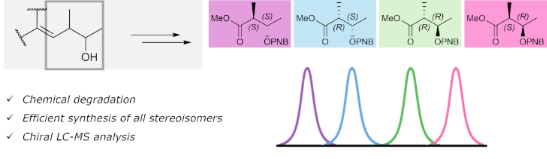
- terminal position of various polyketide natural products such as a series of azaphilones including chaetomugilins [14], chaetoviridins [14][15], and some other α-pyrone polyketides [16][17][18] (Figure 1). Among the available strategies for elucidating the stereochemistry of MPO, X-ray crystallographic


Muyocopronones A and B: azaphilones from the endophytic fungus Muyocopron laterale
Beilstein J. Org. Chem. 2020, 16, 2100–2107, doi:10.3762/bjoc.16.177
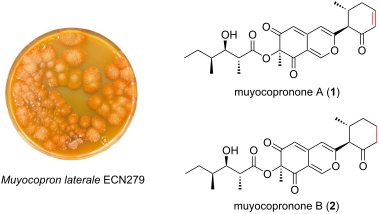
- -cho, Chikusa-ku, Nagoya, Aichi, Japan 10.3762/bjoc.16.177 Abstract Two new azaphilones, namely muyocopronones A (1) and B (2), were isolated from the cultures of an endophytic fungus Muyocopron laterale ECN279. Their structures were elucidated by extensive spectroscopic analysis. Their absolute
- configurations were determined using the modified Mosher’s method and through comparisons of experimental and calculated electronic circular dichroism data. In addition, muyocopronone B (2) was found to exhibit a weak antibacterial activity against some Gram-positive bacteria. Keywords: azaphilones; endophytic
- fungus; modified Mosher’s method; Muyocopron laterale; polyketides; Introduction Azaphilones, which are a class of fungal polyketides with diverse structures, have received growing attention due to their various biological activities, such as the inhibition of some protein–protein interactions [1][2




Other Beilstein-Institut Open Science Activities



