


Search results
Search for "azoxy compounds" in Full Text gives 3 result(s) in Beilstein Journal of Organic Chemistry.
Sustainable electrochemical synthesis of aliphatic nitro-NNO-azoxy compounds employing ammonium dinitramide and their in vitro evaluation as potential nitric oxide donors and fungicides
Beilstein J. Org. Chem. 2025, 21, 2739–2754, doi:10.3762/bjoc.21.211
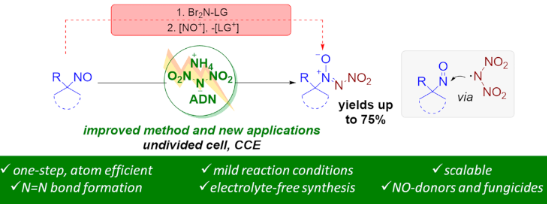
- , Russian Federation 10.3762/bjoc.21.211 Abstract An atom- and step-economical electrochemical method for the synthesis of aliphatic nitro-NNO-azoxy compounds from the corresponding nitroso compounds was developed employing ammonium dinitramide, a prospective green oxidant for aerospace propulsion
- phytopathogenic fungi. Keywords: ammonium dinitramide; antifungal agents; azoxy compounds; electrosynthesis; NO donors; Introduction Organic compounds containing N–N and N–O bonds are ubiquitous in diverse fields, including pharmaceuticals, agrochemicals, natural products [1][2][3][4], as well as in
- particular interest for the regioselective synthesis of azoxy compounds [5][71][72]. Unique and understudied representatives of the latter are nitro-NNO-azoxy compounds [R–N(O)=N–NO2], first synthesized at ZIOC RAS [73][74][75]. Nowadays, aromatic and heterocyclic compounds of this class have been studied in

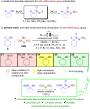




New azodyrecins identified by a genome mining-directed reactivity-based screening
Beilstein J. Org. Chem. 2022, 18, 1017–1025, doi:10.3762/bjoc.18.102
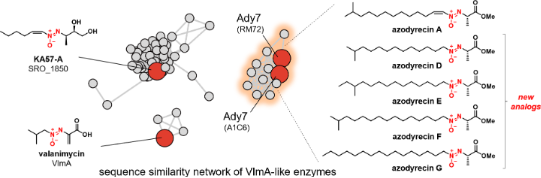
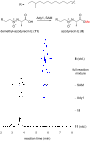
- , antifungal, nematicidal, and cytotoxic activities (Figure 1) [1][2][3]. Since the discovery of the natural azoxy compound macrozamin in 1951 as the first example of a nitrogen–nitrogen bond-containing natural product [4], azoxy compounds have been isolated from various natural sources including bacteria
- functional groups, which led to the discovery of actinopyridazinones with a unique dihydropyridazinone scaffold [11]. N2H4 generates similarly in the acid hydrolysate of azoxy compounds, and this feature has been exploited as proof for the presence of N–N bonds in the plant-derived methyl azoxy compound




Catalytic asymmetric synthesis of biologically important 3-hydroxyoxindoles: an update
Beilstein J. Org. Chem. 2016, 12, 1000–1039, doi:10.3762/bjoc.12.98
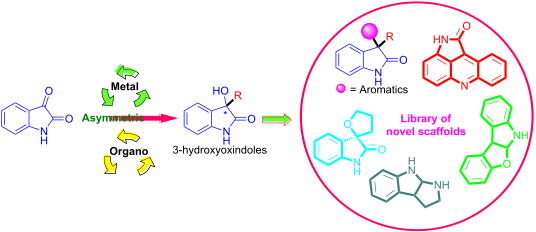
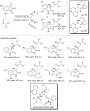
- yields (up to 99% yield, Scheme 42) [59]. Interestingly, treatment of the adducts with magnesium monoperoxyphthalate (MMPP) gave the corresponding azoxy compounds in excellent yields (up to 99%) and with complete regioselectivities and excellent enantioselectivities (up to 99% ee). A stereochemical model




Other Beilstein-Institut Open Science Activities



