Search results
Search for "chiral macrocycles" in Full Text gives 11 result(s) in Beilstein Journal of Organic Chemistry.
Measuring the stereogenic remoteness in non-central chirality: a stereocontrol connectivity index for asymmetric reactions
Beilstein J. Org. Chem. 2025, 21, 1995–2006, doi:10.3762/bjoc.21.155
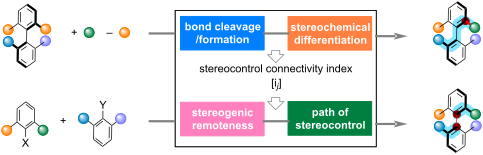
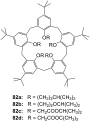
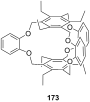
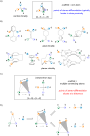
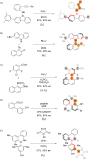
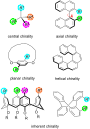
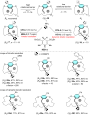
- , asymmetric synthesis of “inherently chiral” macrocycles have gained growing attention [22]. Practically, such reactions that yield “inherently chiral” macrocycles can be treated similarly as planar chirality (Scheme 6). The synthesis of calix[4]arenes via C–H arylation [23] is [31] (Scheme 6A), following the




Synthesis of N-doped chiral macrocycles by regioselective palladium-catalyzed arylation
Beilstein J. Org. Chem. 2025, 21, 1917–1923, doi:10.3762/bjoc.21.149
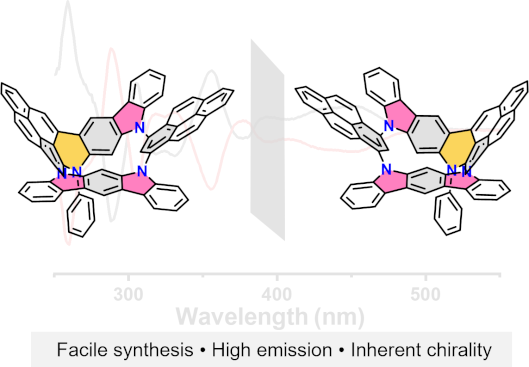
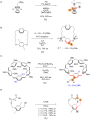
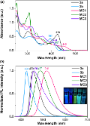
- revealed the formation of isomeric products depending on the substituents on the N atoms. Notably, two intrinsically chiral macrocycles MC1 and MC3 with C1 symmetry were successfully obtained. These macrocycles exhibit exceptional photophysical properties, particularly remarkable high fluorescence quantum
- ; inherent chirality; N-doped macrocycle; nonplanarity; regioselective cyclization; Introduction Chiral macrocycles have attracted significant research interest owing to their diverse applications in enantioselective recognition [1][2], catalysis [3][4], and circularly polarized luminescence [5][6
- , including molecular bowls [11][12][13] and medium-sized macrocycles containing a saddle-shaped eight-membered ring [14][15]. In the past decades, despite rapid progress in chiral macrocycles, inherent chirality is largely limited to calix[n]arene derivatives. This underscores a critical opportunity to




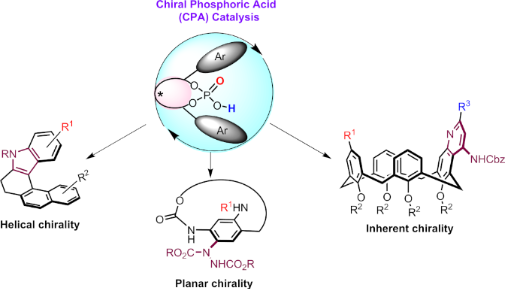
Chiral phosphoric acid-catalyzed asymmetric synthesis of helically chiral, planarly chiral and inherently chiral molecules
Beilstein J. Org. Chem. 2025, 21, 1864–1889, doi:10.3762/bjoc.21.145
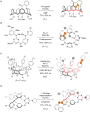
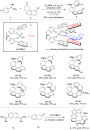
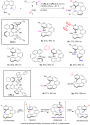
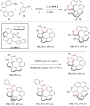
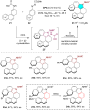
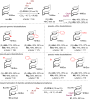
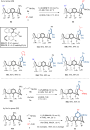
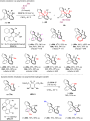
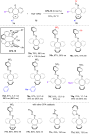
- advances in asymmetric catalytic synthesis of planarly chiral macrocycles have attracted significant attention, leading to the development of several distinctive strategies, such as (dynamic) kinetic resolution and asymmetric macrocyclizations [33][34][35][36]. In 2022, our group reported the
- enantioselective synthesis of planarly chiral macrocycles through a dynamic kinetic resolution approach [15]. Despite bearing an amino group on the phenyl ring, the configuration of the macrocyclic paracyclophane 32 was found to be unstable at room temperature. Consequently, by employing a CPA-catalyzed asymmetric
- demonstrated the successful construction of planarly chiral macrocycles with 12- to 14-membered ansa chains with high enantioselectivity when using NH2 as the directing group (see 33a,b). However, extending the ansa chain to 15 members led to the loss of planar chirality due to insufficient steric hindrance to










3,3'-Linked BINOL macrocycles: optimized synthesis of crown ethers featuring one or two BINOL units
Beilstein J. Org. Chem. 2025, 21, 1719–1729, doi:10.3762/bjoc.21.134

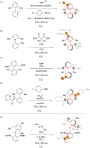
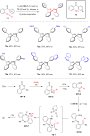
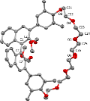
- , 45141 Essen, Germany 10.3762/bjoc.21.134 Abstract Chiral macrocycles hold significant importance in various scientific fields due to their unique structural and chemical properties. By controlling their size, shape, and substituents, chiral macrocycles offer a platform for designing and synthesizing
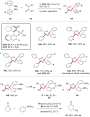
- highly efficient catalysts, chemosensors, and functional materials. We have recently made strides in developing macrocyclic organocatalysts; however, their synthesis remains challenging. In this work, we aimed to discover a straightforward method for producing a diverse range of chiral macrocycles
- , thereby enabling further exploration in the field of interlocked and macrocyclic organocatalysts. We successfully established optimized synthetic routes for the synthesis of chiral macrocycles containing one or two stereogenic units, featuring varying ring sizes and substituents (21 examples in total





Wittig reaction of cyclobisbiphenylenecarbonyl
Beilstein J. Org. Chem. 2025, 21, 1454–1461, doi:10.3762/bjoc.21.107
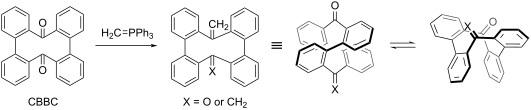
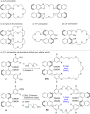
- Cyclobisbiphenylenecarbonyl (CBBC) represents a readily available chiral figure-eight macrocycle containing two carbonyl groups. However, the transformation of the carbonyl groups has been unexplored. Herein, we conducted the Wittig reaction of CBBC with methylenetriphenylphosphorane to furnish two chiral macrocycles
- formation between carbonyl and alkene units. Keywords: bathtub; chirality; cyclobisbiphenylenecarbonyl; figure-eight; Wittig reaction; Introduction Figure-eight π-conjugated molecules represent chiral macrocycles with a twisted crossover structure [1][2][3][4][5][6][7][8][9][10][11][12][13][14][15



Supramolecular approaches to mediate chemical reactivity
Beilstein J. Org. Chem. 2022, 18, 1463–1465, doi:10.3762/bjoc.18.152
- tetraaminobisthiourea chiral macrocycles as catalysts in decarboxylative Mannich reactions. Low macrocycle loading was used to catalyze the decarboxylative addition of malonic acid half thioesters to isatin-derived ketimines with excellent yields and good enantioselectivity. It was reported that effective activation
Bioinspired tetraamino-bisthiourea chiral macrocycles in catalyzing decarboxylative Mannich reactions
Beilstein J. Org. Chem. 2022, 18, 486–496, doi:10.3762/bjoc.18.51
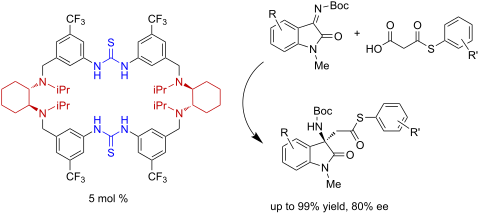
- 10.3762/bjoc.18.51 Abstract A series of tetraamino-bisthiourea chiral macrocycles containing two diarylthiourea and two chiral diamine units were synthesized by a fragment-coupling approach in high yields. Different chiral diamine units, including cyclohexanediamines and diphenylethanediamines were
- readily incorporated by both homo and hetero [1 + 1] macrocyclic condensation of bisamine and bisisothiocyanate fragments. With the easy synthesis, gram-scale of macrocycle products can be readily obtained. These chiral macrocycles were applied in catalyzing bioinspired decarboxylative Mannich reactions
- tertiary amine sites were found to be crucial for achieving efficient activation and stereocontrol. As shown in control experiments, catalysis with the acyclic analogues having the same structural motifs were non-selective. Keywords: chiral macrocycles; cooperative asymmetric catalysis; decarboxylative




Synthesis of a sucrose-based macrocycle with unsymmetrical monosaccharides "arms"
Beilstein J. Org. Chem. 2018, 14, 634–641, doi:10.3762/bjoc.14.50

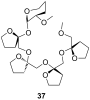
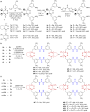
- -O-benzylsucrose with different unsaturated monosaccharide units is presented. Such a highly functionalized intermediate was cyclized under RCM conditions to afford a macrocyclic derivative containing a 31-membered ring in 26% yield. Keywords: chiral macrocycles; ring-closing metathesis; sucrose


Homochiral BINOL-based macrocycles with π-electron-rich, electron-withdrawing or extended spacing units as receptors for C60
Beilstein J. Org. Chem. 2014, 10, 1308–1316, doi:10.3762/bjoc.10.132
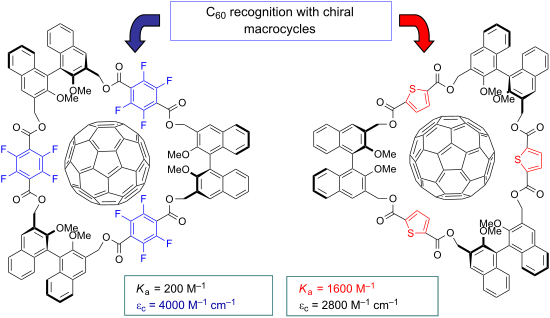
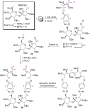
- protocol for the preparation of several chiral macrocycles incorporating BINOL (1,1′-bi-2-naphthol) units, through the formation of bridging ester functionalities, which ensure chemical inertness for the purposes of supramolecular sensing, recognition, or self-assembly. We have shown their application in


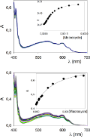
Synthesis and anion recognition properties of shape-persistent binaphthyl-containing chiral macrocyclic amides
Beilstein J. Org. Chem. 2012, 8, 967–976, doi:10.3762/bjoc.8.109
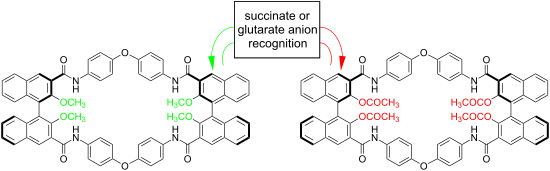
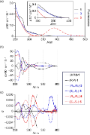
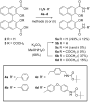
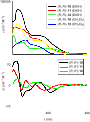
- at the Cineca supercomputer facility by using the Gaussian 09, Revision C.01 package [49]. Structure of the macrocycle (R,R)-1 (top), and synthetic strategies for the production of novel amide-containing, axially chiral macrocycles (bottom). UV and CD (EtOH) spectra of macrocycles (R,R)-10, (R,R)-11





Molecular recognition of organic ammonium ions in solution using synthetic receptors
Beilstein J. Org. Chem. 2010, 6, No. 32, doi:10.3762/bjoc.6.32
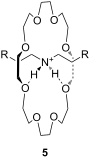
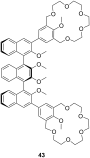
- studied the chiral recognition ability of binaphtol based chiral macrocycles using the picrate salt extraction method [175]. Many examples of chiral receptors have been reported, which exhibit chiral recognition towards cations derived from phenylethylamine. The biphenanthryl-18-crown-6 derivative 38