


Search results
Search for "cyanide addition" in Full Text gives 3 result(s) in Beilstein Journal of Organic Chemistry.
Symmetrical D–π–A–π–D indanone dyes: a new design for nonlinear optics and cyanide detection
Beilstein J. Org. Chem. 2026, 22, 131–142, doi:10.3762/bjoc.22.6
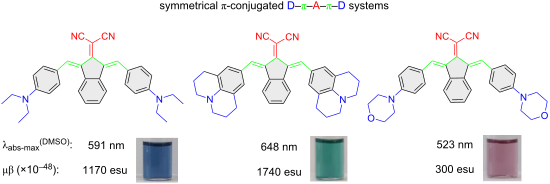
- interaction mechanism is determined as mono-cyanide addition to the vinyl group via Michael reaction. These results show that symmetrical indanone-based D–π–A–π–D dyes can be used in future optoelectronic devices and environmental monitoring. Design of the functional dyes. Normalized absorption spectra of


Recent advancements in the synthesis of Veratrum alkaloids
Beilstein J. Org. Chem. 2025, 21, 2657–2693, doi:10.3762/bjoc.21.206
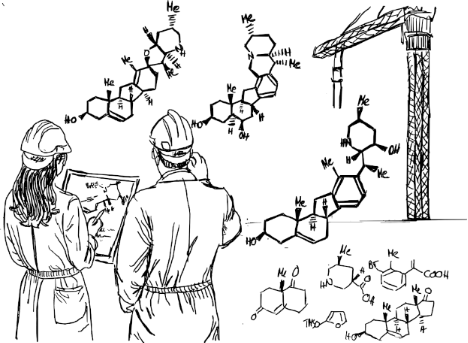
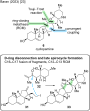
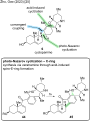
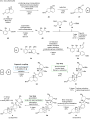
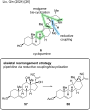
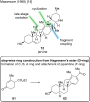
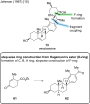
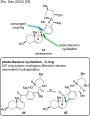
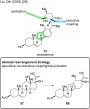
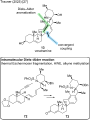
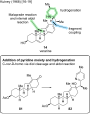
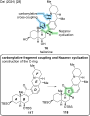
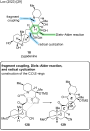
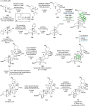
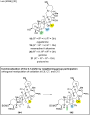
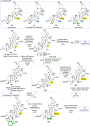
- starting material was again the (S)-Wieland–Miescher ketone (34). This was transformed to nitrile 46 via a seven-step sequence consisting of protecting group manipulations, a double bond isomerization to position C5–C6, as well as a 1,2-cyanide addition, and subsequent elimination (Scheme 10). The cyanide
















A versatile and efficient approach for the synthesis of chiral 1,3-nitroamines and 1,3-diamines via conjugate addition to new (S,E)-γ-aminated nitroalkenes derived from L-α-amino acids
Beilstein J. Org. Chem. 2013, 9, 832–837, doi:10.3762/bjoc.9.95

- alcohol; amino aldehyde; azide addition; Baylis–Hillman reaction; cyanide addition; Michael addition; Introduction Nitroalkenes constitute a class of organic compounds that present exceptional versatility in organic synthesis [1][2][3][4]. They are reactive in Michael reactions with a wide variety of
- reaction times were employed (Table 1, entries 4 and 5). On the other hand, a severe decrease in the diastereoselectivity occurred with longer durations, presumably due to an equilibration by a retro-conjugate addition [77] (Table 1, entries 6–8). Next, the conjugate cyanide addition to 2a,b promoted by
- addition of “HCN” equivalent to nitroalkenes is rare in the literature [78][79][80][81][82][83]. Paulsen [78] and Sakakibara [79] were the first authors to report the cyanide addition to α,β-unsaturated nitroalkenes. In agreement with our results, Sakakibara [79] and Spanevello [80] observed a total or


Other Beilstein-Institut Open Science Activities



