


Search results
Search for "double-beta decay" in Full Text gives 1 result(s) in Beilstein Journal of Organic Chemistry.
On the aromaticity and photophysics of 1-arylbenzo[a]imidazo[5,1,2-cd]indolizines as bicolor fluorescent molecules for barium tagging in the study of double-beta decay of 136Xe
Beilstein J. Org. Chem. 2025, 21, 1627–1638, doi:10.3762/bjoc.21.126
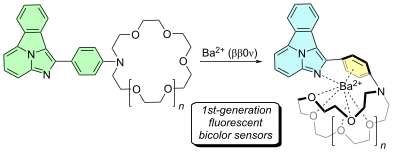
- Abstract In this paper, the behavior of a bicolor fluorescent indicator for the detection of barium cations formed by double-beta decay of 136Xe is analyzed by means of computational tools. Both DFT and TDDFT permit to understand the origin of the bicolor fluorescent signal emitted by 1-arylbenzo[a]imidazo
- decoupling between the para-phenylene and benzo[a]imidazo[5,1,2-cd]indolizine components that results in a blue shift upon Ba2+ coordination. Keywords: aromaticity; DFT-TDDFT calculations; double-beta decay; fluorescent sensors; polycyclic arenes; Introduction Double beta-decay [1] is a radioactive decay
- in which two neutrons are converted into two protons by means of the transformation of two quarks down into two quarks up (Figure 1). This process involves the emission of two W− bosons that in turn evolve towards the emission of two electrons. In the two-neutrino double-beta decay (ββ2ν), two





Other Beilstein-Institut Open Science Activities



