


Search results
Search for "gold nanoparticle" in Full Text gives 7 result(s) in Beilstein Journal of Organic Chemistry.
Synthesis of a HDAC inhibitor–nanogold probe for cryo-EM visualization in class I HDAC co-repressor complexes
Beilstein J. Org. Chem. 2026, 22, 480–485, doi:10.3762/bjoc.22.35
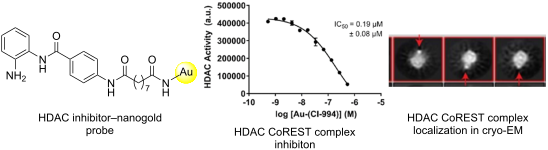
- revealed the bi-lobed architecture of the CoREST complex and partial localization of the gold nanoparticle probe to the CoREST complex. However, the probe was not observed in classes showing the side-view of the CoREST complex, limiting unambiguous identification and positioning of the HDAC catalytic
- domain within the CoREST complex. Keywords: CI-994; co-repressor complex; CoREST; cryo-EM; gold nanoparticle; HDAC; Introduction Histone deacetylase (HDAC) enzymes catalyze the hydrolysis of acetyl groups from N-acetylated lysine residues in histone proteins. HDACs are also capable of the deacetylation
- Au–NH2 and Au–(CI-994) did not affect fluorescence under the HDAC assay conditions, implying that the gold nanoparticle does not interfere with the HDAC assay conditions. As expected, 20 µM of CI-994 completely inhibited HDAC activity of the CoREST complex. Notably, Au–(CI-994) also exhibited near

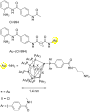


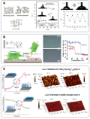
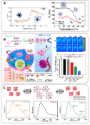
Constrained thermoresponsive polymers – new insights into fundamentals and applications
Beilstein J. Org. Chem. 2021, 17, 2123–2163, doi:10.3762/bjoc.17.138
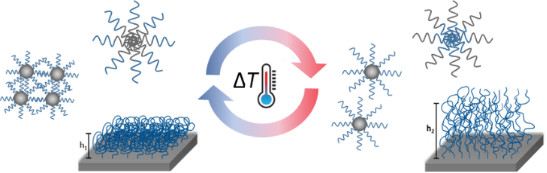


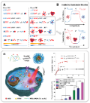
Recent applications of click chemistry for the functionalization of gold nanoparticles and their conversion to glyco-gold nanoparticles
Beilstein J. Org. Chem. 2018, 14, 11–24, doi:10.3762/bjoc.14.2
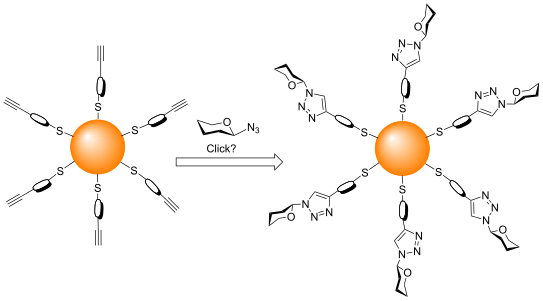
- combination of a gold nanoparticle core and an outer-shell comprising multivalent presentation of carbohydrates. The combination of the distinctive physicochemical properties of the gold core and the biological function/activity of the carbohydrates makes glyco-gold nanoparticles a valuable tool in

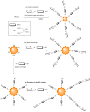


Glyco-gold nanoparticles: synthesis and applications
Beilstein J. Org. Chem. 2017, 13, 1008–1021, doi:10.3762/bjoc.13.100
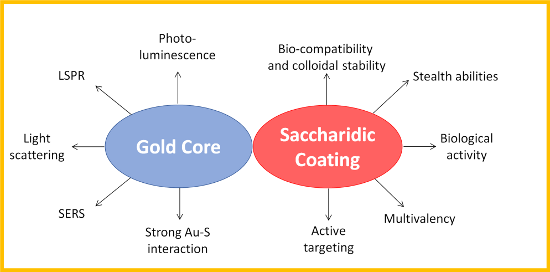
- presentation of saccharide moieties and to exploit the peculiar optical properties of the metallic core. In this review, we present recent advances on glyco-gold nanoparticle applications in different biological fields, highlighting the key parameters which inspire the glyco nanoparticle design. Keywords
- for designing the best performing nanosystem are discussed. Then, three sections summarize the achievements and ongoing researches published in the last four years, from 2013 to 2016 with a special focus on glyco-gold nanoparticle applications (in biosensing field, as drug carriers or contrast agents


Efficient mechanochemical synthesis of regioselective persubstituted cyclodextrins
Beilstein J. Org. Chem. 2016, 12, 2364–2371, doi:10.3762/bjoc.12.230
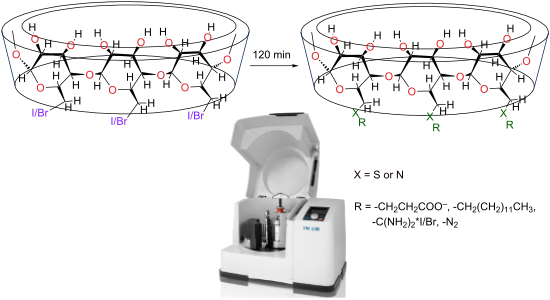
- well as solvent impurities increase synthesis and purification costs and time. Selectively per-6-thiolated CDs are also used in gold nanoparticle chemistry, particularly in electrochemical sensors [17]. Thiourea (TU) is one of the best precursors of those CDs because as the halogen is exchanged to the


Impact of multivalent charge presentation on peptide–nanoparticle aggregation
Beilstein J. Org. Chem. 2015, 11, 792–803, doi:10.3762/bjoc.11.89
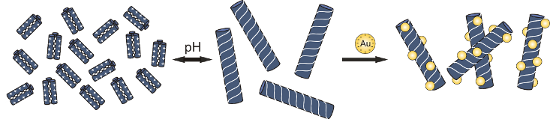
- repeats. It must be concluded that sample drying and the addition of a staining reagent has an effect on the final fiber structure. Peptide-induced nanoparticle assembly The absorption maximum of the LSPR band is a size-dependent property of a gold nanoparticle: the greater the size of the gold
- nanoparticle, the more red-shifted its absorption maximum. When numerous smaller gold nanoparticles get into close proximity due to aggregation they behave as one larger gold nanoparticle the electronic properties of which can be monitored by the red-shift and broadening of the absorption maximum of the LSPR


Synthesis of rigid p-terphenyl-linked carbohydrate mimetics
Beilstein J. Org. Chem. 2014, 10, 1749–1758, doi:10.3762/bjoc.10.182
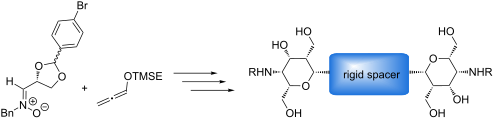
- our group [24][25]. When they are coupled by amide bonds to gold nanoparticle and O-sulfated these conjugates gave extremely high binding affinities towards L- and P-selectin in sub-nanomolar concentrations. These results were achieved by a multivalent presentation (ca. 1000–1200 ligands per


Other Beilstein-Institut Open Science Activities



