


Search results
Search for "light-controlled materials" in Full Text gives 2 result(s) in Beilstein Journal of Organic Chemistry.
Pd-catalyzed dehydrogenative arylation of arylhydrazines to access non-symmetric azobenzenes, including tetra-ortho derivatives
Beilstein J. Org. Chem. 2025, 21, 2234–2242, doi:10.3762/bjoc.21.170
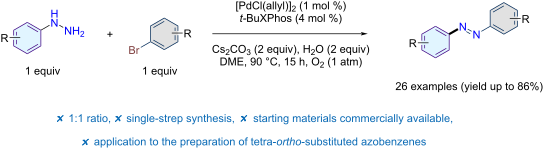
- Paris, France 10.3762/bjoc.21.170 Abstract Azobenzenes are photoresponsive compounds widely used in molecular switches, light-controlled materials, and sensors, but despite extensive studies on symmetric derivatives, efficient methods for synthesizing non-symmetric analogues remain scarce due to
- of applications, including molecular switches, sensors, and light-controlled materials [1][2][3][4][5][6][7][8]. The photoswitching behavior arises from the reversible photoisomerization between the E- and Z-forms of the azobenzene chromophore, driven by the isomerization of the N–N double bond. This


Recent advances towards azobenzene-based light-driven real-time information-transmitting materials
Beilstein J. Org. Chem. 2012, 8, 1003–1017, doi:10.3762/bjoc.8.113
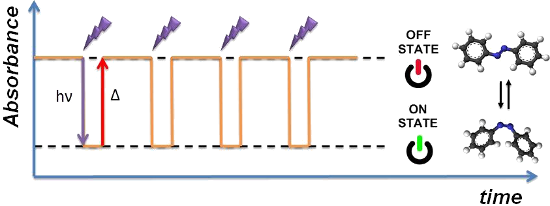
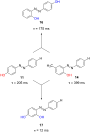
- -chromophore and the thermal cis-to-trans isomerisation, the kinetics and mechanism are also discussed as a key point for reaching azoderivatives endowed with fast thermal back-isomerisation kinetics. Keywords: kinetics; light-controlled materials; molecular switches; photochromic switches; push–pull







Other Beilstein-Institut Open Science Activities



