


Search results
Search for "metalloradical catalysis" in Full Text gives 2 result(s) in Beilstein Journal of Organic Chemistry.
Enantioselective radical chemistry: a bright future ahead
Beilstein J. Org. Chem. 2025, 21, 2283–2296, doi:10.3762/bjoc.21.174
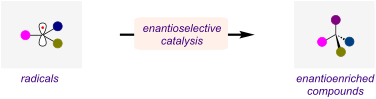
- . A mechanistically distinct way of achieving enantioselective radical transformations is the use of metalloradical catalysis [54]. A metalloradical is a persistent metal-centered radical species that can homolytically activate substrates without other initiators, light, or electricity. Several
- different transition-metal complexes have been employed in metalloradical catalysis, including porphyrin complexes of cobalt(II) [55][56] and iron(III) [57][58]. Both cobalt in oxidation state +2 and iron in oxidation state +3 can be viewed as persistent metalloradicals. Zhang and co-workers reported a
- lactone 26. The Zhang group has extended the chiral metalloradical catalysis to cyclopropanation by the intermolecular reaction between styrenes and ketodiazoacetates [59]. Cyclopropanes were obtained in good yields with high relative and absolute stereocontrol. Properties, such as relatively high earth


Synthesis of chiral N-phosphoryl aziridines through enantioselective aziridination of alkenes with phosphoryl azide via Co(II)-based metalloradical catalysis
Beilstein J. Org. Chem. 2014, 10, 1282–1289, doi:10.3762/bjoc.10.129
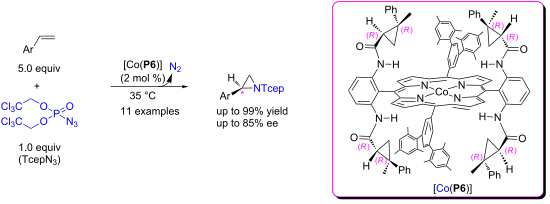
- ; cobalt complex; metalloradical catalysis; organophosphorus; phosphoryl azide; Introduction Aziridines, the smallest three-membered nitrogen-containing heterocycles, are highly valuable heterocyclic compounds that are widely used in organic synthesis and pharmaceuticals [1][2]. As a result, tremendous
- radical intermediate [29][30][31][32][33][34]. It is worthy to note the importance of dual functions of the chiral amide units of the D2-symmetric chiral amidoporphyrin ligands played in the Co(II)-based metalloradical catalysis (MRC): the rigid amide spacers do not only support and orient the chiral
- metalloradical catalysis (MRC). (A) Potential H-bonding interaction in postulated nitrene radical complex of [Co(D2-Por*)]. R* represents a chiral unit. (B) Geometry corresponding to the minimum energy from simplified computer modeling by molecular mechanics with Spartan 10. The P=O…H–N distance of (1.87 Å


Other Beilstein-Institut Open Science Activities



